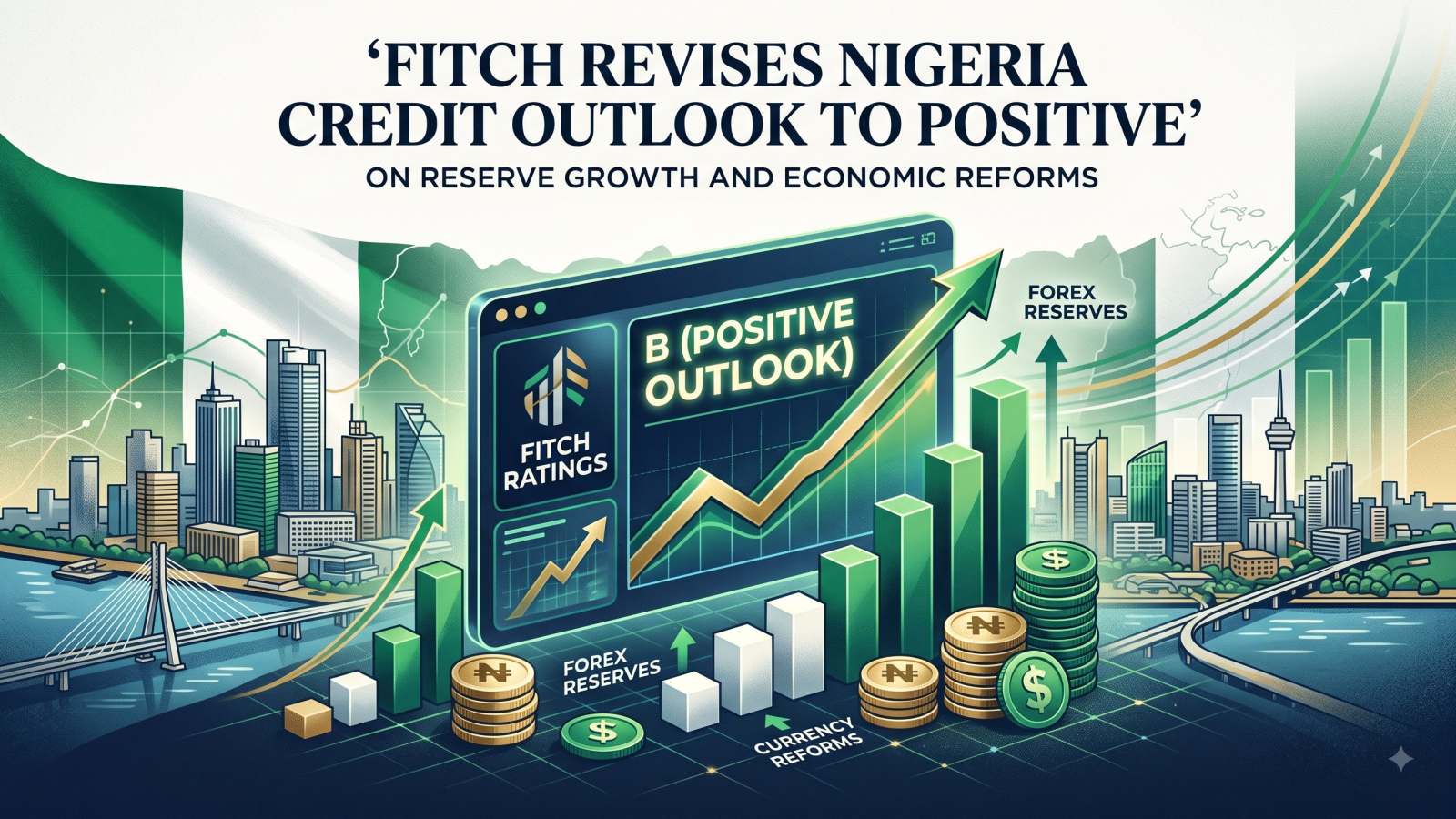
Fitch revised Nigeria's credit outlook to Positive while keeping its long-term issuer default rating at B.
Fitch Ratings announced the decision on Friday, 9 October 2026, and affirmed the country's long-term issuer default ratings at B. The move came as gross foreign exchange reserves climbed sharply and the agency assessed progress in monetary, exchange-rate and fiscal reforms.
The decision is a signal of possible future improvement, not an upgrade already in force. Fitch said the rating could rise if the gains continue, but the country remains exposed to fiscal pressures and high debt-servicing costs.
The external position is the clearest reason for the change. Gross foreign exchange reserves reached $54.9 billion on 25 September 2026, compared with $32 billion in mid-April 2024. Fitch said reserve growth reflected the formalisation of foreign exchange transactions, along with remittances, export receipts and portfolio inflows.
Reserve figures use different dates and measures
Fitch measure
Gross reserves, 25 September 2026
$54.9 billion
- Net reserves were $34.8 billion at end-2025
- Net figure followed a reduction in central-bank foreign-exchange liabilities
Central bank claim
Later figure reported by Olayemi Cardoso
$55 billion
- Net reserves were said to be $46 billion
- The governor said the net measure deducts near-term liabilities
The improvement in net reserves is also substantial, although it is a different measure from the larger gross-reserves figure. Fitch reported net foreign exchange reserves of $34.8 billion at the end of 2025, up from about $4 billion at the end of 2023 after the Central Bank of Nigeria reduced its foreign exchange liabilities.
Central Bank Governor Olayemi Cardoso said gross reserves had reached a record $55 billion and that net reserves stood at $46 billion. Net reserves had risen by $11.2 billion from the end-2025 figure of $34.8 billion, after accounting for near-term liabilities including foreign exchange swaps and forward contracts.
The figures are not directly interchangeable. Fitch's gross-reserves figure is dated 25 September 2026, while another report placed the same $54.9 billion figure on 9 September 2026. The pack said it did not establish why those dates differ, or how Cardoso said his $46 billion net figure relates to Fitch's figures and methodology.
A stronger external position gives Nigeria more capacity to absorb economic shocks and meet external payments. Fitch projected a current-account surplus of 6.4% of GDP in 2026 and expected reserve coverage to total 6.3 months of current external payments by year-end.
The agency also expected coverage to remain above that of peer countries in 2027-2028. It cautioned, however, that large net errors and omissions in the external accounts remain a source of uncertainty.
Fitch connected the reserve accumulation to changes in monetary and exchange-rate policy. It said greater naira flexibility, disinflation and faster-than-expected reserve accumulation had followed the reforms, while better reserve quality had strengthened the country's ability to withstand shocks.
"Monetary and exchange rate reforms have supported greater naira flexibility, disinflation and faster-than-expected FX reserve accumulation, while improved reserve quality enhances resilience to shocks"
The agency expected the naira to trade broadly around its current level through the end of 2026, despite the likelihood of weaker oil prices in 2027-2028. That expectation supports the outlook, but it does not remove the uncertainty associated with the country's external accounts.
Growth and oil support the external position
Fitch forecast economic growth of 4.3% in 2026, up from 4% in 2025, and expected growth to stay above 4% in 2027 and 2028. In the second quarter of 2026, average daily crude oil production excluding condensates was 1.52 million barrels.
Since May 2026, Nigeria's oil output has matched the OPEC target of 1.5 million barrels per day. The higher production backdrop supports export receipts, one of the channels Fitch identified behind the reserve increase.
Refinery activity has also reduced pressure on foreign exchange. The ramp-up of Dangote Petroleum Refinery and the rehabilitation of other refineries cut refined-fuel imports and the foreign exchange demand associated with them.
- End-2023Net reserves at about $4 billion
Fitch later linked the increase in net reserves to a reduction in the Central Bank of Nigeria's foreign exchange liabilities.
- May 2026Oil output meets OPEC target
Fitch said crude oil production reached Nigeria's OPEC target of 1.5 million barrels per day from this month.
- June 2026TRS warning
Fitch warned about a proposed $5 billion Total Return Swap facility with First Abu Dhabi Bank.
- 9 September 2026Alternative reserve date reported
One account placed the $54.9 billion gross-reserves figure on this date.
- 21 September 2026Frontier Market status restored
FTSE Russell restored Nigeria to Frontier Market status, effective on this date.
- 9 October 2026Fitch changes the outlook
Fitch moved the outlook from Stable to Positive while affirming the B rating.
The fiscal picture is less supportive. Fitch put the 2026 fiscal deficit at 3.6% of GDP, up from 3.1% in 2025, with higher government spending partly responsible. High debt-servicing costs remain a concern even as the broader debt ratio compares favourably with other countries in the same rating category.
Tax reforms are expected to lift non-oil revenue to 7.5% of GDP, or 66% of government revenue. Fitch said implementation constraints could limit those gains.
General government debt is projected to average 32% of GDP between 2026 and 2028. That is below the median of 56% for countries rated B, giving Nigeria a relative strength despite the pressure from servicing its debt.
Reforms face fiscal and political risks
Inflation is projected to average 15.4% in 2026, less than half its 2024 level. The government has acknowledged that inflation remains elevated compared with peer countries, and Fitch said household incomes could be reduced and economic growth slowed by higher food and fuel prices, more petrol price increases and security risks.
The rating therefore reflects both progress and continuing vulnerabilities. Fitch cited Nigeria's large economy, a comparatively developed and liquid local debt market, substantial oil and gas reserves and a stronger macroeconomic policy framework as supporting factors.
Weak governance indicators, dependence on hydrocarbons, persistent inflation, security challenges and structurally low government revenue compared with peers remain major constraints.
Financing practices add another risk. In September 2026, Fitch said Nigeria's reliance on Total Return Swaps and repurchase agreements could create problems involving transparency, liquidity and creditor recovery. The warning followed an earlier June concern over First Abu Dhabi Bank and a proposed TRS facility valued at $5 billion.
The full effect of those arrangements on transparency, liquidity and creditor recovery remains unknown in the material available for this story. Fitch's Positive outlook does not mean those financing risks have been resolved.
Fitch also linked the outlook to the political timetable. It said reform momentum was increasingly likely to survive the coming election period.
"The outlook revision reflects ongoing reform of the policy framework and Fitch’s increased confidence that momentum will not be disrupted by upcoming elections"
The agency assumed that incumbents were on track to win the 2027 elections because the ruling party controls most of the states in the country. The exact date of the general elections is not supplied in the material.
That makes the 2027 election period a test of whether the policy framework continues without disruption. Fitch has not said that an upgrade will definitely follow, and the rating could remain at B if the improvements do not last.
Nigeria welcomes the signal but needs more progress
The Federal Government disclosed Fitch's decision in a statement from Taiwo Oyedele, the minister of finance who also serves as coordinating minister of the economy. The government said the revised outlook showed growing confidence that the reforms could be sustained, while acknowledging that continued momentum would be needed for a possible future upgrade.
The finance ministry said the Fitch action formed part of a wider sequence of positive ratings developments in 2026. In August, Moody's Ratings revised Nigeria's outlook to positive, following S&P Global Ratings' May upgrade of Nigeria's rating from B- to B.
FTSE Russell also restored Nigeria to Frontier Market status effective 21 September 2026. These developments are separate from Fitch's decision, which kept Nigeria's rating at B.
The government has said its medium-term ambition is to put Nigeria on a path towards investment-grade credit status. It argues that improved ratings could reduce the cost of borrowing, bring in private investment and help create jobs, but that ambition is not a rating outcome contained in Fitch's action.
Fitch identified the conditions that could support another positive action: sustained disinflation, continued reform implementation, further accumulation of external reserves and stronger mobilisation of non-oil revenue.
Those conditions explain why the outlook changed before the rating did. Reserves, external payments and growth have improved, but fiscal execution, inflation, governance, security and financing transparency still affect the case for an upgrade.
What we know
- Fitch changed Nigeria's outlook from Stable to Positive on 9 October 2026.
- Nigeria's long-term issuer default rating remains B.
- Fitch reported gross foreign exchange reserves of $54.9 billion as of 25 September 2026.
Still unclear
- Whether Fitch will upgrade Nigeria's B rating.
- Why the sources give different dates for the $54.9 billion gross-reserves figure.
- How the central bank governor's claimed net-reserves figure of $46 billion relates to Fitch's figures and methodology.
- The exact date of the 2027 general elections.
The next major test identified in the material is the 2027 election period. Its exact date is not supplied, and Fitch's future decision will depend on whether reserve accumulation, disinflation, reform delivery and non-oil revenue gains continue.