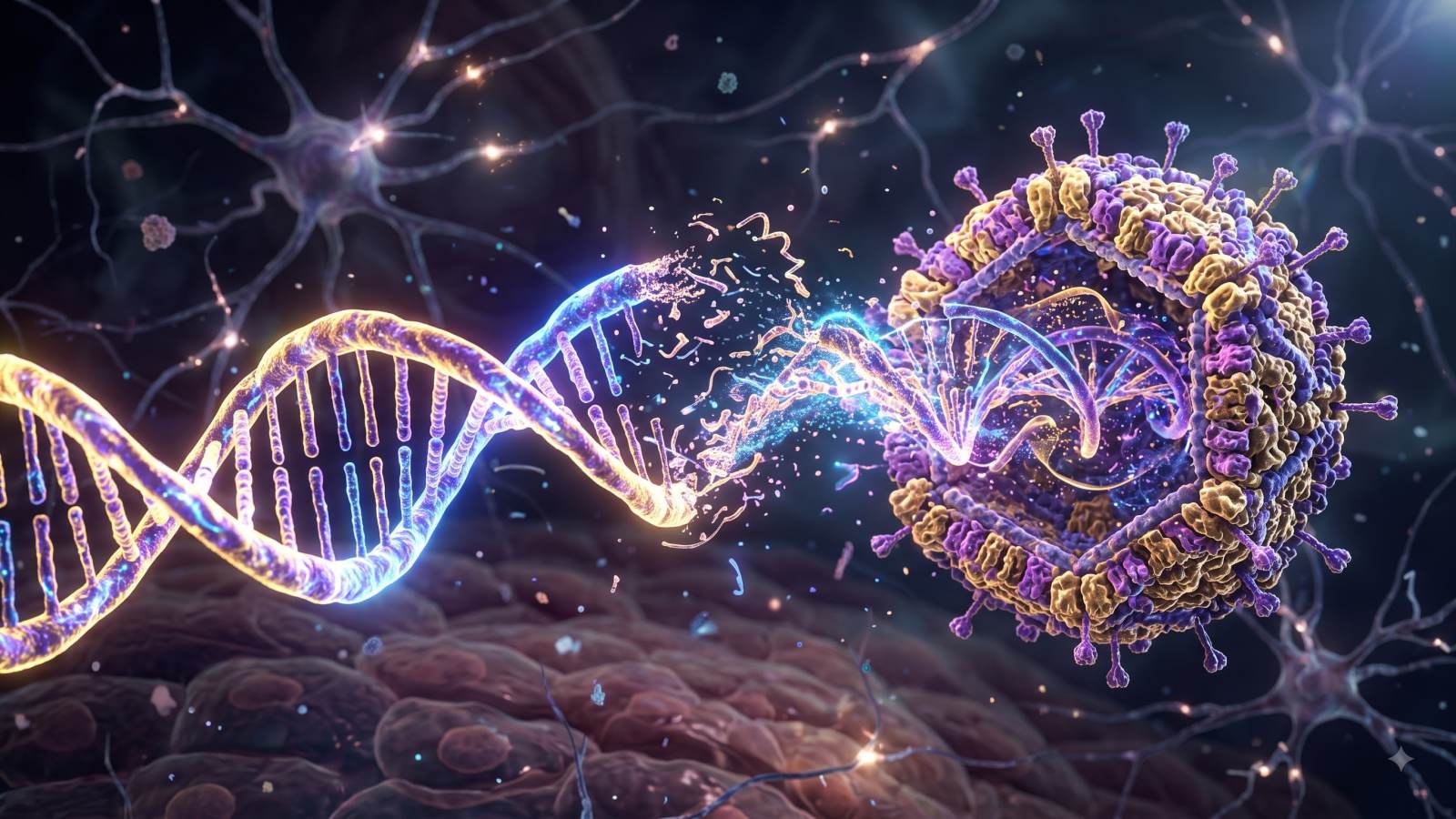
Scientists found two fragments derived from the human brain gene BC200 inside molluscum contagiosum virus.
Neurons are the primary cells expressing BC200. The sequence originated millions of years ago from a transposon, or “jumping gene”.
A common ancestor shared by monkeys and apes acquired a precursor to BC200 roughly 35 to 55 million years ago. BC200 later took on a cellular function around 40 million years ago, apparently helping regulate protein production in neurons.
What we know
- A jumping gene is mobile DNA that can move or copy itself within a genome.
- BC200 produces a short RNA molecule instead of coding for a protein.
- LINE-1 can produce the molecular machinery to copy RNA into DNA and insert it into a genome.
Still unclear
- BC200's precise physiological role remains poorly understood.
- The transfer into the virus was reconstructed from DNA evidence rather than directly observed.
BC200 works differently from most genes because it skips the step of coding for a protein altogether. It produces a short RNA molecule instead.
Researchers screened available poxvirus genomes for sequences resembling mobile genetic elements. They found two BC200-derived sequences in molluscum contagiosum virus, which infects skin and causes small, raised lesions.
BC200 in cells and in the virus
BC200 in cells
Human brain gene
- Derived from a mobile element
- Produces RNA rather than a protein
- Used in neurons
BC200 in the virus
Molluscum contagiosum virus
- Two transferred fragments
- Not a complete, intact gene
- One fragment covers the entire Alu-derived domain
One viral sequence contained the full Alu-derived domain of the human gene, which came from its mobile ancestor. The second sequence was incomplete and shorter at both ends. These findings indicated two independent transfer events rather than one insertion that subsequently duplicated within the virus.
The likely mechanism involves LINE-1 copying BC200 RNA into DNA while molluscum contagiosum virus was infecting skin cells. The researchers think those are the only cells known to be infected by the virus.
BC200 was itself created from a mobile element but has retained its mobility and yet it is also clearly serving a cellular function. Somehow evolution hasn't been able to untangle these two things.
The team detected transcription of the viral BC200-derived sequences into RNA. In cultured human fibroblasts infected with the virus, they also observed higher BC200 expression.
The team examined sequencing data from 908 people and found eight BC200-derived insertions that differed between individuals. Two appeared broadly in all five continental population groups, consistent with ancient origins, whereas another occurred mainly in African individuals.
What the BC200-derived sequences do inside the virus is unknown. Whether the virus benefits from them remains uncertain, and whether viral RNA helps manipulate protein production in infected cells still needs testing.
The findings do not show that the virus is more dangerous. The researchers plan to determine whether molluscum contagiosum virus exploits BC200 to alter human host cells for its own benefit.