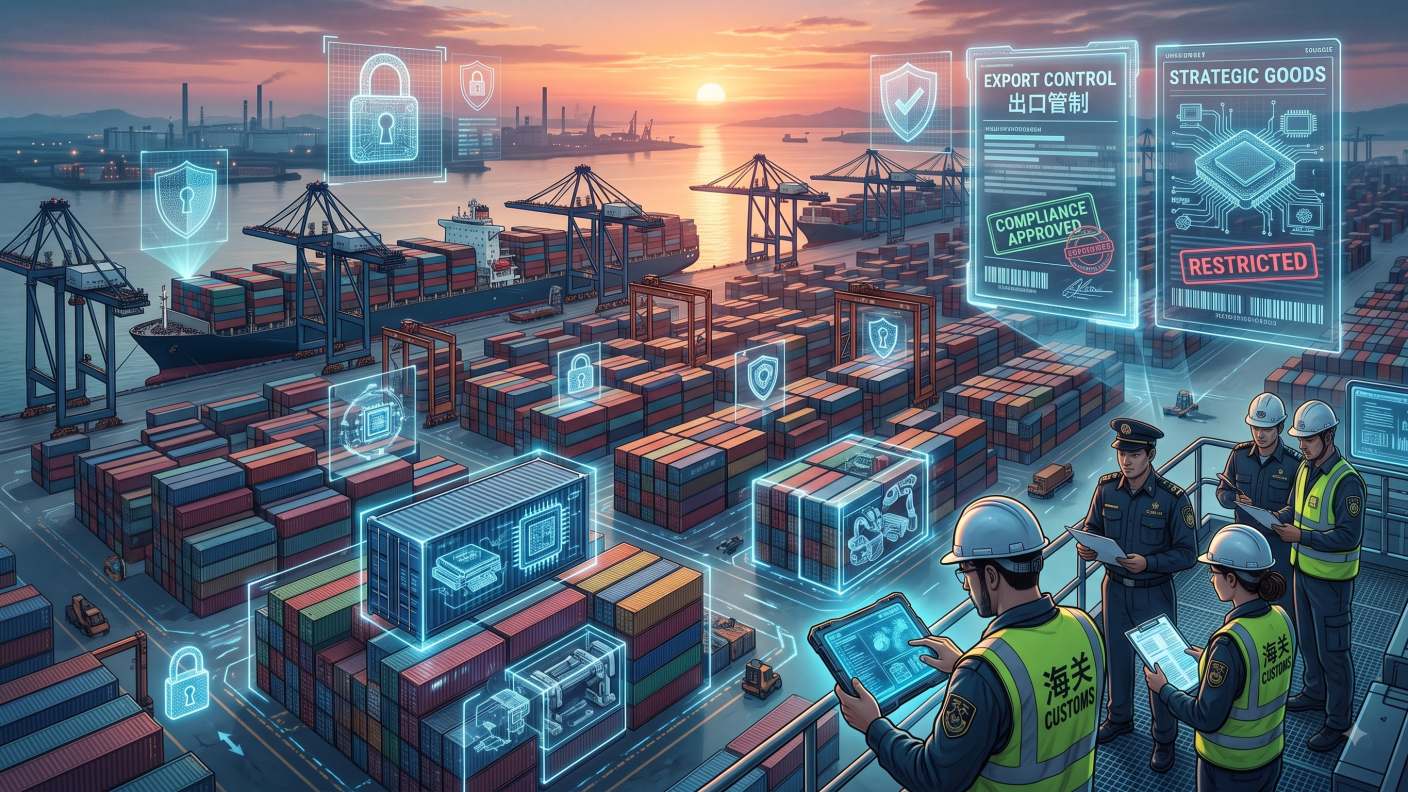
China announced a draft plan on Friday to prohibit or restrict exports of more than 40 advanced technologies.
China’s Ministry of Commerce and Ministry of Science and Technology issued the proposal as "Announcement No. 48" on 16 October 2026. It covers technologies used in AI, biomedicine and photovoltaics, including solar manufacturing technologies, AI models and some biotech platforms.
The distinction is important. A prohibited export would be completely barred under the proposal. A restricted export could proceed only through the controls set out by the authorities, including registration or licensing requirements.
The proposed prohibitions include technology for producing perovskite and tandem solar-cell modules. They also cover AI systems that could generate or alter malicious code, as well as some platforms used in cell and gene therapy.
The restricted category includes polysilicon engineering technology used in solar-cell production when the relevant lines have annual capacity of at least 30,000 tonnes. The proposal does not individually identify all of the technologies in either category.
Prohibited versus restricted
Complete prohibition
Export would be barred
- Perovskite and tandem solar-cell module manufacturing technology
- Some AI technology for generating or mutating malicious code
- Some cell and gene-therapy platforms
Restricted export
Registration or licensing may be required
- Polysilicon engineering for lines with annual output of at least 30,000 tonnes
- Certain AI model weights and source code
- Advanced AI-chip and memory-chip design technology
AI controls reach beyond finished models
The AI section contains 23 technologies. It reaches beyond completed products to include model weights and source code for systems that exceed performance thresholds. Model weights are the numerical settings that allow a trained model to produce results, while source code describes how the system is built.
The proposal would restrict core technology for models trained on "important data" when they contain at least 2 trillion parameters. It would also apply to models that rank among the world’s top 10 on measures that include performance, usage and safety.
China’s cyberspace regulator broadly treats important data as information whose disclosure could threaten national security, economic operation, social stability or public safety. The proposal does not specify the exact performance thresholds beyond the 2 trillion-parameter figure and the top-10 criteria.
The stated examples of models meeting the 2 trillion parameter threshold are Moonshot AI’s Kimi K3 and Alibaba Group Holding’s Qwen3.8-Max. In September, Alibaba said it planned to develop models with between 5 and 10 trillion parameters for longer and more complex tasks.
What we know
- The proposal covers model weights and source code above specified performance thresholds.
- Models with at least 2 trillion parameters are included if they were trained on important data.
- AI-chip design technology using 14-nanometer or more advanced techniques is proposed for restriction.
- Open-source AI technology and research already in the public domain would generally be exempt.
- Important data can include information whose leakage may endanger national security, economic operation, social stability or public safety.
Still unclear
- The exact performance thresholds beyond the 2 trillion-parameter and top-10 criteria.
- The full list of the 40 covered technologies.
The ministry also proposed controls on design technology for AI chips made with 14-nanometer or more advanced techniques, or using 2.5D or 3D advanced packaging. Design technology for certain advanced memory chips would also be restricted.
The proposal separately treats overseas deployment. Putting a covered model into use abroad would count as a technology export. If a Chinese provider runs a covered model on overseas infrastructure it owns, the deployment could qualify for automatic licensing.
Open-source technology and research already available to the public would not be covered, and exports involving open-source AI technology could receive streamlined treatment such as automatic licensing. The pack does not state whether every open-source transaction would receive that treatment.
China has simultaneously imposed a temporary registration requirement for exports covered by the proposal. It applies from 16 October 2026 and reaches transactions already under way but not completed.
The registration requirement includes intellectual-property transfers, overseas licensing and changes that put Chinese technology owners under foreign control. It is not known whether the temporary system will become permanent.
Solar and biomedical technologies are also included
The proposal covers five biomedical technologies and 12 solar technologies. The biomedical section includes proprietary cell and gene-therapy platforms, while the photovoltaic section includes production technology for certain advanced solar modules.
The Commerce Ministry said China was adding photovoltaic technologies involving polysilicon production, wafer manufacturing and solar-cell manufacturing, citing national security and national interests. The specific 12 photovoltaic technologies are not individually named in the material available for this proposal.
The ministry said "only a limited set of technologies would be regulated" and that "other photovoltaic technologies would remain freely exportable". Most AI technologies would continue to be freely exportable, even as 23 key technologies were added to the proposal.
China’s Commerce Ministry spokesperson said AI, biomedicine and photovoltaic technologies have gained wider use in sensitive areas in recent years and said:
Major economies around the world have implemented varying degrees of export controls in these areas. Drawing on international practice, China is implementing necessary controls in accordance with the law to prevent risks arising from loss of control over technologies or inappropriate proliferation, while also safeguarding normal international technological cooperation
The ministry said its security concerns include the possible use of autonomous malicious-code generation and mutation to attack critical infrastructure, defence systems and core government networks, or to circumvent national security defences. The measures were not aimed at a particular country, region or entity.
The proposal adds to existing export controls
China regularly updates its catalogue of technologies whose exports are prohibited or restricted. In 2020, Beijing added algorithms to the catalogue. The move followed a threat from the first Trump administration to ban TikTok unless an American company bought its US assets.
Chinese AI startups made significant progress in summer 2026 in narrowing the gap with US industry leaders. Moonshot AI’s Kimi K3 and DeepSeek’s latest editions offered better pricing, while Chinese companies favoured sharing model weights so developers could build on their systems.
Chinese AI companies are also increasingly seeking markets outside China. Z.AI has made its products available through US cloud service providers such as Amazon Web Services.
The proposed controls therefore cover technology at a time when Chinese companies are expanding their models, sharing weights and looking overseas for users. The draft does not provide the full list of 40 technologies, and the exact treatment of every transaction is not stated.
By targeting AI, solar and biotech – industries where China holds a growing edge – Beijing is signalling that steadier relations with the West do not mean it will stand still
Etzcorn also said, "This is more than routine maintenance". The assessment was an outside interpretation of the proposal’s strategic signal, rather than a government description of its purpose.
The guidelines are likely to add uncertainty for an AI industry already dealing with content controls, a licensing regime and potential US sanctions. Restrictions on sending very large models abroad could hamper development as AI laboratories train increasingly large systems.
Most solar exports remain unrestricted under the plan. Controls on next-generation solar manufacturing technologies could affect efforts by countries including India to reduce dependence on China while developing their own position higher in the solar supply chain.
Indian solar projects may face delays
Santosh Pai, an Honorary Fellow at the Institute of Chinese Studies and a cross-border lawyer, said Indian solar manufacturers could be affected, including through delays in obtaining licences.
The timetable for localisation is set to launch when domestic capacity from three independent domestic manufacturers exceeds 15 GW. This initial set of domestic manufacturers might experience delays in commencing production due to Announcement 48
India amended restrictions on Chinese investment in March. It gave polysilicon and ingot-wafer segments priority status for fast-track approvals.
Pai said those changes might not receive traction because Chinese companies could face constraints on solo investment in India, joint ventures and licensing agreements with Indian counterparts as a result of Announcement No. 48.
The proposal leaves several operational questions unanswered. The material does not give the date when the draft will be finalised or come into force, beyond the registration requirement taking effect on 16 October 2026. It also does not state whether the temporary registration arrangement will become permanent.
The draft plan and its temporary registration requirement begin on 16 October 2026. The date for finalisation of the plan has not been stated.