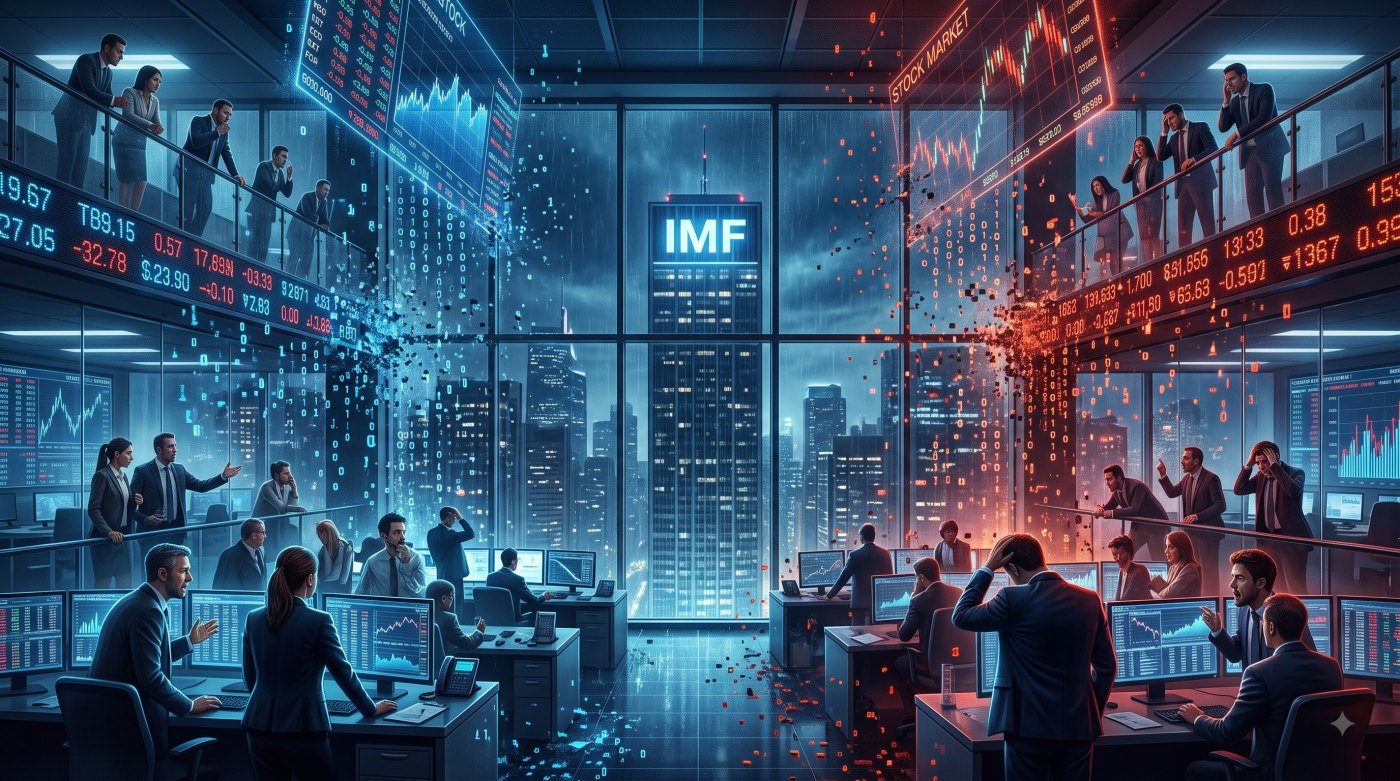
The IMF said AI-driven market losses and cyberattacks are plausible triggers for severe financial turmoil.
The warning came as the fund published its latest Global Financial Stability Report during its annual meetings with the World Bank in Bangkok, Thailand. The IMF said on Tuesday, 13 October 2026, that risks facing the global financial system were elevated.
The report said an AI-related market correction and cyber threats could have severe consequences. It described both as credible short-term events that could sharply tighten financial conditions and send markets into turmoil.
The fund said the recent AI boom had supported global growth. That expansion included a rush to manufacture semiconductors and build data centres, even as geopolitical pressures included the West Asia war.
But the same investment cycle could expose markets to a sudden change in expectations. The IMF said growing evidence suggested that AI capabilities might be delivered with lower levels of investment, or that the economic gains could be smaller than expected.
AI growth could turn into a market shock
growing evidence suggests that AI capabilities can be delivered at lower investment levels... or that potential economic gains may not be as large as expected
The report said weaker or less durable AI investment and profitability could trigger a market correction. Such a repricing could quickly tighten financial conditions and unsettle markets.
Weaker or less durable AI investments and profitability could be a shock that triggers a market correction.
The stability warning adds to wider concerns about how AI may affect labour markets, education and inequality. The report did not limit its assessment to technology companies or to the direct effects of artificial intelligence.
It also pointed to sovereign debt markets. The IMF said a rise in bond yields could produce severe shocks because sovereign bond markets are foundational to the financial system.
The report said further increases in energy prices could reignite inflation and force tighter monetary policy. That would add pressure to bond markets already vulnerable to higher yields.
Two strands of the Bangkok warning
Systemic market risks
IMF stability report
Elevated
- AI investment shock
- Cyber disruption
- Higher sovereign bond yields
Trust and fraud risks
Bangkok panel
Financial inclusion
- Online fraud
- Social-media platforms
- Responsibility across institutions
Cyber threats are growing with digitisation
The IMF said confidence in markets could be shaken and essential financial-market infrastructure and operations disrupted by severe cyber incidents. Rapid digitisation had expanded the attack surface, so an attack could have severe effects.
Severe cyber incidents could undermine market confidence and disrupt critical financial market infrastructure and operations
The report also said the risk of successful attacks on critical financial institutions and market infrastructure was worsening as AI capabilities improved. Frontier AI models could be used to stage attacks, while they could also support cyber defence.
Caio Ferreira said that emerging markets faced more menacing cyber threats when they had not allocated enough resources for prevention. He is deputy division chief at the IMF's Monetary and Capital Markets Department.
Partly understood and partly not were the risks to the financial system, said Athanasios Vamvakidis, the IMF's deputy director of the Monetary and Capital Markets Department.
known and very much unknown
Vamvakidis said the policy priority was to improve resilience before another shock reached the economy.
The policy priority should be to strengthen resilience before new shocks hit the economy
The report's publication on 13 October 2026 came during the second day of the IMF and World Bank gatherings. A separate account dated 14 October described a Bangkok panel at which the cyber-fraud and trust risks were discussed. The exact date and time of that panel event were not given.
Fraud threatens trust in formal finance
Bank of England governor Andrew Bailey and IMF managing director Kristalina Georgieva spoke at the panel about online fraud. The event launched the Bangkok blueprint, a newly issued framework of international principles designed to help financial institutions avoid cyber-fraud.
Bailey said the debate over AI depended on trust in technology and on human control. He also linked confidence in technology to confidence in money and the way society operates.
If you try to say what’s at the heart of this debate about AI – for me, it’s about trust in technology and it’s about human control to achieve that trust in technology
If we don’t have trust in money, we don’t operate as a society.
Georgieva said the scale of cyber-fraud could lead people to leave the formal financial system altogether. The danger was especially acute for people on its margins.
And I worry, today, that unless we figure out how to get ahead of this curve, given the speed, the scale and the cost of fraud growing up, we may end up with lots of people with shoeboxes under their beds.
Georgieva used her experience of growing up under communism to illustrate the risk. She said distrust of the system had led her to keep dollars in a shoebox under her bed, and warned that fraud could produce a similar retreat from formal finance.
Bailey said fraud was increasingly transmitted through social-media platforms and apps rather than only through traditional financial channels. He called for the companies operating those platforms to share responsibility.
We must get the social media companies involved because a lot of this fraud is transmitted through those channels.
Bailey also said the tools used by cybercriminals should be used to protect the financial system. The technology was strengthening attacks, but could also strengthen defence.
I’m going to use a sporting metaphor: this technology is arming the offence but it can also arm the defence, and it must do.
The IMF's stability report and the Bangkok panel addressed related but distinct risks. The report focused on shocks to markets, financial infrastructure and sovereign debt. The panel focused on fraud, trust and responsibility among financial institutions and technology platforms.
The full contents of the Bangkok blueprint were not described. The IMF's specific measures for strengthening resilience were also not detailed.
The immediate agenda is to strengthen resilience before new shocks and advance the Bangkok blueprint. The report was released on 13 October 2026, while the panel account was dated 14 October.