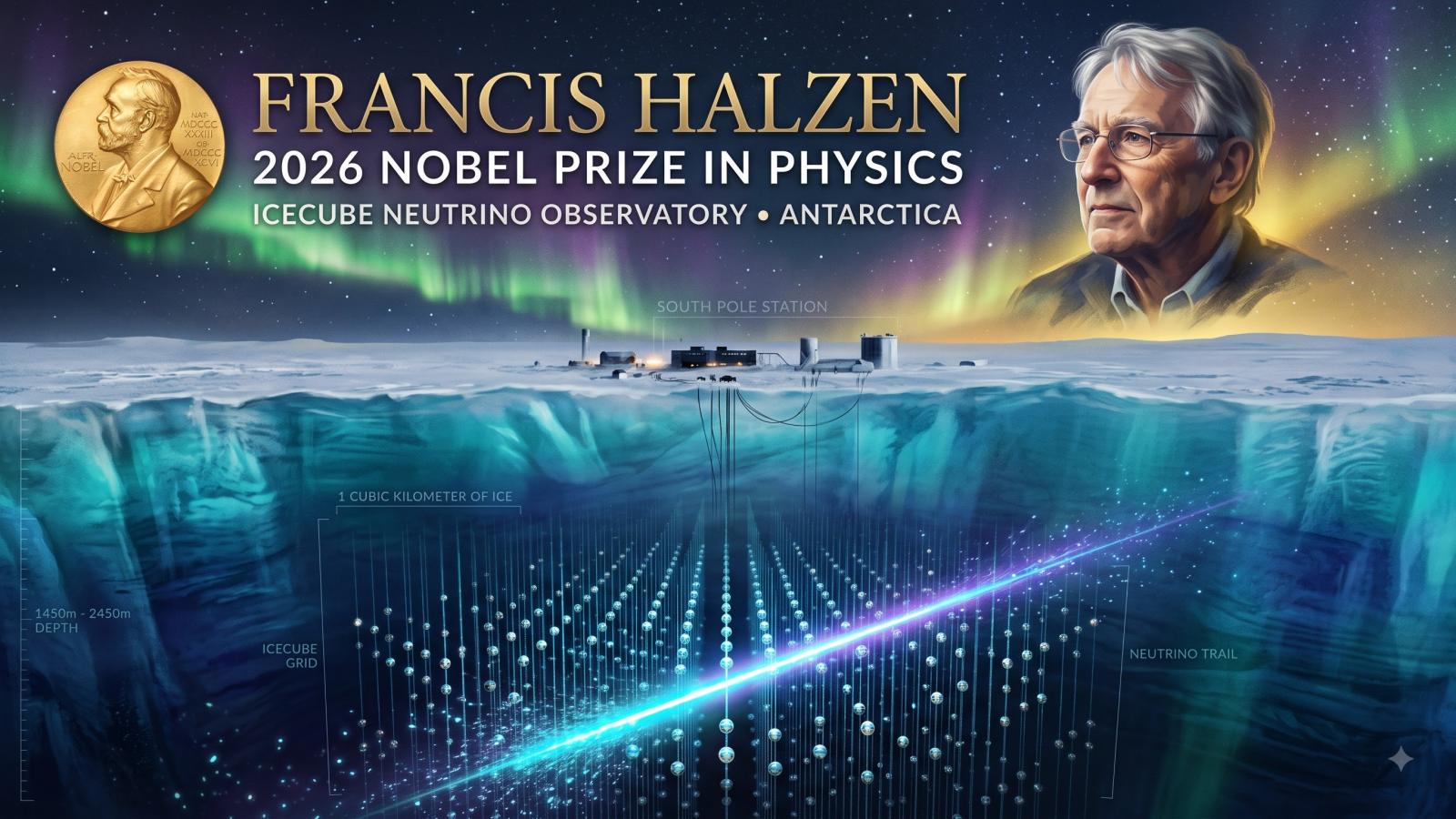
The Royal Swedish Academy of Sciences awarded the 2026 Nobel Prize in Physics to Francis Halzen for discovering high-energy astrophysical neutrinos.
The prize went to Francis Halzen of the University of Wisconsin-Madison. It recognised his work on the IceCube Neutrino Observatory and finding high-energy neutrinos from space. The award was announced on 06 October 2026.
It was a great surprise and I obviously didn't expect it.
IceCube is an observatory made of a cubic kilometre of Antarctic ice at the South Pole. It is equipped with light sensors to detect particle interactions. The facility has 5,160 optical sensors buried over a mile under the ice. These sensors detect the Cherenkov light produced by neutrino interactions.
We have over 5,000 of these sensors, kilometer by kilometer by kilometer, and that's our detector. That's really it.
How the detector works
What we know
- Neutrinos are point-like particles with no measurable size and no electric charge.
- They rarely interact with the atoms they pass through.
- When a neutrino collides with an atomic nucleus, the interaction produces a flash of light.
- Sensors embedded in the clear glacial ice detect this light.
- Cherenkov light is the blue flash produced when a charged particle travels through a transparent medium faster than light can travel through that medium.
Still unclear
- The exact cosmic sources of most high-energy neutrinos remain unidentified.
The South Pole offers an ideal location for this work. The ice is free from various types of interference. The area is geologically stable with little seismic activity.
It's very flat and very white and desolate (laughter).
A long road to recognition
Halzen faced early doubt about his concept. He recalled that everybody thought it was a cute idea that would not work. Reports on the completion date of the observatory vary. Daily News Egypt states IceCube was completed in 2011. The Hindu says it was completed in 2010.
Researchers reported the first high-energy cosmic neutrinos in 2013. In 2018, researchers traced one high-energy neutrino to a distant blazar. A blazar is a galaxy with a supermassive black hole at its centre. It shoots a beam of radiation and particles nearly straight at Earth.
Erin O'Sullivan, IceCube spokesperson and a professor at Uppsala University in Sweden, offered a different timeline. She said the very first neutrino traced to a source was in 2017, coming from the direction of a blazar, which she described as a supermassive black hole.
Other neutrinos detected by IceCube came from somewhere in our own galaxy, according to O'Sullivan. She spoke on behalf of the collaboration to congratulate Halzen on the achievement.
And I think I speak on behalf of the whole collaboration when we say, congratulations, Francis, on this great achievement.
Signal versus noise
Identifying these particles presents a significant challenge. For every one space neutrino IceCube catches, there are about a trillion particles made in the Earth's atmosphere. These atmospheric particles form background noise, according to Naoko Kurahashi Neilson.
A billion. What's after a billion? A trillion, right? So for every one space neutrino we catch, there's about a trillion particles made in the Earth's atmosphere that's essentially background to us.
Neilson compared the current state of knowledge to static on an old television. She said viewers might think they can make something out of the noise, but not really. The exact cosmic sources of most high-energy neutrinos remain unidentified.
Some of the most violent events in the universe create extremely high-energy neutrinos. These particles traverse immense spans of space without significant energy loss or deflection. This allows scientists to trace them back to distant cosmic sources.
Mark Pearce, Chair of the Nobel Committee for Physics, praised Halzen's leadership. He said Halzen led an international team of researchers and engineers who built a powerful instrument, and that his tenacity and scientific vision enabled a new type of astronomy.
Four hundred fifty researchers in 14 countries are part of the IceCube collaboration. They are celebrating with Halzen. The academy said future IceCube observations might yield fresh understanding of extreme environments and possibly uncover unknown cosmic phenomena, though this is not yet known.
Global context and historical attempts
Neutrino detection has a history in other parts of the world. Physicists from the Tata Institute of Fundamental Research in Mumbai started studying cosmic rays during the 1950s and early 1960s. They used the deep shafts of the Kolar Gold Fields in Karnataka.
An international collaboration installed detectors about 2.3 km underground at the Kolar Gold Fields in 1964-65. They logged atmospheric neutrinos at roughly the same time as a rival test in a South African gold mine. The work at Kolar Gold Fields lasted for decades until the mines shut down in 1992.
India conceived the India-based Neutrino Observatory (INO) to revive this tradition. Planners designed an underground laboratory specifically for Pottipuram, located in the Theni district of Tamil Nadu. The plan included a 50,000-tonne magnetised iron calorimeter (ICAL) to examine how atmospheric neutrinos oscillate and how Earth's matter affects them.
The INO project became mired in environmental and local opposition. Construction of the intended lab and detector never began. INO/ICAL and IceCube are distinct experiments, with INO targeting lower-energy atmospheric neutrinos while IceCube focuses on higher-energy astrophysical ones.
IceCube vs Proposed INO
IceCube
South Pole
Completed
- Higher-energy astrophysical neutrinos
- Cubic kilometre of ice
- 5,160 optical sensors
INO/ICAL
Tamil Nadu, India
Stalled
- Low-energy atmospheric neutrinos
- 50,000-tonne magnetised iron calorimeter
- Never constructed