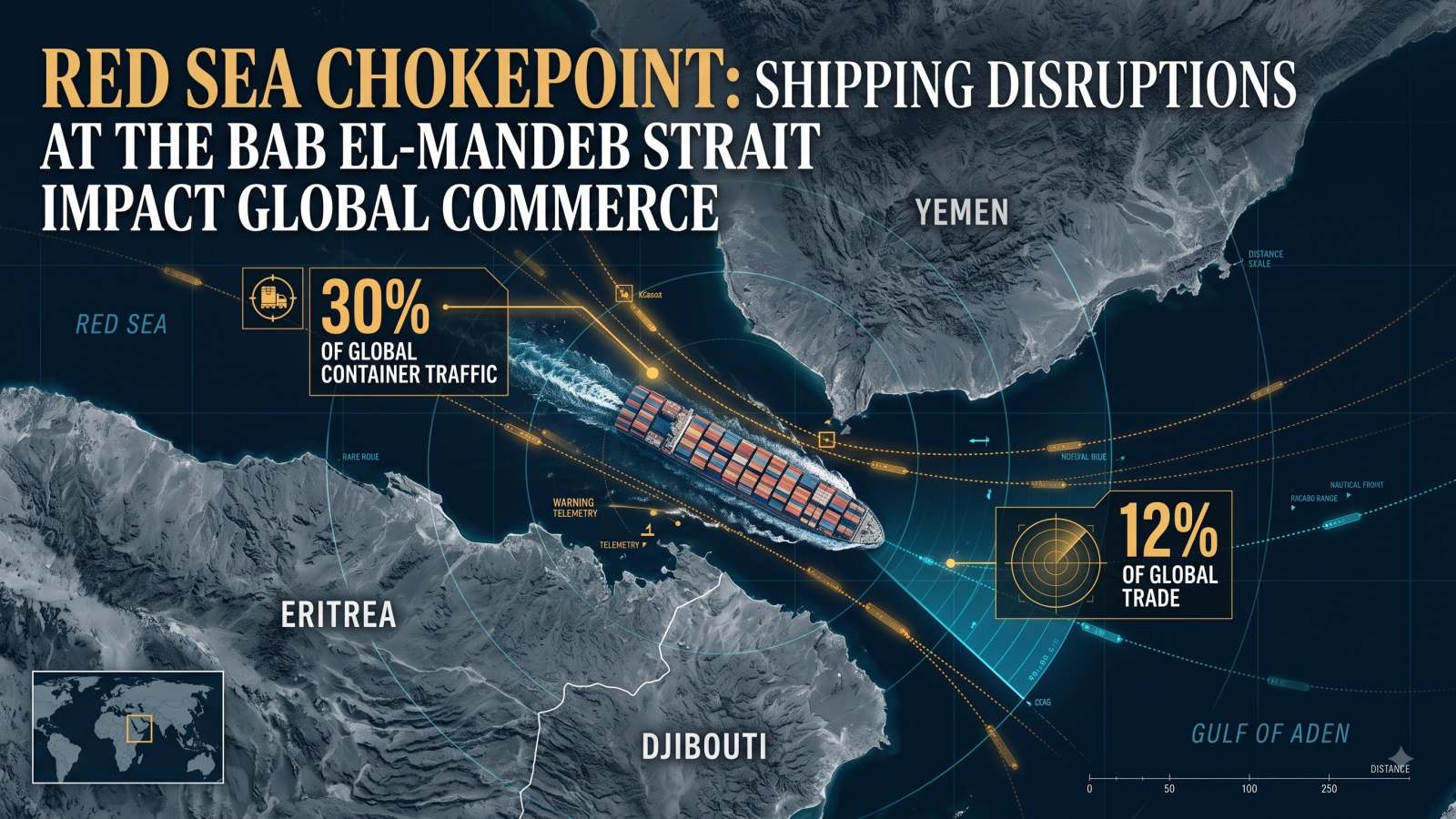
The Houthi militia's capture of territory at the entrance to the Red Sea has given it the ability to disrupt shipping through the Bab el-Mandeb Strait, a critical chokepoint for global trade.
The strait carries about 30% of global container traffic, 15% of global oil and shipping transits, and 12% of global annual trade. African economies are already feeling the effects through higher costs and security risks.
How the Houthis gained control
After the U.S. and Israel struck Iran in February, the Iran-aligned Houthi militia in Yemen took over territory at the mouth of the Red Sea. Last month, that seizure gave the Houthis a degree of control over shipping through the strategic Bab al-Mandab strait.
In recent days, Yemen's government, supported by a Saudi-led military coalition, regained some authority over Bab al-Mandab, prompting the Houthis to escalate missile strikes on Saudi airports.
Since the Gaza war began in 2023, the Houthis have repeatedly targeted merchant vessels.
The threat to shipping
Sahan research group Strategic Analyst and Founding Partner Matt Bryden says Houthi interdiction of the Bab el-Mandab could involve anti-ship missiles, unmanned aerial vehicles, and maritime drones (unmanned surface vehicles), which are hard to defend against.
Houthi interdiction of the Bab el-Mandab [could] involve anti-ship missiles, [unmanned aerial vehicles], and maritime drones [unmanned surface vehicles], which are hard to defend against,

Bryden said that by striking only a few ships, the Houthis could effectively shut the passage to commercial traffic by frightening international carriers and driving up insurance costs.
would only have to target a handful of ships to effectively close the passage to commercial shipping
Economic impact on Africa
Even before the Houthis seized Bab al-Mandab, their attacks on ships had already damaged the economies of Egypt, Sudan, Eritrea, Djibouti and Somaliland through reduced vessel traffic, higher freight costs and increased insurance premiums.
In 2024, despite fewer Houthi attacks on commercial shipping, Cairo still lost about $3.76 billion in Suez Canal revenue.
Africa relies on imports for 98 per cent of its refined oil products, and the higher cost of Red Sea shipping makes African imports and exports more expensive and less competitive.
| Metric | Value |
|---|---|
| Global container traffic through Bab el-Mandeb | 30% |
| Global oil and shipping transits | 15% |
| Global annual trade | 12% |
| Suez Canal revenue lost by Cairo in 2024 | $3.76 billion |
| Africa's refined oil product imports | 98% |
Refugee crisis in Djibouti
At least 3,700 refugees crossed from Yemen into Djibouti since September 10, the UN Refugee Agency (UNHCR) said. Most refugees who reached Djibouti's northern Obock region are women and children.
The UNHCR is getting ready to help another 10,000 people who have not yet made the crossing into Djibouti.
Obock, on the border with Eritrea, is extremely dry and has no groundwater, so everything must be desalinated, according to UNDP representative Alessandra Roccasalvo.
We don't have much water here; there's no groundwater at all. Everything has to be desalinated.
Ethiopia's vulnerability
Ethiopia, the most populous landlocked country in the world, relies on Djibouti's ports for about 95% of its imports and exports.
For months, Ethiopia has been among the African countries hit hardest by the blockade of the Strait of Hormuz, and it has already had to ration fuel at times.
Houthi-al-Shabaab ties
Experts have voiced worries about growing cooperation between the Shiite Houthis and the Sunni terrorist group Al-Shabab, based in Somalia, driven especially by shared hostility toward Israel and the US.
The Africa Center for Strategic Studies said the renewed attacks have caused more piracy in the Gulf of Aden, and it noted strengthening Houthi-Al-Shabaab ties since early 2025, mostly involving arms shipments and Houthi training of militants.
The Africa Center for Strategic Studies said al-Shabaab provides funding to the Houthis and uses less traceable routes for arms trafficking.
The Africa Center for Strategic Studies said the Houthis might give al-Shabaab more lethal military-grade drones and missiles, which would increase its power to destabilise Somalia's government, and could set up communications and surveillance equipment on Somali territory, extending Houthi missile and drone range.
A spokesperson for the United States military's Africa Command said the link between the Houthis and al-Shabaab is highly concerning and a threat to regional stability.
highly concerning... threat to regional stability.
Regional implications
Alan Boswell warned that as Middle Eastern countries get more involved in the Horn, internal conflicts in Ethiopia and Sudan are more likely to merge into a larger regional war zone.
Middle Eastern countries' expanding involvement in the Horn increases the risk that internal conflicts in Ethiopia and Sudan will merge into a larger regional war zone,
Alan Boswell says Houthi military gains and their emerging alliance with al-Shabaab reveal a larger geopolitical transformation in which the Horn of Africa and the Arabian Peninsula are no longer separate strategic regions.
For much of the past century, policymakers have treated the Horn of Africa and the Arabian Peninsula as separate strategic regions divided by the Red Sea. That distinction is now evaporating. Wars on one side of the sea increasingly alter the military calculations on the other.
International response
The three African non-permanent members of the UN Security Council — the Democratic Republic of the Congo, Liberia, and Somalia — held an emergency meeting in mid-September. They jointly called for free shipping lanes and endorsed the demand that the crisis in Yemen be resolved under the auspices of the UN.
Ports in Kenya and Tanzania are becoming increasingly attractive for transshipment as some African economies could benefit from relocation activities.
Nigeria's Dangote Group has announced an initial public offering and a new refinery in Kenya.
What happens next
If the Bab el-Mandeb Strait becomes impassable, shipping companies would have to detour via the Suez Canal, which Egypt controls, or around the southern tip of Africa, as some already do, and the additional costs would be passed on to consumers.
In the long term, Ethiopia wants to rely less on imports, for example by using domestically generated electricity to power vehicles instead of imported gasoline.
The situation remains fluid, with the Saudi-backed counteroffensive ongoing and the Houthis threatening further attacks. The next dated step is the UN Security Council's response to the African members' call for action.