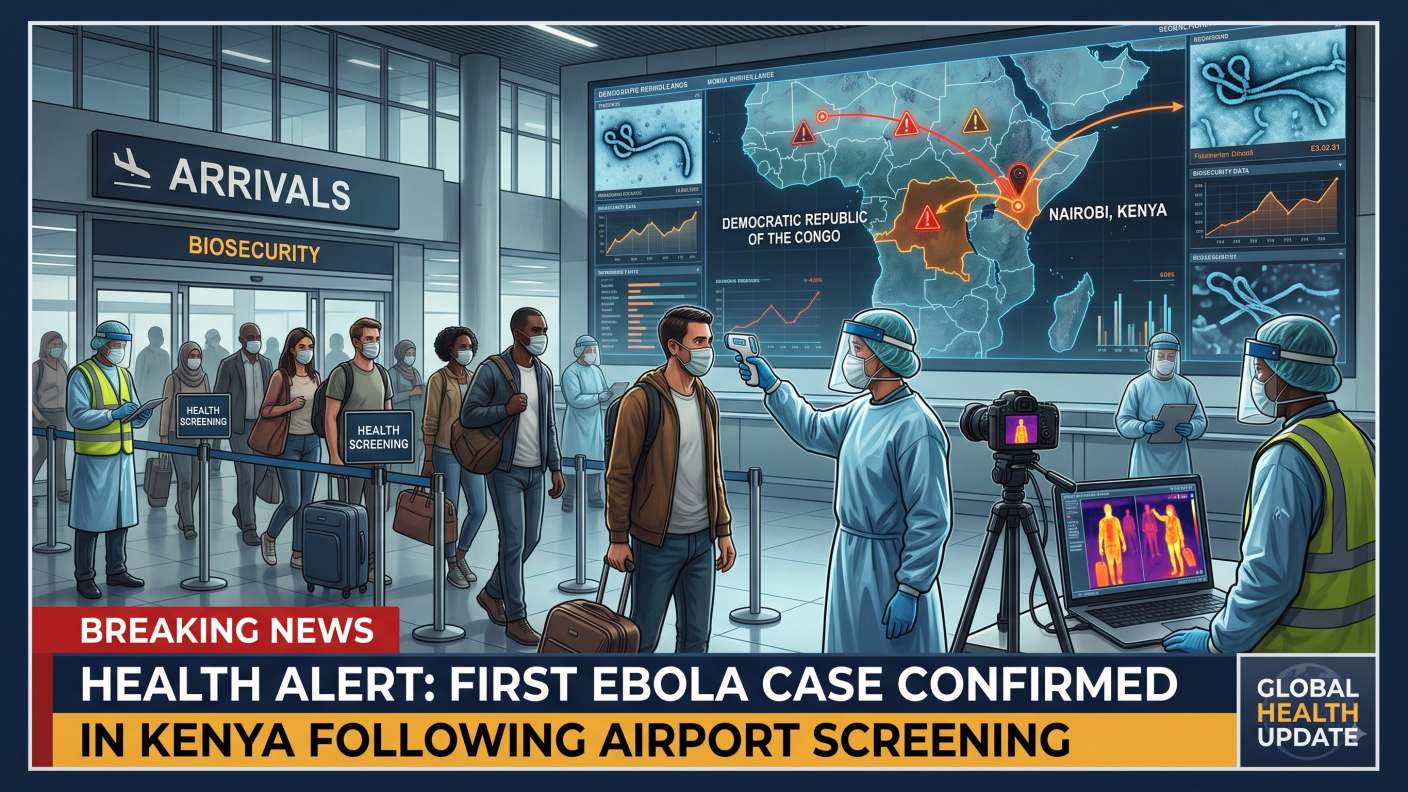
Kenya confirmed its first Ebola case after a traveller from the Democratic Republic of the Congo died in Nairobi two days after passing airport screening.
The man died of Ebola at Nairobi Hospital two days after being driven there from Jomo Kenyatta International Airport on 3 October.
The infection was caused by the Bundibugyo strain, which had neither specialised treatment nor a vaccine until now.
- 17 SeptemberTreatment sought in the DRC
The man sought care at health centres in Bondo and Kasangani in the Democratic Republic of the Congo.
- 3 OctoberFlight to Nairobi
His final flight went from Entebbe in Uganda to Nairobi. A family member collected him at Jomo Kenyatta International Airport and drove him to Nairobi Hospital.
- 6 October 2026Kenya confirms the case
Kenya confirmed its first Ebola case after the man died in Nairobi.
He had sought medical treatment in the Democratic Republic of the Congo and travelled through at least eight towns and cities while sick. One account said he took three flights during that period.
Accounts said the man’s final journey was from Entebbe to Nairobi on 3 October, with one account including travel by road from the Democratic Republic of the Congo to Uganda before he boarded the flight. In both accounts, a relative took him to hospital after he arrived in Nairobi.
Dr Wessam Mankoula, head of health emergencies for the Africa Centre for Disease Control and Prevention, said the man first had fever and a skin rash. By the time he reached Nairobi, he also had a sore throat, muscle pain and bleeding at some infection sites.
The World Health Organization and Mankoula said the patient’s temperature was recorded as normal during two separate screenings, with antipyretic medicine potentially hiding his fever.
Why screening did not detect the illness
Airport screening looks for warning signs, but it cannot rule out Ebola when symptoms are hidden by medication. Kenyan health authorities said the medicines the man was taking probably allowed him to pass without raising concerns.
We have tried, through thermal screening, through some of the questionnaires in the countries, to track the history of the travellers and also if they have any symptoms or signs. So this is helping the countries to take quick measures to identify any suspected cases quickly and deal with this.
Temperature checks are therefore one part of screening rather than a guarantee that every infected traveller will be found. Questionnaires and honest disclosure of symptoms or recent exposure are also part of the process.
Ebola spreads through contact with infected bodily fluids. Ordinary proximity alone does not transmit the virus, according to the fact pack.
What we know
- The man had a normal temperature during two screenings.
- Ebola spreads through contact with infected bodily fluids.
- People being monitored will remain in isolation for 21 days.
Still unclear
- The sources do not say whether the patient’s contacts have tested positive or negative.
- The total number of contacts being traced is not known beyond the groups identified by the authorities.
Contact tracing and isolation have begun
Quarantine has been imposed on eight family members of the patient and 21 healthcare workers. Authorities are also tracing 23 passengers and four crew members who travelled on his flight from Uganda.
Isolation separates people who may have been exposed from others while authorities watch for illness. Anyone who develops symptoms is to be tested and isolated immediately, while people who remain without symptoms for 21 days can leave.
Kenya has put its public health emergency operations centre into action and established a national task force led by the Ministry of Health. Screening and surveillance have also been strengthened at Kenyan airports.
Mankoula said cooperation between the three affected countries had helped officials reconstruct the man’s movements and begin tracing his contacts.
Please, if you start having any symptoms related to Ebola, if you have been in touch with any confirmed cases of Ebola, report this to the health authorities in your countries.
If you start having fever, please don't try to take drugs to mask those symptoms so that you can start crossing the borders.
When you reveal if you have any symptoms or signs related to Ebola, you are not only preventing further spread to other countries, but also you are protecting yourself first. When you seek medical care early, we see an improvement in the outcome. When you delay in seeking medical care, this is when we see worse outcomes.
The sources do not state the exact date on which the man died. They also do not say whether any traced contact has tested positive or negative, or how many people are being traced beyond the family members, healthcare workers, passengers and crew identified.
There was some suggestion that the man might have been incorrectly diagnosed with Rift Valley Fever, but the available account does not establish that this happened.
The outbreak remains centred in the DRC
One report said more than 8,700 Ebola cases had been reported in the Democratic Republic of the Congo, including 4,205 deaths and a 48% case fatality rate. Another listed a lower total of over 8,300 confirmed cases across the country.
Different reports of the DRC outbreak
Reported measure
One account
More than 8,700 cases
- 4,205 deaths
- 48% case fatality rate
Reported measure
Another account
Over 8,300 confirmed cases
- Confirmed cases across the DRC
- Different measure from the other report
In Ituri, the Democratic Republic of the Congo has recorded a 24% decrease over three weeks, while Nord-Kivu has seen a 19% decline. Conflict in Nord-Kivu is affecting surveillance.
After the Democratic Republic of the Congo declared an Ebola outbreak in May, Uganda also reported Ebola cases and deaths. After the World Health Organization declared Uganda free of the disease, cases occurred only in the Democratic Republic of the Congo until this Kenyan death.
An Ebola death has occurred in another country during the outbreak, marking the first such case. The World Health Organization said the epidemic will exceed the regional outbreak of 2014-2016. That earlier outbreak killed over 11,000 people, primarily in Guinea, Liberia and Sierra Leone.
The World Health Organization has not supported imposing travel and trade restrictions on affected regions. Not all international travellers are required to complete a self-declaration form saying whether they have visited Ebola-affected countries or recently had symptoms.
Human trials for a vaccine began in July, while three other candidates are in development. The Bundibugyo strain in the Kenyan case had no specialised treatment or vaccine available until now.
Mankoula has called for stronger health screening at countries’ entry and exit points. He said screening depends on more than detecting fever, because people must also disclose symptoms and possible exposure.
Africa CDC is calling for vigilance, not panic,
The immediate response is to continue isolating and monitoring traced contacts. Anyone who develops symptoms is to receive rapid testing and immediate isolation.