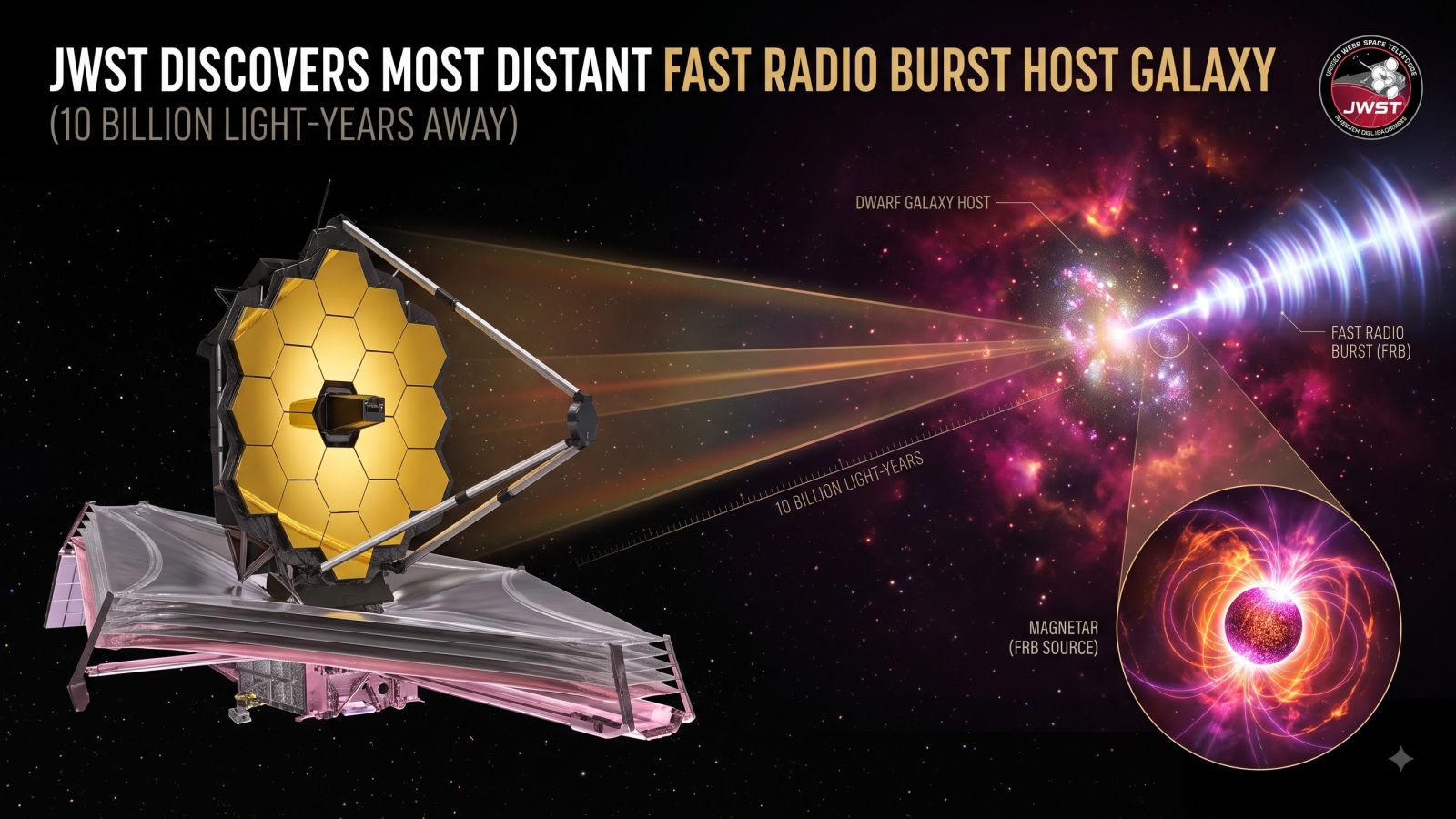
Astronomers identified the home galaxy of a fast radio burst farther away than any previously found, sitting 10 billion light-years distant in a cosmic infant just 3 billion years old.
Using NASA's James Webb Space Telescope, astronomers identified FRB 20240304B as the most distant fast radio burst observed so far. The findings appeared Thursday in Science, with Manisha Caleb of the University of Sydney as lead author.
What we know
- Fast radio bursts are ultra-fast radio waves from deep space that last a fraction of a second but release as much energy as the sun emits in three days.
- Fast radio bursts were first discovered in 2007, and not much is known about them.
Still unclear
- While magnetars (highly magnetized, collapsed dead stars) are currently the leading theory, scientists do not know if magnetars are responsible for all FRBs. Dozens of models exist—ranging from black hole collisions to cosmic strings—and it is highly possible that different types of cosmic events create the exact same kind of radio
- FRBs act as "cosmic lighthouses". As their signals travel billions of light-years, they get stretched out by floating gas and electrons in deep space. While this helps us map the universe, we still do not know the exact distribution of matter between galaxies, though tracking more distant FRBs is slowly helping us solve this "missing matter" problem.
The MeerKAT telescope detected the burst on 4 March 2024 as part of the MeerTRAP team's work. Radio observations indicated the burst originated from a great distance, potentially the farthest yet recorded, though determining the exact distance required examining its source galaxy.
Although astronomers knew the FRB's position with high precision, ground-based telescopes including the world's largest could not identify a galaxy at that location. Webb was enlisted for the task.
Webb's NIRCam detected a galaxy at the expected location, while its NIRSpec measured the precise redshift. The host galaxy's redshift of 2.148 places it at a time just 3 billion years after the Big Bang.
Array
The finding more than doubles the previous distance record for fast radio bursts. The source lies more than 10 billion light-years away.
A galaxy like no other
The host galaxy is a small dwarf galaxy actively forming stars, and it is 1,000 times less massive than astronomers expected. It was also metal-poor and showed intense star formation.
FRB 20240304B host
This discovery
- Dwarf galaxy
- 1,000 times less massive than expected
- Young and metal-poor
- Actively forming stars
Typical FRB hosts
Earlier detections
- Massive star-forming galaxies
- Billions of years later in cosmic history
- At typical galaxy scale
Array
Array
The vast majority of fast radio bursts detected to date occurred billions of years later in cosmic history than this one. The host galaxy existed at the height of cosmic noon, a period when star formation was at its peak in the universe.
The galaxy's star formation rate suggests most of its stars may have formed in just 30 million years.
What generates the burst
The researchers' findings make it highly improbable that a merger caused this fast radio burst. A supernova likely generated the burst instead.
Array
The host galaxy's youth supports the hypothesis that magnetars produce at least some fast radio bursts, since these objects form more readily in galaxies undergoing intense star formation. A magnetar is a highly magnetic star core left after a supernova.
Array
Opening a new window
Fast radio bursts are millisecond-long flashes of radio emission from the distant universe, and most are seen once and never again. Astronomers have detected thousands of them before this one, but because the events last only milliseconds they are extremely difficult to study.
Array
The team plans to continue hunting for fast radio bursts with JWST, triggering observations once ground-based radio telescopes find and localize a suitable new source.
Array