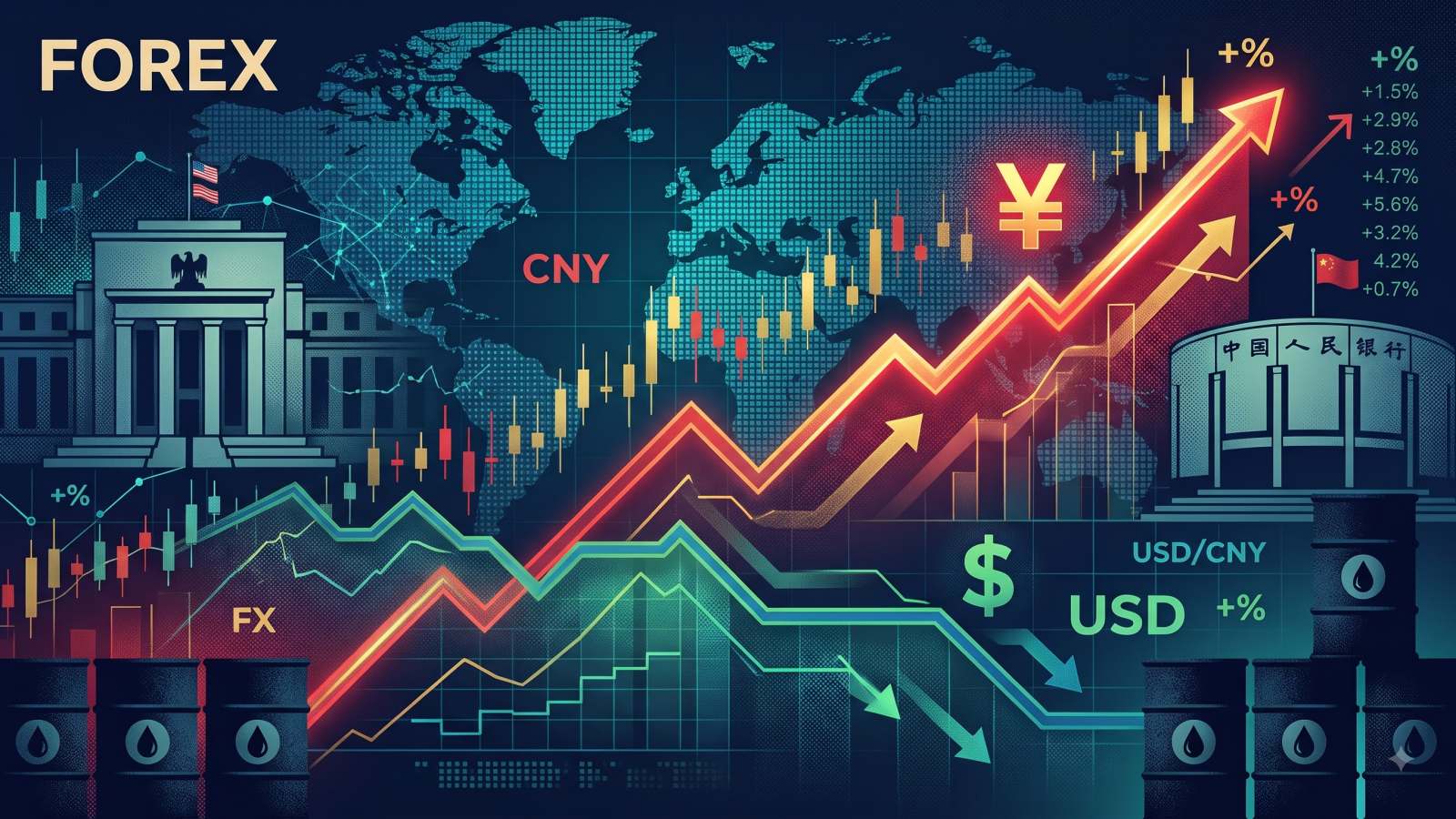
China's yuan climbed to its strongest level against the dollar in four years as the US currency softened before a week of rate meetings.
The move links China's currency to a wider change in global markets. Investors are weighing easier dollar conditions against renewed risks from oil, while markets are already pricing possible rate increases later in the year even though some central banks may hold this week.
The yuan reached its four-year high as the People's Bank of China set its daily midpoint at its strongest position since early February. The currency's rise came alongside signs of dollar weakness and local policy adjustments.
Experts expect the yuan's upward trend may continue. The exact level of the four-year high and the precise midpoint rate were not given.
Asian markets began the week cautiously despite the yuan's strength. MSCI's broadest index of Asia-Pacific shares outside Japan fell 0.1%.
Japan's Nikkei dipped 0.8% after losing 4.0% the previous week. South Korea's market fell 0.4% and has shed almost 19% so far this month.
The contrast shows that a resilient Chinese currency has not removed broader unease in regional markets. The yuan can continue to rise even as investors remain cautious about shares and future interest-rate decisions.
Oil prices eased after a sharp rally in the previous week. Brent futures fell 1.0% to $115.48, while US crude futures dropped 1.1% to $102.08 a barrel.
Brent futures had risen 6.2% in the previous week to their highest weekly close since mid-2022. Houthi attacks in Saudi Arabia had raised concern about energy supplies.
Reports said Qatari mediators were in Tehran on Sunday to help reduce regional tensions in coordination with the United States. The outcome of the mediation and the future path of Iran-related tensions remain unknown.
- Previous weekOil rally
Brent futures jumped 6.2% to their highest weekly close since mid-2022.
- SundayMediation reports
Qatari mediators were reported to be in Tehran to help de-escalate regional tensions.
- WednesdayNew Zealand decision
The central bank is widely expected to raise rates.
- SeptemberUS inflation signal
A core inflation reading is expected to show cost pressures at 3.1%.
- This weekEarnings test
Alphabet, Microsoft and Amazon are among the companies reporting results.
Central banks face competing signals
Bruce Kasman, global head of economics at JPMorgan, said: "The main message from global central banks grappling with this year's macroeconomic surprises is that a relatively shallow rate hike cycle is underway".
Kasman said: "G3 central banks are likely to remain on hold, but Canada should start its tightening cycle and first moves are expected from the UK and Sweden next month."
Markets widely expect New Zealand's central bank to raise rates on Wednesday. They assume the US Federal Reserve will keep rates unchanged in October but imply an 80% chance of a hike in December.
Markets price much the same outcome for the Bank of Japan and the European Central Bank. Those are market expectations rather than confirmed decisions, and the sources do not identify every meeting referred to by the broader week of rate decisions.
Rate expectations
Likely holds
G3 central banks
October
- Federal Reserve
- Bank of Japan
- European Central Bank
Possible moves
Other policy signals
Wednesday and December
- New Zealand expected to raise rates
- Federal Reserve hike priced for December
Goldman Sachs said: "The Fed is set to skip raising rates at its October meeting but is likely to deliver a second hike in December".
Forecasts for US economic data add to the uncertainty. A core inflation measure is expected to put cost pressures at 3.1% for September, and forecasts point to 3.2% annualised economic growth, partly supported by heavy spending on data centres.
The actual September inflation and economic growth figures have not yet been published. Markets must therefore distinguish between current forecasts, priced policy probabilities and confirmed central-bank decisions.
Oil remains the main inflation risk
Oil is the central inflation concern for policymakers meeting this week. The report said the inflationary pulse from energy prices is likely to alarm all central banks involved, with rate increases seen as a matter of time even if some officials hold for now.
Goldman Sachs said: "The most important risk is that oil futures are above our forecasts, largely reflecting concerns about potential further conflict with Iran".
They also said: "The more extreme and long-lasting the energy shock becomes, the more Fed participants will worry that inflationary pressures could broaden." A larger or longer energy shock could therefore add pressure to policymakers even where markets expect no immediate move.
Other major currencies were mixed. Safe-haven demand kept the Japanese yen at 157.00 per dollar after it gained around 0.8% the previous week.
Political unrest in France kept investors wary, but the euro was little changed at $1.1204 after France avoided a credit downgrade the previous week. Sterling held at $1.3346 before Britain's new finance minister John Healey delivers his first budget on Wednesday.
Gold was a fraction firmer at $4,001 an ounce after falling more than 4% the previous week. Yields on 10-year Treasuries stood at 5.0%, below a peak of 5.36% reached early in the month.
The yuan's rise therefore sits alongside a mixed market picture. Dollar weakness has helped the Chinese currency, but oil, regional equity losses, safe-haven demand and high Treasury yields continue to shape investor caution.
The policy decisions will be accompanied by another confidence test from corporate results. Among the one-third of S&P 500 companies reporting this week are Alphabet, Microsoft and Amazon, along with Intel and Sandisk.
Consensus forecasts put Microsoft's revenue at $90.6 billion and adjusted earnings per share at $4.73. Amazon is expected to report $202 billion of revenue and earnings per share of around $1.97, while Alphabet is forecast to post $128 billion of revenue and earnings per share of $3.00.
Investors will look to Wednesday's expected New Zealand rate decision and the week's central-bank meetings and US data for the next signal.