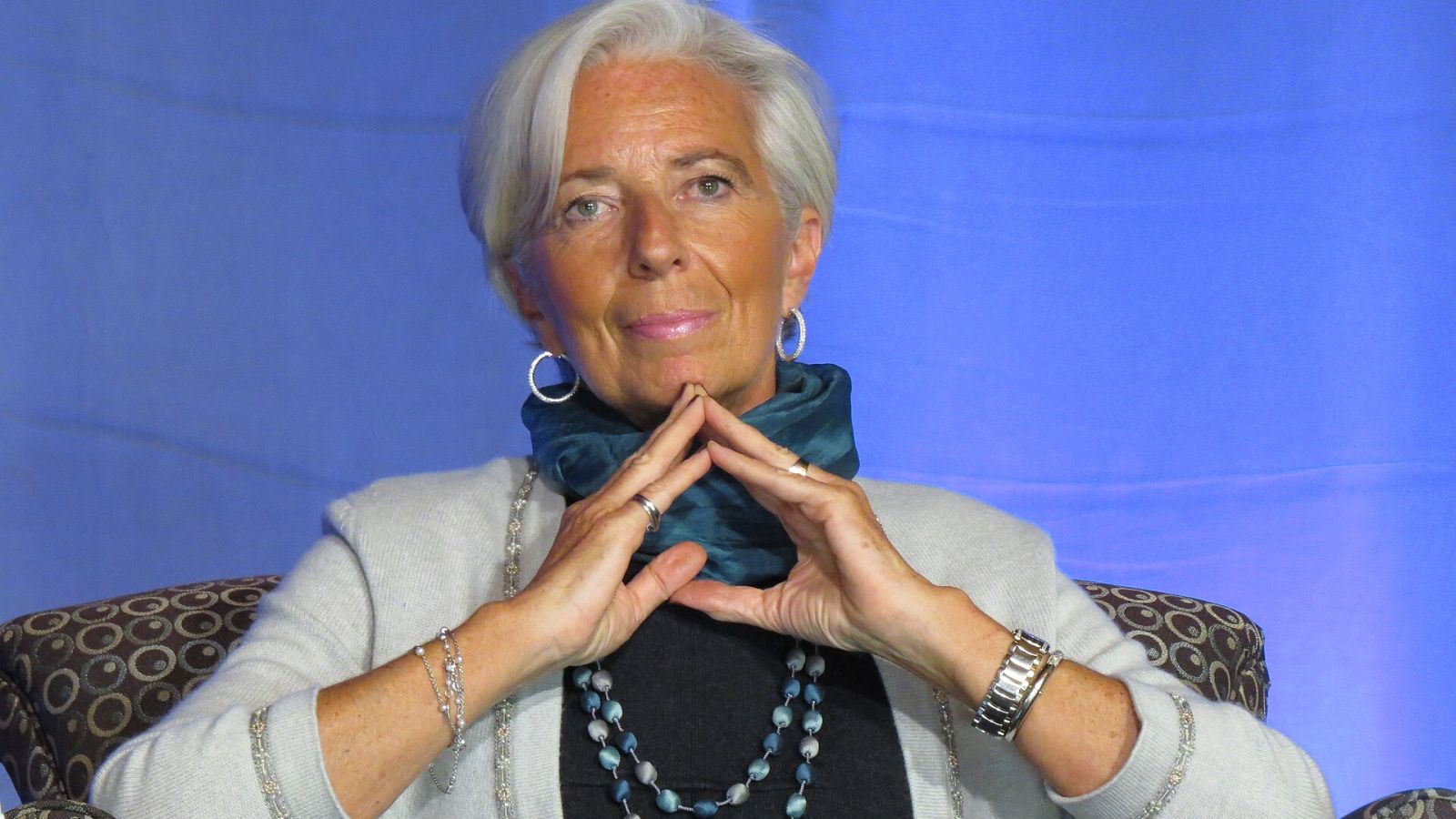
Christine Lagarde will leave the European Central Bank on 7 February 2027, nine months early, setting off a race to choose her successor.
Lagarde's eight-year term as president was due to end on 31 October 2027. Her early departure means new leadership for the council that decides interest rates across the 21 countries using the euro, while policy is still tightening.
She said she chose to leave so she could speak more freely about issues beyond monetary policy, including her ability to express herself and take part in discussions on other subjects.
The reason she gave was personal and specific. In her current post, she is bound to comment on the situation with monetary policy as the focus. She said she could no longer stay within that constraint.
I don't think that I can be comfortable in that neutrality at the present time.
She also addressed the obvious objection to any mid-term exit. There is never a good time to leave, she said, and she framed the decision as one of timing rather than of confidence in the bank.
There is never a good time to leave.
From Draghi's pledge to a pandemic stimulus
Lagarde was appointed in 2019 to succeed Mario Draghi. One source placed that appointment in 2011; the same outlet later published a correction saying she succeeded Draghi in 2019, not 2011.
Draghi pledged in 2012 to take any necessary action to protect the euro, easing bond-market turmoil and fears that the eurozone could split. Lagarde took over an institution that had made this commitment central to its approach to defending the currency.
In 2020, she made a defining choice: the bank used 1.35 trillion euros for emergency bond buying to keep the COVID-19 pandemic from choking off credit to the economy.
- 2019Appointed
Lagarde succeeds Mario Draghi as ECB president.
- 2020Pandemic stimulus
The bank deploys 1.35 trillion euros in emergency bond purchases.
- 3 January 2027Schnabel leaves
Executive board member Isabel Schnabel resigns to move to the International Monetary Fund.
- 7 February 2027Lagarde leaves
The president departs nine months before her term was due to end.
- 31 May 2027Lane's term ends
Chief economist Philip Lane's term expires.
- 31 October 2027Original term end
The end of Lagarde's eight-year term.
Three posts, one package deal
The selection began at once. European Council president Antonio Costa said the process would be initiated today and proceed without delay.
will be initiated today and will proceed without delay.
| Post | Holder | Departure |
|---|---|---|
| President | Christine Lagarde | 7 February 2027 |
| Executive board member | Isabel Schnabel | 3 January 2027 |
| Chief economist | Philip Lane | 31 May 2027 |
On 3 January, Isabel Schnabel will leave for a role at the International Monetary Fund, while chief economist Philip Lane's term ends on 31 May. European leaders are expected to negotiate a package for the three openings, dividing them among member countries rather than making appointments individually.
Holger Schmieding, chief economist at Berenberg bank, said EU leaders would probably try to settle the three appointments together ahead of a summit meeting on 17-18 December.
The frontrunners
The leading candidates for the presidency, Schmieding said, appeared to be Klaas Knot, former head of the Netherlands central bank, and Spain's Pablo Hernandez de Cos, general manager of the Bank for International Settlements. Both former central bank governors are widely seen as frontrunners.
Piet Haines Christiansen, an economist at Danske Bank, said the rumoured successors are both very competent, well established central bankers, so markets wouldn't be much moved by the choice.
The rumored successors are both very competent, well established central bankers, so for markets, it won’t matter too much.
Markets barely moved after the announcement. Goldman Sachs' head of Fixed Income Macro Investing, Simon Dangoor, said the ECB is firmly established and investors know how it operates.
Our view is that institutional behavior is likely to outlast Lagarde, and be quite similar, whoever takes over.
Schmieding said the early departure was expected and wouldn't change the outlook for ECB policies.
That she leaves early is no surprise and does not change the outlook for ECB policies.
An inflation fight left unfinished
To prevent a surge in oil costs tied to the Iran war from pushing up prices and wages more broadly, the bank is raising rates. On Thursday, it left its benchmark interest rate unchanged at 2.5 percent.
With the US-Iran war driving up oil costs, annual inflation was 3.8 percent. Money markets priced in three further rate rises by the end of next year, taking the deposit rate to 3.25 percent.
Oliver Rakau at Oxford Economics said another rate increase in December could require little justification. Higher energy prices may prompt the ECB to raise its inflation forecast again.
There is likely a low bar to another hike in December, given the likelihood of another upward revision of the ECB’s inflation forecast due to higher energy prices.
France sets the political clock
The choice is entangled with French politics. Schmieding said EU leaders want some protection against the possibility that Marine Le Pen, the right-wing candidate, wins the French presidential election in April-May 2027.
Before he, the staunchly pro-European centrist, leaves the Elysee Palace and Lagarde's successor is chosen, Macron said European partners should arrange the succession in an orderly and balanced way.
Jean-Philippe Tanguy, who is drafting economic policy for her election manifesto, told Reuters the move disregarded the rule of law and was another insult. The response from Le Pen's camp was hostile.
If the impression arises that such a departure is timed around national elections, it damages trust in an institution that must stand above any domestic political calculation.
Markus Ferber, a German member of the European Parliament for the centre-right European People's Party, said stepping down early would be a poor message amid elevated inflation, unsettled bond markets and approaching elections.
Marcel Fratzscher, president of the German think-tank DIW, offered a different view. He told Reuters that Lagarde was showing a strong sense of responsibility towards Europe and that her early departure would let European governments and institutions select a successor committed to European values and the ECB's independence.
By leaving office early, Christine Lagarde gives European governments and institutions an opportunity to appoint a successor who will safeguard European values and protect the ECB's independence.
Bond pressure the next president inherits
A surge in government bond yields, especially in debt-laden France, has pushed up borrowing costs for households and businesses. France is now paying some of the highest yields in a quarter-century to raise money on bond markets. The premium investors demand to hold French debt over benchmark German bonds is larger than for any other eurozone country.
The ECB could first use flexible reinvestment to redirect bond proceeds from its asset-purchase programmes of the previous decade towards countries facing pressure. If needed, it could then turn to its Transmission Protection Instrument, an unused tool kept in reserve since its creation.
Lagarde sought to close off the question of drift in the interim. She said a process has already started to identify her successor and there are plenty of excellent candidates.
Don't worry about decision making in limbo — no, absolutely not.
The institution, she said, is solid and strong and will continue to be so.
What we know
- Lagarde leaves on 7 February 2027.
- The ECB held its benchmark rate at 2.5 percent.
- Annual inflation was 3.8 percent.
- The bank deployed 1.35 trillion euros in pandemic-era stimulus.
Still unclear
- Who will succeed Lagarde as ECB president.
- Whether the three vacancies will be agreed before the 17-18 December summit.
- Whether the ECB raises rates again in December.
- Whether the ECB would activate its Transmission Protection Instrument if bond pressure builds.
EU leaders aim to settle all three ECB posts before or at the 17-18 December summit in 2026.