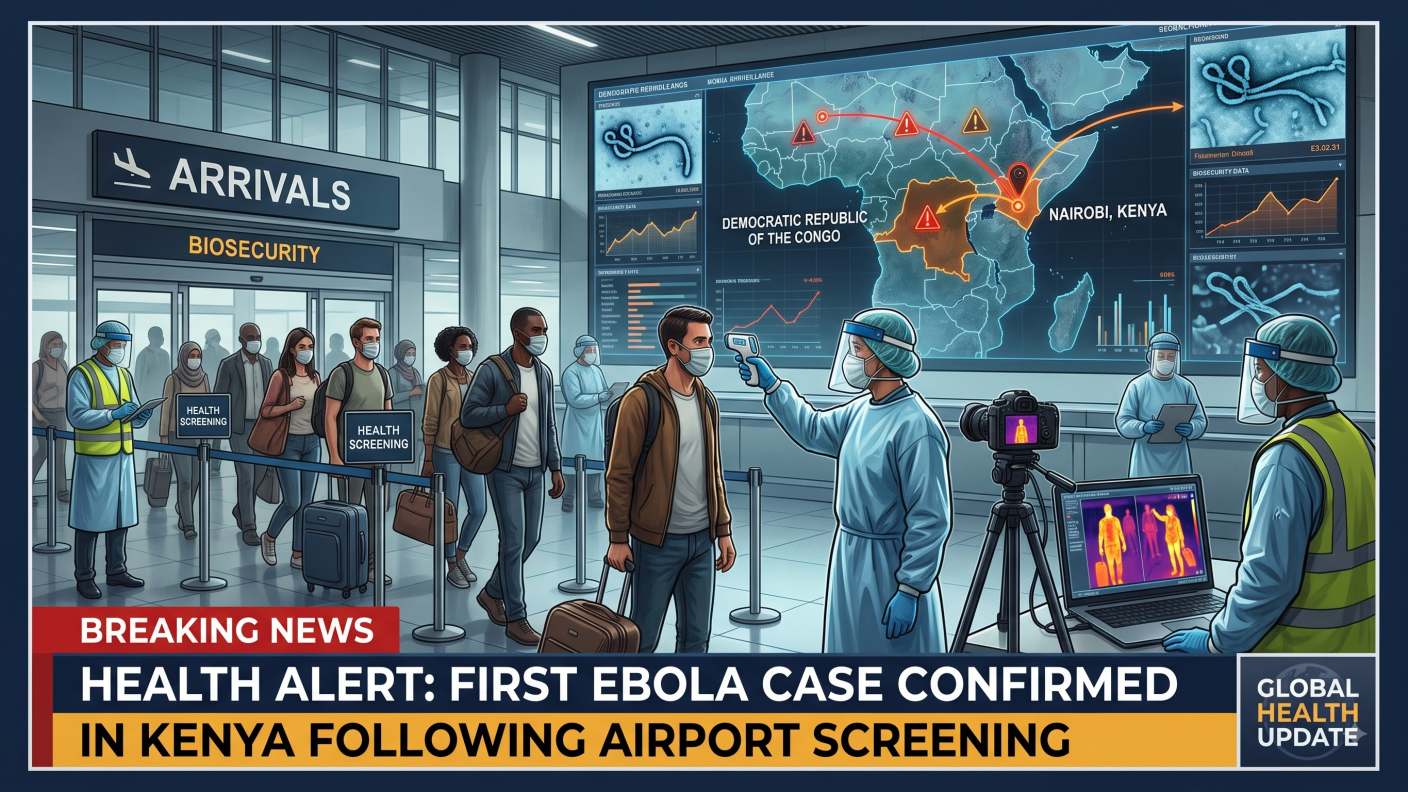
The first participant in the Tumaini Ebola vaccine trial was vaccinated on Friday, October 23, 2026, in Bunia, eastern DR Congo. Tumaini means “hope” in Swahili.
Bunia is the capital of northeastern Ituri province and the epicentre of the outbreak. DR Congo declared its 17th Ebola outbreak on May 15, and the World Health Organization triggered a public health emergency of international concern two days later.
- May 15Outbreak declared
DR Congo declared its 17th Ebola outbreak.
- May 17Emergency triggered
The WHO triggered a public health emergency of international concern.
- October 20Latest WHO figures
Congo had recorded 9,704 confirmed cases and 4,687 deaths.
- October 23, 2026Trial begins
The first participant was vaccinated in Bunia.
As of October 20, Congo had 9,704 confirmed cases and 4,687 deaths, the WHO said. It is the largest Ebola outbreak ever recorded in Congo, regardless of the virus species involved.
The epidemic is being driven by the Bundibugyo species of Ebola. The virus spreads through contact with bodily fluids and causes haemorrhagic fever. More than 15,000 people in Africa have died from Ebola during the past 50 years, while the Bundibugyo species has no approved vaccine or treatment.
The initial phase of the trial is deploying specific Bundibugyo vaccine candidates developed to directly target the surface proteins of this particular virus strain. Public health authorities are administering these alongside evaluations of existing vaccines like Merck & Co.'s Ervebo to determine if any cross-protective immunity can be achieved against the Bundibugyo virus species.
Vaccines being used or prepared
Ervebo
Merck & Co.
Approved vaccine
- Approved against Zaire Ebola strain
- First shot given in the Tumaini trial
- Testing for cross-protective immunity
Bundibugyo candidates
Oxford and Moderna
Candidates under preparation
- Designed specifically for Bundibugyo strain
- Expected to enter trial tracks within weeks
- Funded by CEPI for targeted Phase 2/3 trials
Tumaini is a single trial framework that can examine the safety, efficacy and immunogenicity of multiple vaccines. This allows the study to test more than one candidate within the same overall trial rather than creating a separate framework for each vaccine.
The study uses ring vaccination. Under this approach, people who have had contact with cases and are judged to face a high risk of infection are immunised. Pregnant women and children aged 12 years and older will take part in the trial.
What we know
- Tumaini can test multiple vaccines under one trial framework.
- The study uses ring vaccination for high-risk contacts.
- Pregnant women and children aged 12 years and older will be included.
Still unclear
- Whether Ervebo offers cross-protection against Bundibugyo virus.
- Whether any candidate vaccine will prove safe and effective against Bundibugyo virus.
- Exactly when the Moderna and Oxford candidates will enter the trial.
Two vaccines designed specifically for Bundibugyo Ebola are being prepared. One is a ChAdOx1 adenoviral vector vaccine from the University of Oxford. The other is an mRNA vaccine from Moderna.
The Coalition for Epidemic Preparedness Innovations is funding both candidates. They are expected to enter the trial shortly, and the Moderna and Oxford candidates could be tested in the study within weeks. The Oxford candidate is also being developed with the Serum Institute of India.
Richard Hatchett, Chief Executive Officer of the Coalition for Epidemic Preparedness Innovations, said: “I’m pretty confident that we have the window because the outbreak is not being brought under control”.
The continuing outbreak is also relevant beyond Congo. Infections linked to it have been detected outside the country, although the full extent of those infections is not known.
The trial is intended to determine whether the candidates work against the virus. Tedros Adhanom Ghebreyesus, WHO chief, said: “This trial will help us understand whether any of the vaccine candidates designed for Bundibugyo virus work”.
Chikwe Ihekweazu, WHO emergencies director, said: “If successful, this would be the first time we have clear evidence of vaccine efficacy against Bundibugyo virus — a major advance that could transform how we respond to this outbreak and prepare for future outbreaks and help save lives”.
Steve Ahuka-Mundeke, the DRC Ebola response incident manager, said: “Bringing this trial into the Ebola response is an important step towards addressing the urgent needs of affected communities”.
The Coalition for Epidemic Preparedness Innovations said Tumaini will generate evidence on vaccine performance by working with outbreak response partners, health authorities and affected communities.
The WHO said one account described the outbreak as having passed 9,700 cases and 4,600 deaths, while its figures, which have a stated cutoff of October 20, give the more precise totals of 9,704 confirmed cases and 4,687 deaths.
The sources also used different wording for the launch date. One said the first participant was vaccinated on Friday, while another identified the day as Friday, October 23, 2026. The trial’s first vaccination therefore took place on that Friday.
The Oxford and Moderna Bundibugyo-specific candidates are expected to enter the study within weeks, but no exact date has been given.