AMD guided fourth-quarter revenue to about $17 billion on 3 November, above analyst estimates, after record data-centre sales lifted third-quarter results.
Forecast guidance of about $17 billion carries a margin of 3% either side. Analysts polled by LSEG had expected $16.23 billion, and a second account of the same consensus put the figure at about $16.3 billion.
Third-quarter revenue reached $13.38 billion, up 45% and topping the $13.09 billion estimate. Adjusted profit came to $2.09 a share, above the $1.95 expected, or $1.97 in a second tally of the same estimate.
Data centre did the lifting. Sales of accelerators and server processors nearly doubled, rising 97% to a record $8.55 billion, above an $8.20 billion estimate.
Client and gaming, the segment that houses PC chips and console processors, went the other way. Sales fell 8% to $3.72 billion, short of the $3.79 billion analysts had forecast.
The mix shift is thinning margins. AMD guided fourth-quarter adjusted gross margin to about 55%, in line with the 55.27% analysts expected but down from 56% in the third quarter.
| AMD | Analyst estimate | |
|---|---|---|
| Revenue, third quarter | $13.38 billion | $13.09 billion |
| Data centre, third quarter | $8.55 billion | $8.20 billion |
| Client and gaming, third quarter | $3.72 billion | $3.79 billion |
| Adjusted profit per share, third quarter | $2.09 | $1.95 |
| Revenue, fourth-quarter guidance | About $17 billion | $16.23 billion |
| Adjusted gross margin, fourth-quarter guidance | About 55% | 55.27% |
Accounts of the same results differ only in rounding. Third-quarter revenue also appeared as $13.4 billion, data-centre sales as $8.5 billion and client and gaming sales as $3.7 billion.
Values in $bn
Source: AMD
Record data-centre sales carry the quarter
Demand reflects a shift in AI workloads. Models are increasingly run in real-world applications, not just trained, pulling through both graphics processors and central processors.
AMD has changed its sales approach, too. It now challenges Nvidia with integrated rack-scale systems that combine accelerators and servers in one unit, rather than offering only individual chips.
Helios is its flagship: a rack pairing the MI455X accelerator with new "Venice" server chips. The design is in production, with a larger ramp-up set for the fourth quarter. The first systems are being tested at Meta.
Our fourth-quarter outlook reflects accelerating revenue and earnings growth, driven by strong demand across our data centre portfolio
On the same call, Chief executive Lisa Su looked further ahead. She told analysts AMD expects overall revenue to rise more than 80% in 2027, above the 77% growth analysts model, according to LSEG data.
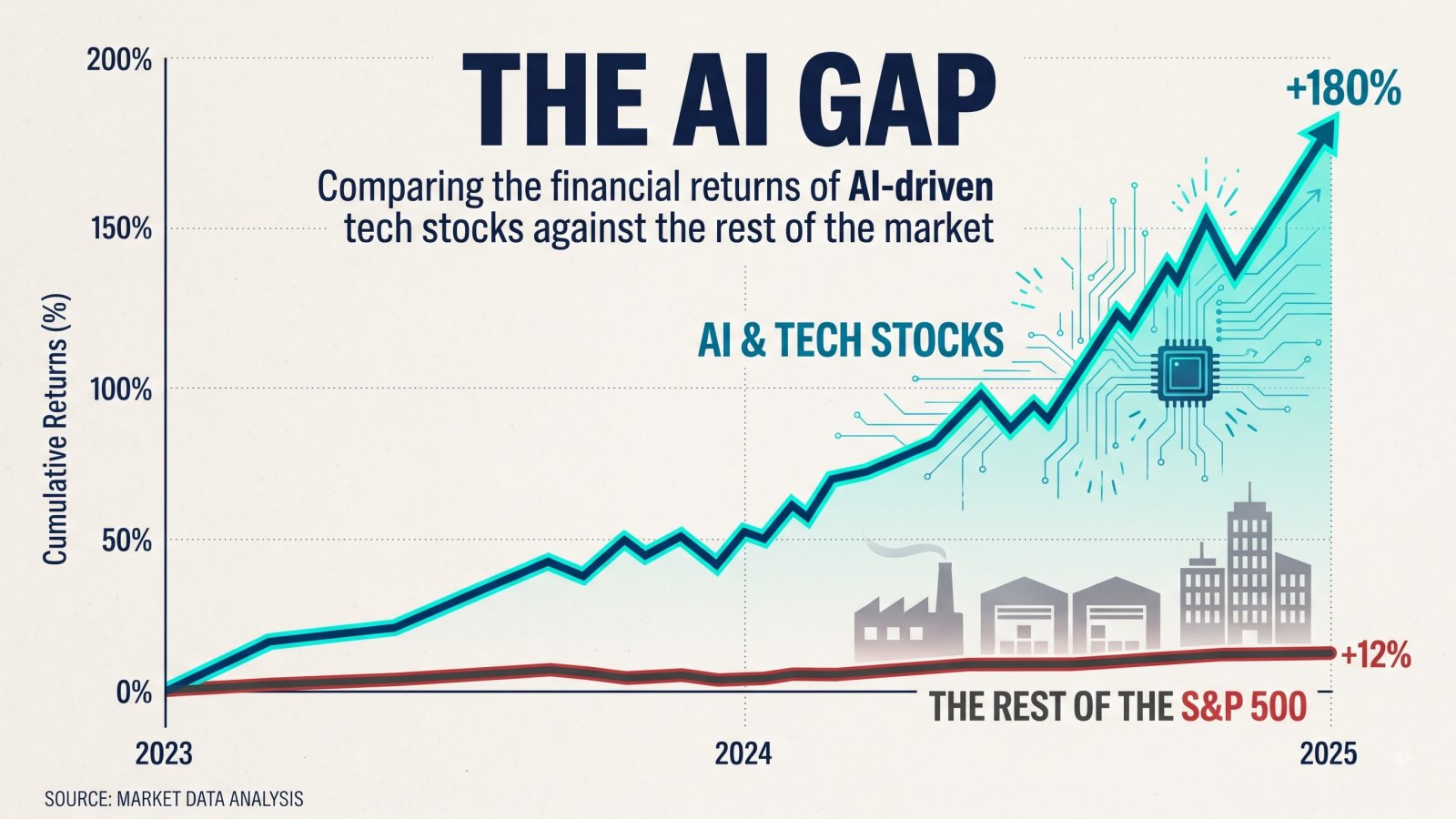
The run-up has been steep. AMD's stock more than doubled in 2026, and its valuation reached $1 trillion in September. According to the company, third-quarter sales were twice what they were two years ago.
Investors added to the move after the close. Shares jumped more than 8% in extended trading by one account, and by about 6% in late trading by another.
A memory shortage and a shrinking PC market
One constraint hangs over the accelerator ramp: a global memory shortage. High-bandwidth memory, the expensive stacked memory AI processors need, is in scarce supply as manufacturers race to add capacity.
Costlier memory has also held back PC production and weakened user demand, though data-centre growth has offset the slump so far. AMD expects PC unit shipments to fall by a double-digit percentage next year. Su said the company would "outperform the market" on that measure.
Intel's guidance points the other way
Intel guided its fourth-quarter chip revenue to a decline in the mid-20% range, with the slowdown expected to run into 2027. Its shares suffered their worst decline in decades after last week's report.
Revenue growth: AMD's 2027 guidance against Intel's outlook
AMD
Third-quarter revenue $13.38 billion
More than 80% growth
- Chief executive Lisa Su gave the figure for 2027
- Analysts model 77%, according to LSEG data
Intel
Chip revenue guided lower
Mid-20% decline
- Forecast covers the fourth quarter
- Company said the slowdown would last into 2027
The stock’s resilience despite broader pressure on AI-related names suggests investors see AMD’s results as confirming its technology leadership and its strong position to keep gaining market share
The AMD numbers provide a greatly needed boost both for AI infrastructure and even, to a smaller degree, the PC market
The beat and forecast also countered the argument that the AI boom is losing steam. They brought relief after Intel's weak outlook.
For weeks, investors had been selling chipmakers and other tech companies over concern about a bubble in AI infrastructure. The report gave them fresh evidence that spending is sustainable, one account concluded.
Nvidia still sets the pace
Nvidia remains far ahead of AMD in AI accelerators, the chips used to train and run models. The biggest chipmaker and the most valuable company in the world, Nvidia is quickly refreshing its line-up and branching into software, networking and complete computers. AMD is debuting new ranges in both CPUs and accelerators. With Helios, it takes Nvidia on more directly.
AMD struck a deal in February to supply Meta with AI chips worth as much as $60 billion over five years. The agreement allows the social media company to buy up to 10% of the semiconductor maker. In September, AMD agreed to buy World Labs for $8.2 billion in stock. Fei-Fei Li founded the startup, which builds artificial intelligence that models three-dimensional environments. The purchase gives AMD a position in research on physical AI systems.
Peers moved with it. Intel's shares rose 2%, Nvidia climbed more than 1% and Broadcom added 1.2%.
What to watch is memory supply, which governs how fast the accelerator ramp can run, and how deep the PC decline goes next year.
What we know
- Fourth-quarter revenue was guided to about $17 billion, plus or minus 3%.
- Data-centre revenue rose 97% to a record $8.55 billion in the third quarter.
- AMD guided 2027 revenue growth above 80%, against a 77% analyst model.
Still unclear
- Whether AMD can secure enough high-bandwidth memory for its AI processors while the global shortage persists.
- How far PC unit shipments will fall next year beyond the double-digit percentage AMD expects.
- Whether the AI infrastructure spending boom continues or gives way to the correction investors have feared.