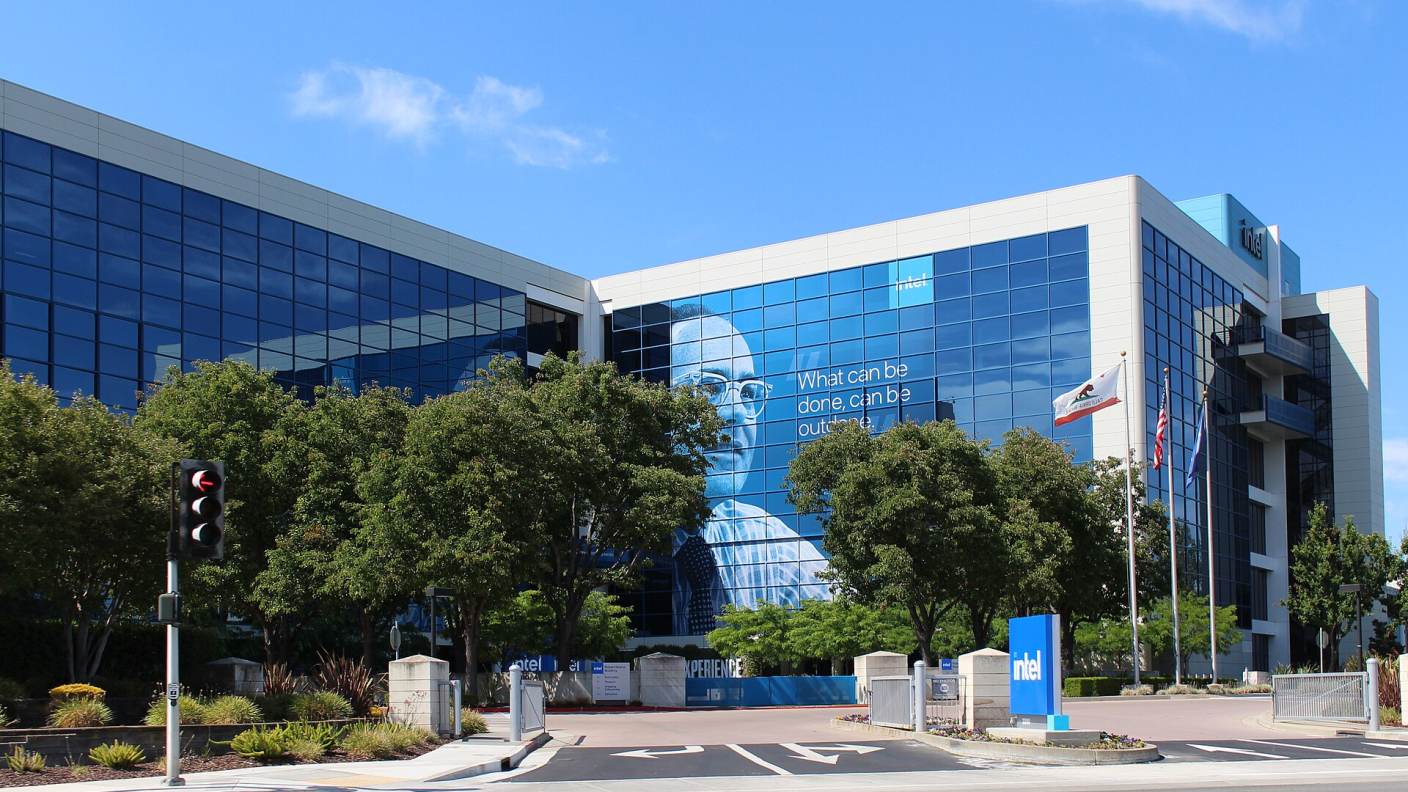
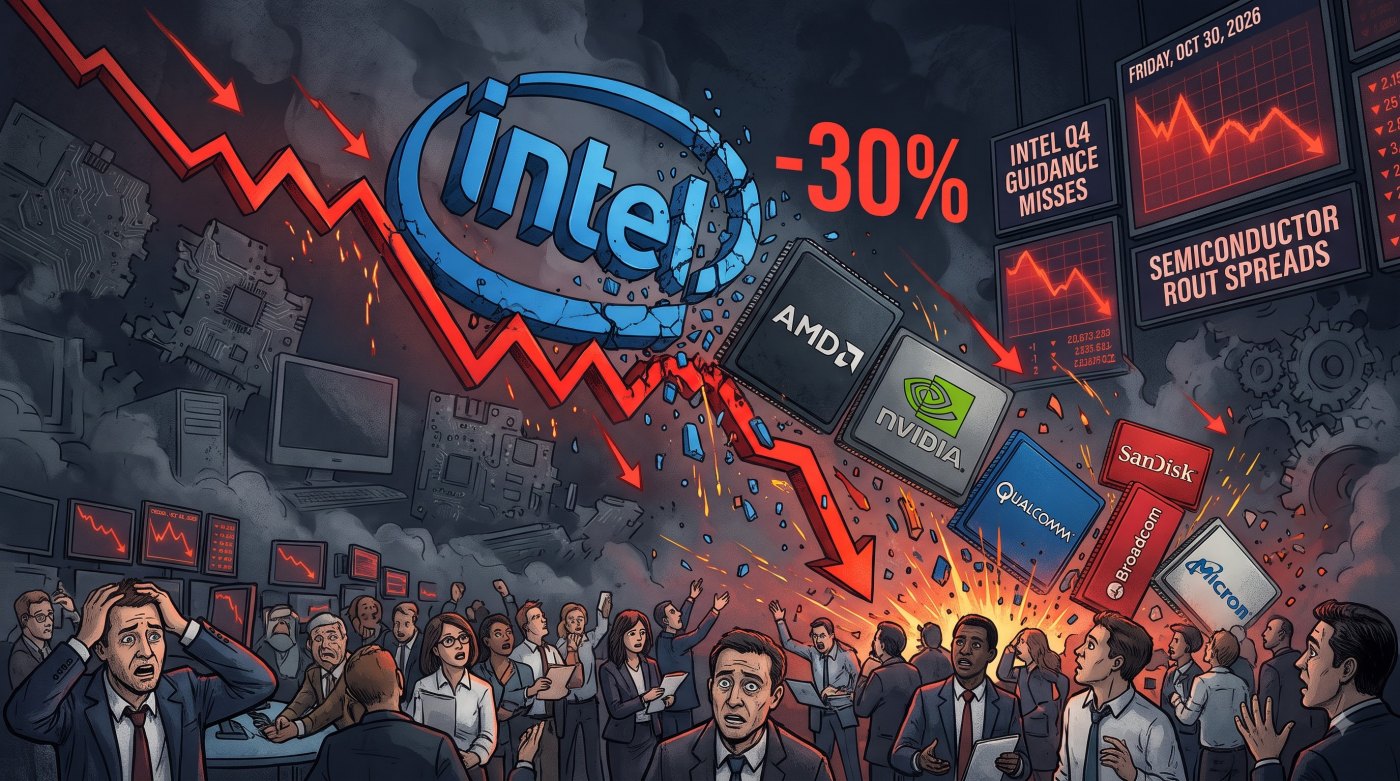
In a single session, Intel lost roughly a third of its value. The chip industry followed it down, from Asia to Europe to the US.
On Friday 30 October 2026, Intel shares plunged about 30% after the company projected weak fourth-quarter revenue and said cash flow was expected to turn negative for the year. The sell-off wiped more than $146 billion off its market capitalisation, sending the stock to $65.
The losses spread across the sector: AMD and Qualcomm each fell 12%, while SanDisk shed 9.7%, Broadcom lost 5%, Nvidia declined 4.86%, Micron Technology fell 4% and Amazon slipped 2%.
| Company | Friday decline |
|---|---|
| Intel | about 30% |
| AMD | 12% |
| Qualcomm | 12% |
| SanDisk | 9.7% |
| Broadcom | 5% |
| Nvidia | 4.86% |
| Micron Technology | 4% |
| Amazon | 2% |
For the December quarter, Intel's guidance set revenue at $15 billion to $16 billion, below the $17.07 billion analysts had expected. Adjusted earnings per share of $0.25 also missed the $0.43 consensus.
The company said it expects its gross profit margin to decline to 37% from 43%.
A strong quarter, a poor outlook
Third-quarter revenue climbed to $16.5 billion, up 21% from a year earlier. Non-GAAP earnings per share rose 126% to $0.52.
Intel's data-centre and AI business generated $7.3 billion, up 78% from a year earlier. Client computing and physical AI revenue went the other way, falling 5% to $8.1 billion.
Strength against guidance
Third quarter
Reported results
- Revenue up 21% to $16.5bn
- Non-GAAP EPS up 126% to $0.52
- Data-centre and AI revenue up 78% to $7.3bn
- Client computing down 5% to $8.1bn
Fourth quarter
Guided
- Revenue of $15bn to $16bn
- Adjusted EPS of $0.25
- Gross margin of 37%
- PC segment sales down more than 20% sequentially
About half of Intel's third-quarter revenue came from its PC chip business. Sales in the business fell 5% in the September quarter, and Intel expects them to drop by more than 20% this quarter compared with the previous quarter.
Intel linked its outlook to manufacturing capacity limits, weaker PC demand and rising memory costs. It expects the market downturn to continue through the first half of 2027.
Manufacturing and advanced packaging bottlenecks are holding back strong demand for data-centre processors. A disruption at Intel's Israeli facility has added to the pressure.
What the CEO and CFO said
Chief executive Lip-Bu Tan said customers had begun warning of a PC slowdown as memory prices and availability shifted. Year-to-date system endpoint prices have risen sharply, adding pressure to already limited IT budgets.
Our customers began signaling a PC slowdown based on the memory prices and availability. Year-to-date system endpoint prices have increased significantly, placing additional pressure on already limited IT budgets
Chief financial officer David Zinsner gave the timeline a date.
We see the PC slowdown continuing at least through the first half of next year
Industry shipment data points the same way. Global PC shipments fell 21% in the third quarter compared with last year, Counterpoint Research said, which forecasts a 27% year-over-year drop this quarter.
Cash, debt and the government's stake
Citing heavy investment in manufacturing and AI, Intel expects free cash flow to remain negative in 2026. Its latest balance sheet showed $21.85 billion in cash and cash equivalents and $50.13 billion in total debt.
The rout cut the value of the US government's holdings by $12 billion. More than a year ago, the Trump administration had the government buy a 10% stake.
To date, the government's investment in Intel remains profitable. Shares have gained 66% in 2026 and are up more than 70% for the year.
Wall Street splits on the target price
Bank of America shifted its Intel rating from Buy to Neutral, lowering its price target to $100 from $145. Roth Capital also changed its rating from Buy to Neutral, reducing its target to $70 from $120.
Susquehanna kept its rating at Neutral but cut its target to $75 from $105. Cantor Fitzgerald also maintained a Neutral rating, lowering its target to $90 from $125.
Two houses held their ground. KeyBanc kept an Overweight rating and lowered its target from $155 to $140. Evercore ISI retained its Outperform rating with a $131 target.
Price targets after the print
Cutting
Downgrades and reductions
- Bank of America: Neutral, $145 to $100
- Roth Capital: Neutral, $120 to $70
- Susquehanna: Neutral, $105 to $75
- Cantor Fitzgerald: Neutral, $125 to $90
Holding
Ratings kept
- KeyBanc: Overweight, $155 to $140
- Evercore ISI: Outperform, $131 target
Investors disagree on whether Intel's setback is a temporary disruption or a more serious threat to its recovery. They also differ on whether the market has already accounted for much of the challenge or whether the worsening near-term outlook points to further losses.
A memory rival and a quantum deal
Chip stocks faced another bout of selling in Friday's trade after China's ChangXin Memory Technologies reported a sharp rise in profits.
CXMT reported third-quarter revenue of 118.71 billion yuan, more than sevenfold higher than a year earlier and up 19.3% from the previous quarter, driven by strong memory-chip demand and tight global supplies.
In the three months to 30 September, net profit attributable to shareholders was 54.4 billion yuan, compared with a loss a year earlier. Profit rose about 3% from the previous quarter. Revenue for the first three quarters of 2026 totalled 269.02 billion yuan, while net profit was 132.04 billion yuan, reversing a loss of about 5.3 billion yuan in the same period last year.
Separately, Intel said it plans to buy Israeli quantum company Classiq to build a full-stack quantum computing platform. The company has been investing in the technology since 2015.
Zinsner said management is looking past the current quarter.
We remain optimistic about the opportunities across our broader portfolio, and we will continue making disciplined investments in capacity and working capital to increase supply and support future growth.
The test ahead
Analysts are watching whether Intel can add server processor capacity, improve yields and win external foundry customers against Taiwan Semiconductor Manufacturing Co. Intel says it's making progress with its Intel 18A manufacturing technology and expanding relationships with cloud computing providers.
Management points to the first half of 2027 as when the PC slowdown may ease. That’s the next dated checkpoint for deciding whether this was a one-quarter reset or a longer slide.
What we know
- Intel shares fell about 30% on Friday 30 October 2026.
- Intel guided fourth-quarter revenue to $15 billion to $16 billion.
- Intel expects to report no positive free cash flow in 2026.
Still unclear
- Whether further losses are justified or much of the challenge is already priced in.
- Whether Intel can lift server chip output, improve yields and win enough foundry customers to change its earnings trajectory.
- The exact closing decline, which sources put between 28% and 30%.