Apollo Global Management economist Torsten Slok says AI has delivered no financial return to US companies outside the tech industry.
Slok published the note on 24 October 2026 as investors assessed whether the large sums committed to artificial intelligence could eventually produce profits.
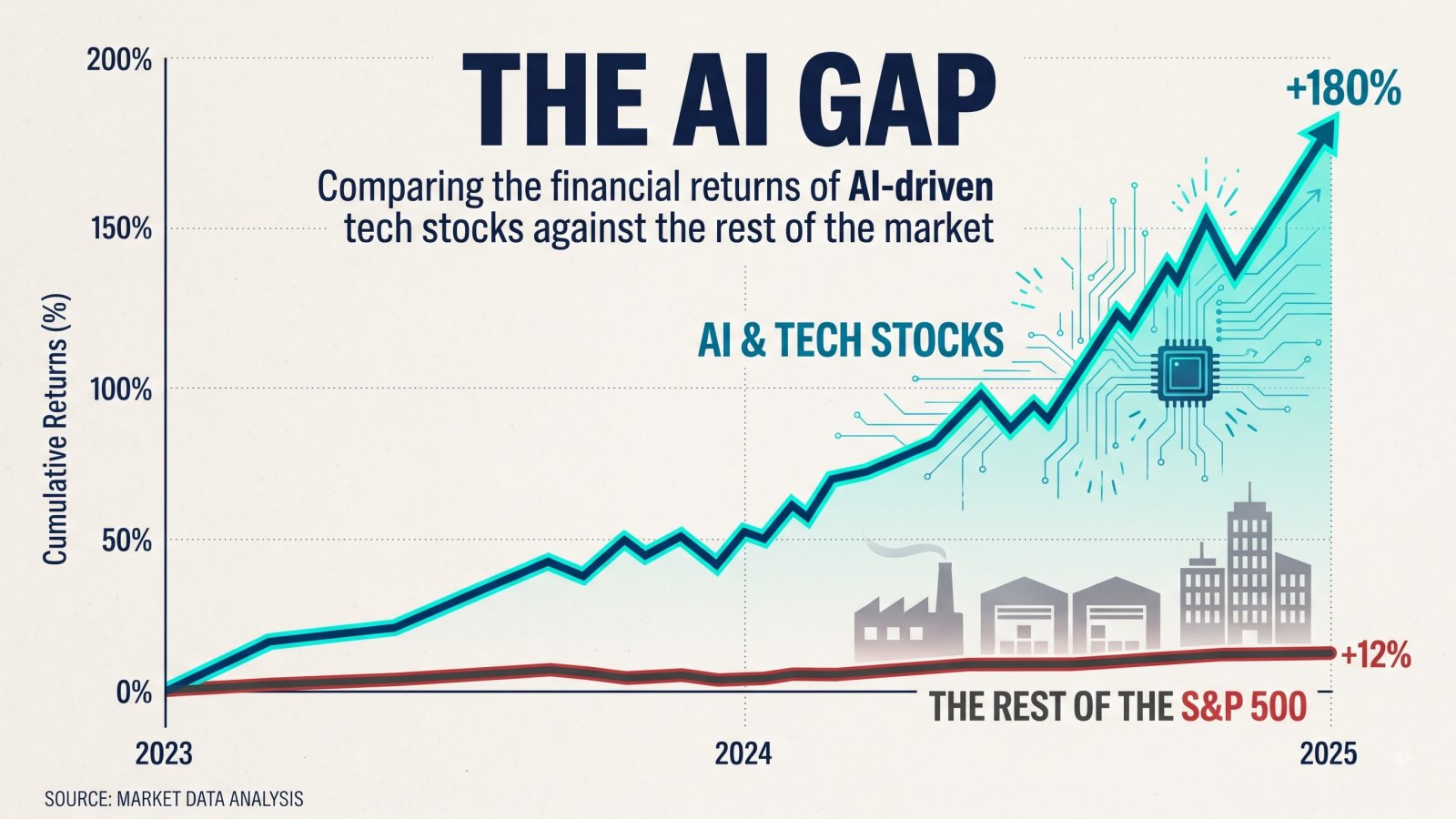
His comparison separates the Magnificent Seven from the rest of the S&P 500. It comes as technology companies promote AI-led growth while questions persist about its effects across the wider corporate economy.
"Despite massive investments and widespread hype around artificial intelligence, the technology has delivered zero financial payoff to corporate America outside of tech"
Slok said his analysis creates an S&P 493 comparison by excluding seven companies from the S&P 500: Tesla, Nvidia, Microsoft, Meta, Apple, Amazon and Alphabet.
The Magnificent Seven versus the S&P 493
Magnificent Seven
Seven major technology companies
Rising revenue per worker
- Includes Alphabet, Amazon, Apple, Meta, Microsoft, Nvidia and Tesla
S&P 493
The other companies in the S&P 500
Flat revenue per worker
- Profit margins look flat
- No sign that AI is lifting productivity
Profit margins and revenue per worker seem unchanged among the S&P 493, offering no sign that AI is improving productivity. Revenue per worker is rising for the Magnificent Seven but remains flat for the S&P 493, Slok said.
Technology executives and investors were counting on AI to produce a productivity boom and substantial corporate profits, The Indian Express said. That case had been harder to make outside the technology sector, while several studies found that enterprise AI adoption had yet to deliver significant productivity gains.
The AI build-out carries a large financial risk
Big Tech plans to spend $650 billion this year on its AI build-out. Gartner estimates that more than $3.5 trillion of AI infrastructure spending could be at risk of impairment by 2030 if revenue from AI does not support the investment.
Meta said after reporting earnings that it expected to become more aggressive with AI-related capital expenditure. The announcement sent its shares down.
Meta spent $34.9 billion on capital expenditure in its third quarter and reported negative free cash flow of $2.1 billion. The figures show how the investment push can increase pressure on cash even at one of the companies driving the AI expansion.
Meta chief executive Mark Zuckerberg promoted the Muse AI model on the company’s earnings call. PYMNTS said more than 10 million people in the United States and Canada had set it up in six weeks, with about a quarter using it daily.
Whether Muse can generate enough revenue to justify Meta’s AI spending remains unproven, PYMNTS wrote.
The concern extends beyond individual technology companies. Nvidia-backed cloud company CoreWeave is loss-making and carries about $50 billion in debt, while the data-centre boom has raised worries about credit-funded growth, pressure on newer businesses and cash-flow strain at Alphabet and Meta, The Indian Express reported.
Investor resistance has also appeared in the data-centre market. Investors balked at Firmus Grid’s targeted $30 billion valuation, causing the initial public offering of the Australian data-centre company to collapse. Data-centre developer Nscale is facing investor protest over the proposed value of its listing.
Adoption is rising but control remains limited
- 2025Limited agent use
Only 7% of surveyed executives were using or piloting AI agents, while 67% said they would not give agents access to company systems.
- 2026Broader reported adoption
Some form of agent use was reported by 89% of executives, and only 2% said they would deny agents access.
- Earnings seasonReturns under scrutiny
Investors are watching AI spending and returns as earnings season gets under way.
PYMNTS Intelligence found that in 2025 only 7% of surveyed executives were using or piloting AI agents. At the time, 67% said they would not grant agents access to company systems.
In at least one part of their business, agents were being used by 89% of executives by 2026, while only 2% said they would deny them access, PYMNTS Intelligence said.
"Most companies have let agents in the door but haven’t let them do much yet. Seventy-eight percent would let agents read company systems but not act on them. Another 18% would let agents carry out tasks with a human’s approval. Just 2% would let agents run routine work on their own."
Slok said mainstream corporate America did not need the newest AI model and was unwilling to pay for it. Companies had begun pulling back and treating token spending as a cost centre that weighed on margins instead of creating growth.
"As long as agentic AI and token spending are confined to a small part of the economy, the macroeconomic effects of AI will be very limited"
Slok said companies would struggle to turn cheaper intelligence into stronger revenue growth and wider profit margins and that "AI may be a great calculator, but in business, intelligence is mostly judgment".
Slok added: "AI does not understand accountability, trust, culture, unwritten rules, ethical trade-offs or fairness, all of which shape reputational risk and ultimately drive revenue growth and profit margins."
The timing and scale of any AI profit payoff remain unresolved. It is also unclear whether companies outside technology are simply lagging the tech giants, or whether Meta’s Muse model can generate enough revenue to justify its spending.
Investors will receive further evidence as earnings season continues, while questions remain about whether and when the massive AI spending will translate into profits.