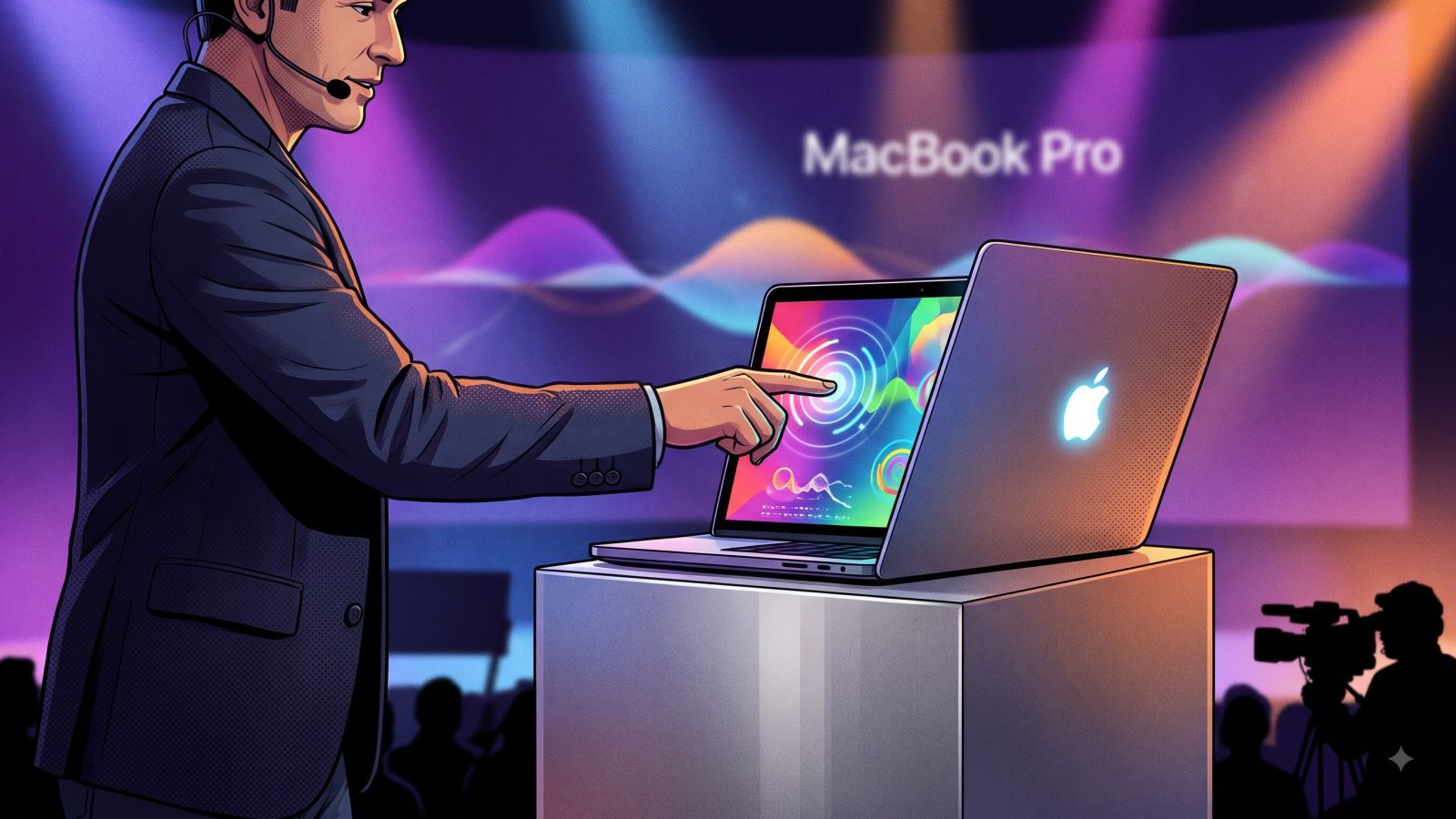
For the first time, Apple has put a touchscreen on the MacBook Pro, reversing a long public refusal. It starts at about $2,899.
At an event in Los Angeles on Oct 28, Apple unveiled the MacBook Pro with PROLED XDR Display. The machine is the first MacBook with a touchscreen, and the glowing logo is coming back on the lid. John Ternus, Apple's new chief executive, said the company would return to the illuminated logo on the back of the laptops.
The laptop comes in 14-inch and 16-inch versions, running on Apple's M5 Pro or M5 Max chips. Pre-orders opened the day of the announcement, and the first machines reach buyers on Nov 6.
What the machine costs
Starting prices for the new line differ across the outlets that reported it on launch day. Slashgear put the base 14-inch M5 Pro at $2,899 and the 16-inch variant at $3,399, with M5 Max models at $4,499 and $4,799. The Straits Times gave the same entry point of US$2,899 for the 14-inch M5 Pro and put the highest-end 16-inch M5 Max configuration at US$4,799. CNN reported $2,899 for the 14-inch and $3,399 for the 16-inch.
iTnews reported Australian starting prices of A$4,599 for the 14-inch M5 Pro model and A$7,699 for the highest-end 16-inch M5 Max configuration. These Australian-dollar prices should not be directly compared with US-dollar prices without clearly identifying the currencies.
| Outlet | 14-inch M5 Pro | 16-inch / M5 Max |
|---|---|---|
| CNN | $2,899 | $3,399 (16-inch) |
| Cybernews | $2899 | $4,800 (16-inch M5 Max) |
| iTnews | $4599 | $7699 (highest-end 16-inch M5 Max) |
| The Straits Times | US$2,899 | US$4,799 (highest-end 16-inch M5 Max) |
| Slashgear | $2,899 | $3,399 (16-inch), M5 Max $4,499 and $4,799 |
Equipped with 128GB of RAM, a 16TB SSD and nano-texture glass, the MacBook Pro M5 Max reaches $14,549, Slashgear reported. The outlet called it the most expensive laptop Apple has ever sold.
Although Apple's Oct 28 model is its least expensive, it costs more than a basic iPhone, MacBook and iPad with add-ons, plus an Apple Watch and AirPods, The Straits Times said.
The pitch is aimed at creators rather than the mass laptop buyer.
This is going to be towards creators, towards designers, towards photographers, people that are going to leverage that high fidelity screen, and who many of whom have grown up tapping on screens, editing on tablets, on phones, etc,
A small, cheap market Apple has never entered
Touchscreen laptops have been on sale for more than a decade. Microsoft made a major push with Windows 8 in 2012, but they remain a minority of the market. Research from the International Data Corporation put touchscreen devices at 16.3% of worldwide laptop shipments in 2025.
In 2025, IDC counted 33.4 million touchscreen notebooks shipped, up 22% from a year earlier and about 16% of all notebooks. The average selling price sat around US$1,009, far below Apple's new machines. Business buyers dominate that segment, where Lenovo, HP and Dell offer cheaper devices. Whether Apple can take share there, and how customers will respond to the touchscreen itself, are the two questions the launch leaves open.
The screen and the internals
With peak HDR and SDR brightness of up to 2,000 nits, the display uses Tandem OLED technology. The Dynamic Island, the pill-shaped cutout that tops iPhone screens, carries over to the laptop.
The touch sensor is built into the display, not placed in an extra layer above it, Apple said. It claims this reduces latency when users swipe or scroll. Many existing apps will also respond to touch immediately, since the software interprets a touch as a click.
Among the uses Apple is promoting: dragging and dropping slides between presentations, letting developers test how their apps behave under touch, and giving graphic designers and musicians a surface for sketches and virtual instruments.
You can expect an OLED to last as long as your typical LCD screen. Apple came out of the gate firing in terms of putting together both a very vibrant display and then adding the touch,
The 16-inch model weighs 0.7 pounds less than its older non-touchscreen counterpart. The battery is rated at 72.4Wh and advertised as lasting 24 hours, with a compatible fast charger taking it to 50% in 30 minutes. There are three Thunderbolt 5 ports, and the M5 Max variant supports up to four external displays.
M5 Pro vs M5 Max
M5 Pro
15- or 16-core CPU
- 16- or 20-core GPU
- 16-core Neural Engine
- 307GB/s memory bandwidth
M5 Max
18-core CPU
- 32- or 40-core GPU
- 16-core Neural Engine
- 460GB/s memory bandwidth
- Up to four external displays
Years of resistance to touchscreen Macs
For years, Apple argued that touch did not belong on a laptop. Steve Jobs said in 2010 that touchscreens on laptops were "ergonomically terrible". Tim Cook, then chief executive, compared such devices in 2012 to joining a toaster to a refrigerator, saying users would like them about as much.
The company did try once. In 2016 it put a touch-sensitive strip above the keyboard, the Touch Bar, and consumers largely ignored it because the extra cost did not buy enough usefulness. The Touch Bar is gone; the touchscreen is not.
Before becoming chief executive, Ternus argued that Apple already sold a touchscreen computer in the iPad. Since he took over, Apple has held several launches: the Oct 28 event, a folding iPhone called Duo unveiled in September at the company's Silicon Valley headquarters, and a smart home hub that debuted in New York earlier in October.
Look, we love the Mac, and it's the reason why so many of us found our way to Apple in the first place. And the Mac has never been better, and it's never been stronger,
One analyst said the resistance was a mistake all along.
I believe they were always wrong on pushing back on touch, and this is the long arm of reality setting in,
- 2010Jobs rejects touch
Steve Jobs calls touchscreens on laptops "ergonomically terrible".
- 2012Cook's toaster line
Tim Cook compares such devices to a toaster fused with a refrigerator.
- 2016The Touch Bar
Apple puts a touch-sensitive strip above the keyboard. It largely flops.
- Oct 28, 2026Touchscreen MacBook Pro
Apple unveils its first MacBook with a touchscreen, with pre-orders open.
- Nov 6On sale
The new MacBook Pro reaches customers.
Scepticism online
Reaction on social media was mixed at best. Some users doubted the demos would hold up in daily use.
Every demo I've seen there has had misinputs and glitches. This is the worst idea and worst implementation Apple has had in many, many years,
Others questioned the purpose rather than the execution.
From a marketing perspective, they still fail to explain why anyone would want a touchscreen Mac. Nothing has meaningfully changed from Steve saying it's pointless all those years ago,
Price drew its own complaints.
Maybe the price is silly, but at least you can leave more fingerprints on your laptop. Who is buying that?
I remember when laptops were getting cheaper and better for a while... How far we've fallen,
Though the Mac line has been selling better lately, much of the growth has come from technology enthusiasts and businesses buying machines to run AI tasks on-device, rather than from the general consumer.
What we know
- Pre-orders opened on Oct 28.
- Sales begin on Nov 6.
- The 14-inch M5 Pro model is the entry point of the line.
Still unclear
- How customers will respond to the touchscreen MacBook Pro.
- Whether Apple can take share from Lenovo, HP and Dell in the business segment where touchscreen devices sell for far less.
Sales begin on Nov 6, the first dated test of whether buyers agree with Apple's pricing.