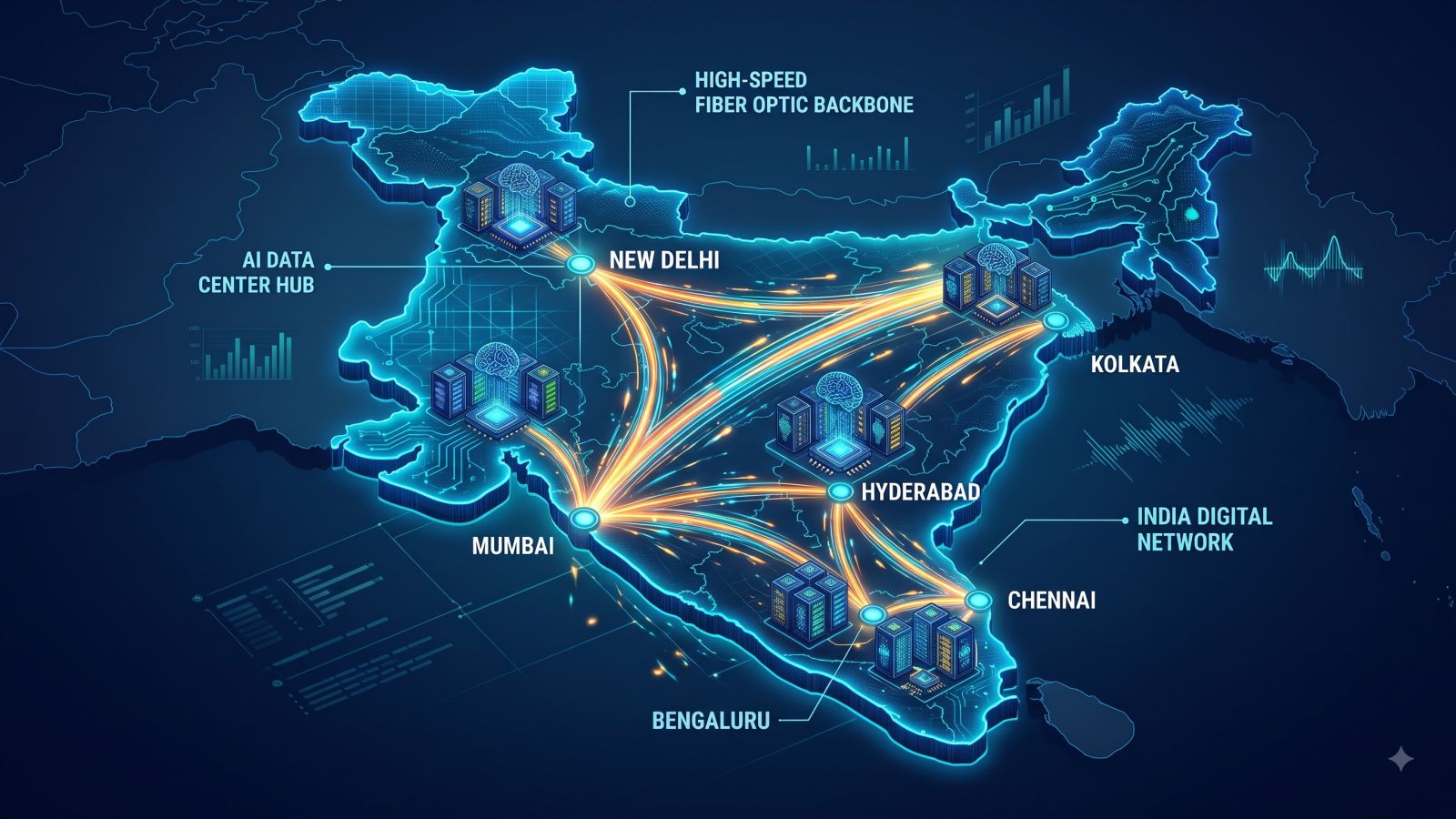
Tata Communications announced a $450 million plan to build 10,000 km of fibre linking India’s AI data-centre corridors.
This increase represents a significant expansion of the company's domestic infrastructure. The current network in India carries 1.25 petabits per second. The new construction will add about 6 petabits per second of capacity, according to the filing. This surge in bandwidth addresses the specific demands of modern computing workloads.
The AI economy needs more than compute. It needs a network built for speed, scale and resilience
Chokshi said artificial intelligence requires more than just processing power, emphasizing the need for a network designed for speed and resilience to support the unique requirements of AI applications.
The rollout will proceed in three distinct phases. The first phase focuses on the Mumbai-Pune-Hyderabad-Chennai corridor. This route connects major technology hubs in western and southern India. Subsequent phases will extend the reach to other regions.
Later stages will target data-centre ecosystems on the east coast and in western India. Specific locations include Vizag, Bhubaneswar, Jamnagar and GIFT City. These areas are becoming central to the country's digital infrastructure landscape. The phased approach allows for targeted deployment in high-demand zones.
The project aims to serve a diverse range of corporate clients. It will connect cloud services firms, global capability centres and banks to data-centre clusters. Global capability centres are the offshore hubs that multinational firms operate in India. These organisations require reliable, high-speed links to manage their data operations.
The company calls this system its AI Network Fabric. It connects data centre clusters with international cable landing stations to link Indian AI infrastructure to global markets, handling workloads that need high bandwidth, low latency and network resilience.
We are excited about the opportunity in the India data centre-to-data centre connectivity, which we believe could evolve into a market exceeding USD 1 billion over the medium term
Lakshminarayanan expressed optimism about the growth potential in this sector. He noted that the market for data centre-to-data centre connectivity in India could exceed $1 billion over the medium term. This projection underscores the strategic importance of the investment for the company.
Tata Communications expects the India data centre-to-data centre connectivity market to exceed $1 billion over the medium term. This forecast matches wider industry trends as local facilities expand to meet needs for cloud services, AI tools and domestic data storage, making links between sites vital for AI tasks.
Adani and Jabil previously revealed plans to manufacture data-centre hardware in the country, showing that other Indian groups are also putting money into AI infrastructure. Such moves underscore the rising rivalry among local conglomerates to back the fast-growing digital economy.
The new investment follows previous infrastructure agreements. Last year Tata Communications agreed to build an 18,000 km fibre network for Amazon Web Services. That project links sites in Mumbai, Hyderabad and Chennai and is due to be finished by the end of 2026. The current plan builds on this experience in constructing large-scale networks for major tech firms.
Reports state that Tata Communications will use operating cash flow to fund the project. This approach allows the company to rely on internal financial resources for the capital expenditure, avoiding external debt or equity issuance for the immediate build.
Lakshminarayanan said anchor customer commitments and contracted demand are fueling a larger portion of the company's growth, providing a foundation for capital deployment. One report noted that these customers have already committed to using the network, though their identities remain undisclosed.
New capacity is scheduled to come online during the financial years from 2030 to 2036. This timeline points to a long-term development schedule, but the start and completion dates for each phase have not been specified, nor is the volume of new capacity already contracted known.
What we know
- Tata Communications will invest close to $450 million.
- The network will span 10,000 km.
- The first phase covers the Mumbai-Pune-Hyderabad-Chennai corridor.
Still unclear
- Exact total cost varies between sources ($400-450m vs close to $450m).
- Identity of specific anchor customers.
- Start date of construction and completion date for each phase.
- Volume of new capacity already contracted.