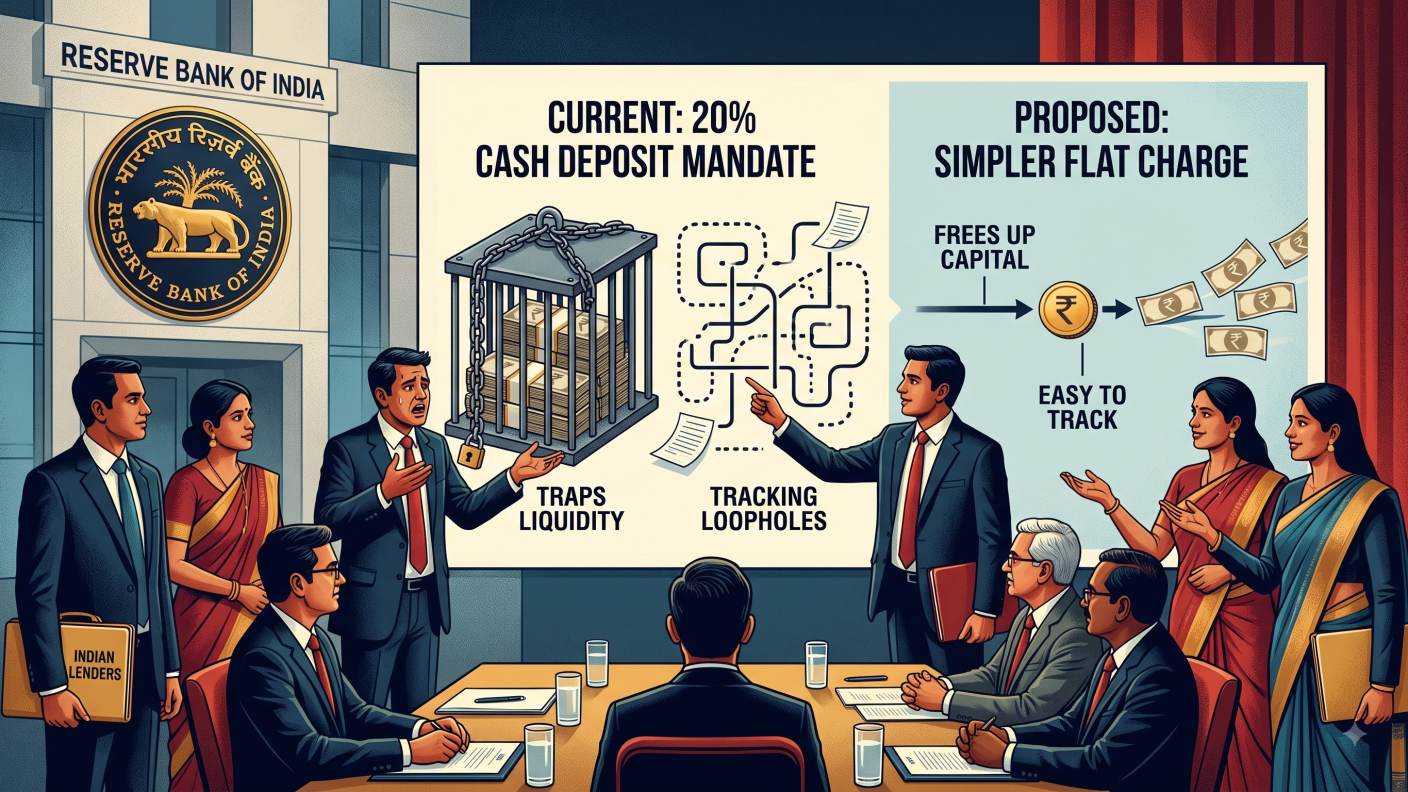
Indian lenders have asked the Reserve Bank to ease new rupee-defence measures by replacing a 20% cash deposit mandate with a simpler flat charge.
The request comes as banks warn the current threshold-based rule ties up critical treasury liquidity and may encourage companies to split transactions to avoid compliance. Clarifying these mechanics is vital for market stability as the rupee faces pressure from oil prices and capital outflows.
Banks have asked the Reserve Bank of India to relax a key measure introduced over the weekend to bolster the rupee. They also requested the removal of the threshold triggering the rule, four people familiar with the discussions said.
Lenders approached the central bank through a forex industry body. They sought to eliminate a mandate requiring banks to park 20% of the value of FX derivatives used for current-account hedging as cash with the RBI.
The RBI announced its measures on Saturday. The steps intend to reduce corporate appetite for forward dollars, which has strained the rupee. Steep oil prices and capital outflows have driven the currency lower.
Regulatory moves prompted the rupee to rise 1% on Monday. It opened 80 paise higher amid intervention by the RBI. Year-to-date, the currency has fallen more than 6 per cent due to capital outflows and oil prices.
"Instead of that (the 20% reserve) just directly imposing a higher charge, say in paisa terms, removes a lot of friction"
Banks proposed that the RBI substitute the 20% deposit rule with a flat fee for firms hedging current-account exposures via forward dollar buys or other derivatives. Lenders argue this change would increase hedging costs without locking up rupee liquidity in treasury operations.
Banks also asked to remove the $2 million threshold activating the deposit requirement. They warned this limit might prompt firms to divide hedges into smaller tranches, making such practices hard to monitor since bankers may not question clients booking multiple small transactions, they said.
What we know
- Banks urge RBI to ease measures and scrap the threshold for the 20% deposit.
- Banks propose a flat charge to raise costs without tying up rupee liquidity.
- Lenders seek removal of the $2 million threshold to prevent hedge splitting.
Still unclear
- Whether the RBI will ease the 20% cash deposit mandate or scrap the threshold.
- Whether the deposit requirement applies to hedges against interest payments on foreign-currency loans.
- The RBI's official response to the banks' proposals.
A banker who attended Sunday's Foreign Exchange Dealers' Association of India meeting said banks will pass costs to clients. Lenders have asked if the 20% deposit rule applies to hedges covering interest payments on foreign-currency loans.
Lenders are seeking clarity on whether interest payments will be exempted, as the rules do not cover hedging for principal repayments on overseas loans. The RBI's measures also included redirecting oil companies' dollar demand away from the spot market.
An email requesting comment drew no immediate response from the RBI.
Liquidity impact and market reaction
Citi economists estimate that liquidity absorption will range from ₹60,000 crore to ₹70,000 crore, or $6.27 billion to $7.31 billion, even if importer hedging drops significantly.
Rupee performance comparison
Monday reaction
Immediate impact
+1%
- Rupee jumped 1%
- Appreciated 80 paise at open
Year-to-date
Longer trend
-6%
- Down over 6 per cent
- Rocked by oil prices and outflows