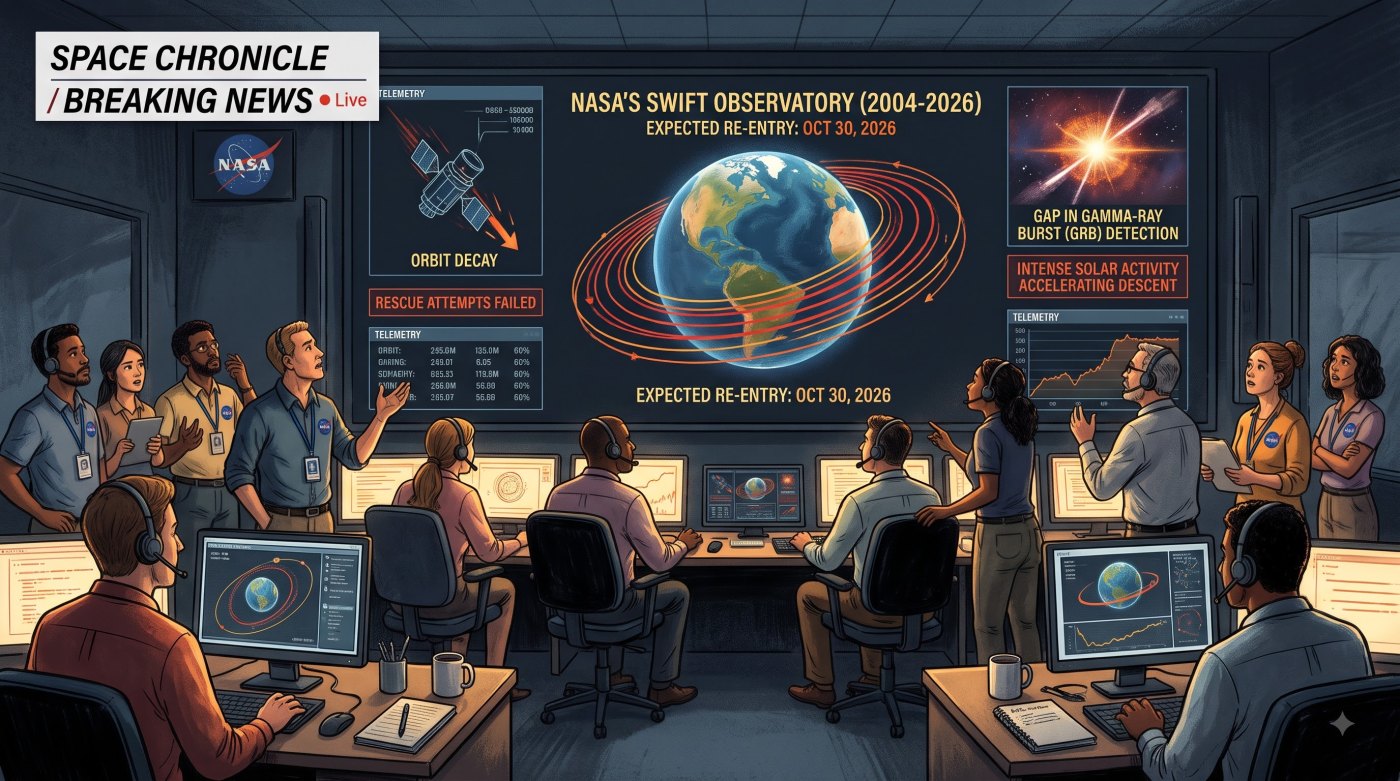
NASA's Swift Observatory is plummeting back to Earth on or around October 30, 2026, ending a 22-year mission that far exceeded its two-year design life.
The U.S. Space Force predicts the telescope will come down on that date. Greater solar activity in recent years increased atmospheric drag on Swift and hastened its descent. Two failed rescue attempts left it without a way to recover.
Swift blasted off on November 20, 2004, to search for gamma-ray bursts and supernovae. NASA said the telescope was designed for a two-year mission. It’s now approaching year 22.
We've known this day would come since before Swift was launched. At least in low-Earth orbit, what goes up must come down. And that end is catastrophic.
How the telescope fell from grace
A year ago, NASA brought in Katalyst Space for a rapid attempt to rescue Swift. The company's three-armed robot, named Link, launched in July but encountered problems, coming no closer than 12 kilometres to 15 kilometres from the telescope. It returned to Earth in September.
A second effort also collapsed. NASA commissioned a spacecraft to raise Swift out of danger. It took off in early July, but technical problems by late August prevented it from attempting a boost.
Over the decades, the spacecraft has descended by about half its original altitude as atmospheric molecules continually slowed it. NASA said the sun's relatively high activity in recent years sped up the process, making it unlikely to continue into the 2030s as engineers hoped.
A telescope that changed astronomy
Swift's final tally includes 2,000-plus gamma-ray bursts and 1,400 stars that exploded, as well as comets, asteroids, and black holes that tear stars apart.
We're coming up on year 22. We are so fortunate to have had the opportunity to do all the things that we have.
Swift earned its name from its capacity to turn quickly towards erupting celestial events. NASA described it as an alert system for the Hubble and Webb space telescopes and other observatories, which could then investigate those events in greater depth.
It has all these views of the universe, all in one observatory, which by itself is rare, but it can also rapidly point any of these instruments.
Before Swift, long gamma-ray bursts were thought to come from stars exploding as supernovae and could last minutes. Short bursts, lasting under two seconds, were attributed to neutron stars merging. Swift confirmed the broad distinction between long and short bursts, but also found events that didn’t fit neatly into either group.
Swift recorded several notable bursts: the brightest gamma-ray burst ever observed, nicknamed BOAT; the highest-energy photons detected from such an event; and several bursts considered candidates for the most distant ever observed.
Swift released its data to the public immediately, while scientists on its team continued analyzing the telescope's observations. In its later years, it tracked between five and 10 targets of opportunity on most days, reaching hundreds or even thousands a year.
Swift contributed to two major discoveries in 2017: the unusual explosion produced by a pair of merging neutron stars, followed by the first neutrino whose source was identified.
Final observations and an uncertain future
After the rescue was abandoned, Swift went back to observing, detecting additional gamma-ray bursts and other ultrahigh-energy events. By late October, it had fallen too low to hold steady during observations, so operators shut down its systems.
The team restarted Swift's instruments after the boost effort ended, giving the telescope a final period of science. This included technical checks on the usefulness of recent data and indirect studies of Earth's atmosphere at altitudes lower than many spacecraft can tolerate.
It feels a little bit like a last hurrah of Swift.
Some of Swift's tasks can be handled by existing and upcoming observatories, but others can’t. Scientists are working out how to address the capabilities Swift leaves behind.
Not just on the common events we have thousands of, but the really rare, unusual ones, which are often the ones we learn the most from.
Most of the telescope is expected to burn up in the atmosphere, though some mirror parts and a few pieces made of tungsten, denser than lead, could survive reentry. Debris is most likely to fall into the ocean, while areas across Africa, Australia, India, Southeast Asia, and Central and South America also lie within the reentry zone.
Our fervent hope is that the lessons learned by the successes of Swift can be applied to new generations of space missions to accelerate our discoveries about the universe.
As the team prepares for reentry around October 30, the Space Force continues tracking Swift's descent.