NASA reaffirmed on Friday a mid-2027 Artemis III test flight in Earth orbit as the stepping stone to crewed lunar landings in 2028.
Artemis III was once planned as a crewed landing mission. NASA restructured it earlier this year into an orbital test of both landers. NASA Administrator Bill Nelson reaffirmed that the agency is holding firmly to its schedule, emphasizing that the restructured orbital flight is the safest and most efficient path forward to return humans to the lunar surface.
The Artemis programme is almost a decade old and has repeatedly suffered setbacks.
What the Artemis III flight involves
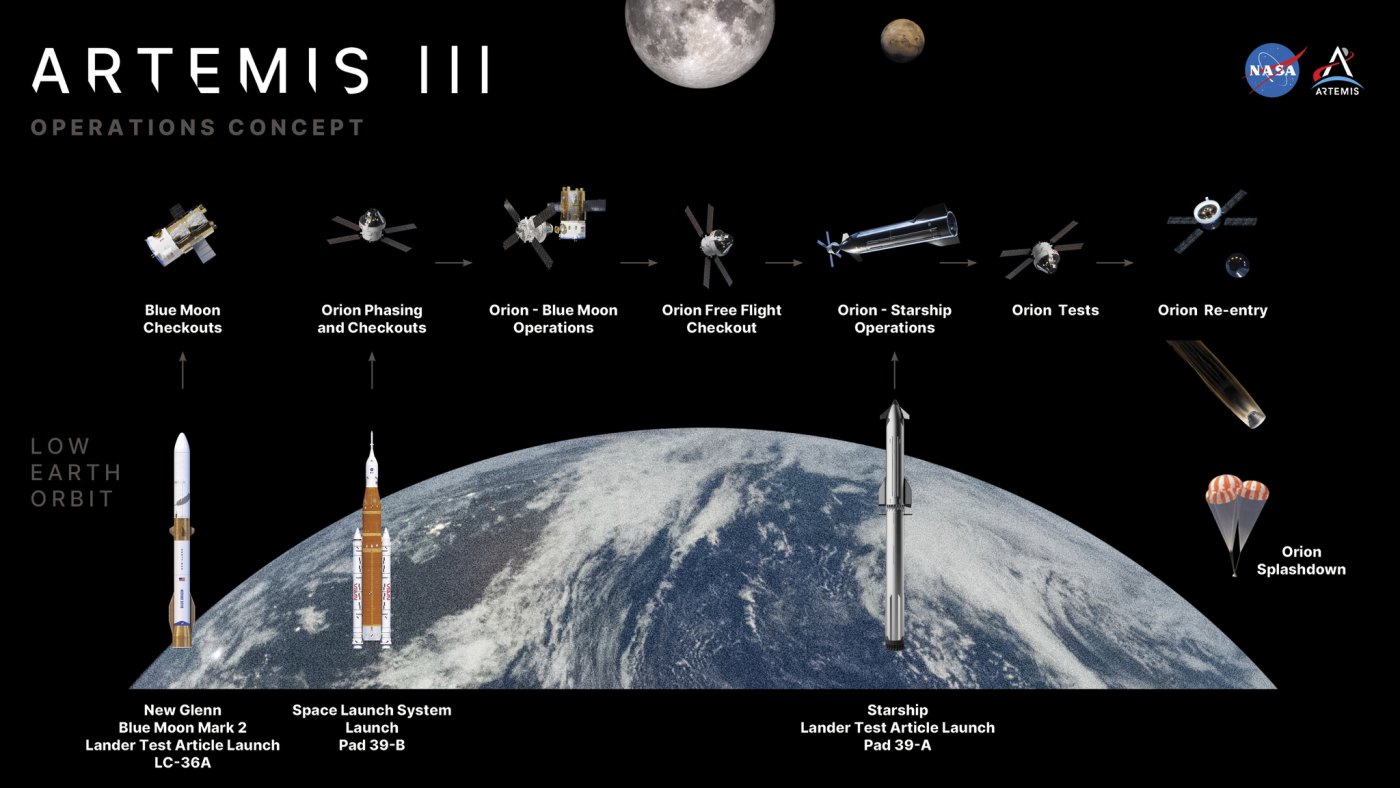
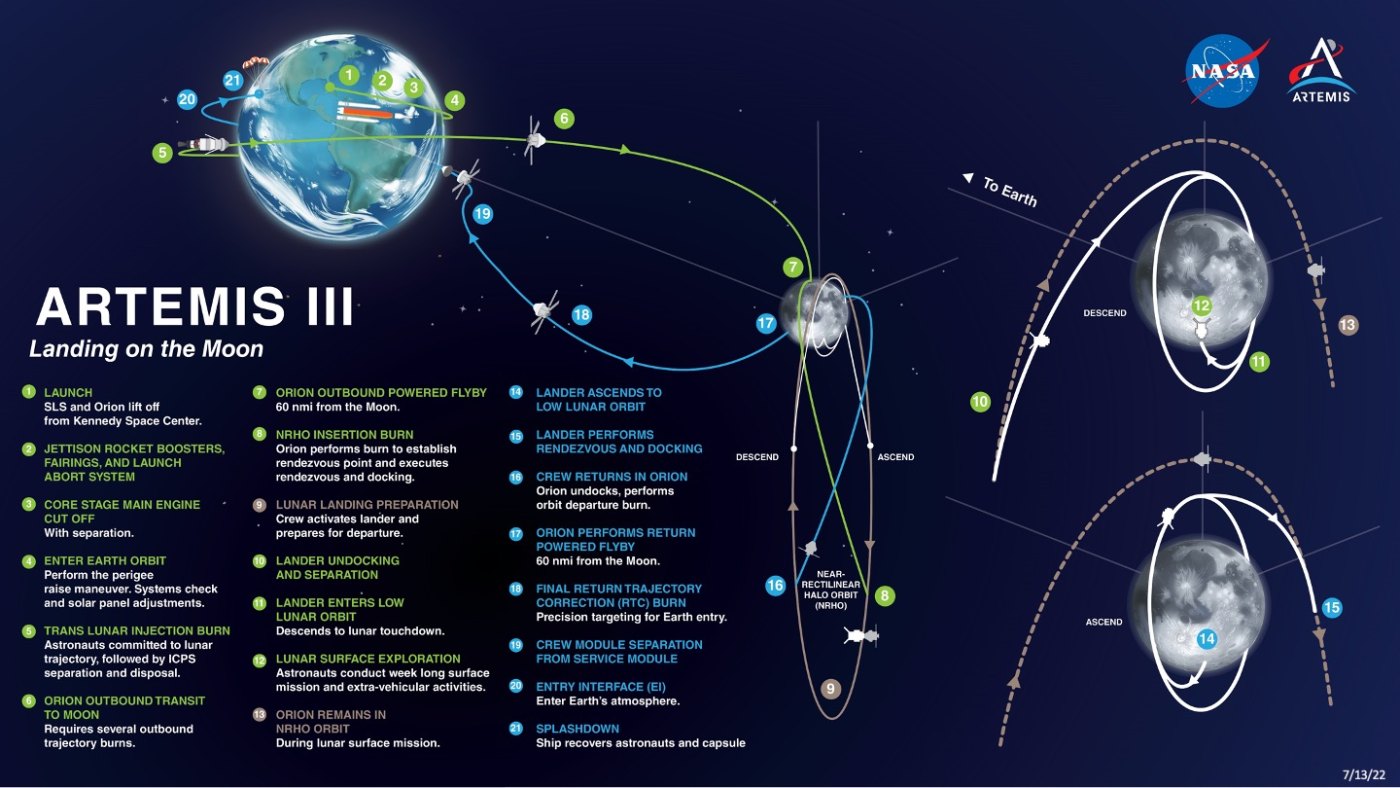
Planned to last 14 to 17 days in low Earth orbit, the mission will put the Orion crew capsule, one lunar lander and three launch vehicles through testing.
Blue Origin's Blue Moon MK2 lander launches first, on a New Glenn rocket, and can loiter in orbit for up to 30 days. Orion flies on an SLS rocket. Because it does not need to leave Earth orbit, it carries a spacer in place of the Interim Cryogenic Propulsion Stage used for Artemis II.
Orion and Blue Moon MK2 dock on Day 3. They stay together for two days while the crew enters the lander and runs tests.
Starship launches on Day 6 with a passive docking system on its nose. Orion stays docked to it for only 2 hours, and the crew does not enter.
- LaunchBlue Moon MK2 goes first
The lander flies on New Glenn and can loiter for up to 30 days.
- Day 3Orion docks with Blue Moon MK2
The crew enters the lander and runs tests over two days.
- Day 6Starship launches
Orion docks with it for 2 hours, with no crew entry.
Jeremy Parsons, NASA's Artemis programme manager, said the flight is designed around risk reduction. "Every day of this mission is built around specific tests that reduce risk, give us valuable science and allow us to test out our capabilities before we go and undertake the lunar landing," he said.
Schedule pressure and the race with China
NASA Administrator Bill Nelson described Artemis III in a September note to NASA staff as "90 days broken to schedule". The message was meant to galvanize the workforce to find solutions.
He said the roughly three-month delay is a dynamic process. Some areas can catch up, and new challenges are expected along the way.
Nelson also tied the pace to competition with China. He said that race is the reason to reach the Moon in two years and that the United States will not relax. "Here we are today, very much in a new space race, and despite decades of accumulated knowledge and extraordinary advancements in technology, this race will be much closer than it ever needed to be," he said.
"We will never launch until we are ready," NASA Administrator Bill Nelson told staff in a blunt internal memo, highlighting that the modern space race leaves zero room for complacency. "But we will not accept that great achievements simply require more time and more money, nor will NASA sit idly by and watch one of the most consequential moments of this new century pass to our overseas competitors."
Two landers, one decision for Artemis IV
NASA targets Artemis IV and Artemis V for returning astronauts to the lunar surface, both in 2028. Accounts of the plan differ. One describes Artemis IV as the first crewed landing since 1972, while another says both Artemis IV and Artemis V will land astronauts.
For Artemis IV, NASA laid out two mission plans. One uses SpaceX's Starship launcher and its human landing system. The other uses Blue Origin's New Glenn rocket and Mark 2 lander.
NASA has not confirmed which company it will pick and will wait as long as possible before choosing. Both companies are planning lunar landing missions in 2028, Parsons said.
Both companies have changed their 2028 approach. Instead of the first plan, in which Orion would be met in lunar orbit, a fully fuelled Starship will dock with Orion while it is still in Earth orbit and send it on to the Moon. Blue Origin will use three smaller Blue Moon MK1 spacecraft as tugs to bring the MK2 lander to lunar orbit, where it meets Orion.
How each company plans the 2028 landing
SpaceX
Starship and HLS
- Fully fuelled Starship docks with Orion in Earth orbit and pushes it to the Moon
- Needs in-space propellant transfer, first demonstration expected early next year
- Uncrewed lunar landing test expected in late 2027
Blue Origin
New Glenn and Mark 2
- Three Blue Moon MK1 tugs bring the MK2 lander to lunar orbit
- Lander meets Orion in lunar orbit
- New Glenn grounded since May, launches expected to resume in November
Unproven technology and open questions
Starship needs in-space propellant transfer to leave Earth orbit. Earth-orbiting fuel depots do not exist yet, and in-space transfer of cryogenic fuel has not been demonstrated. Uncrewed test flights of both landers are also required to show they can land safely on the Moon.
Blue Origin's New Glenn has been grounded since a rocket exploded in May. The company expects to resume launches in November. NASA has no contingency plan to launch Blue Moon on another vehicle if New Glenn is not ready.
SpaceX flew Starship uncrewed in orbit for the first time in September. It aims for another test next month with Raptor engine upgrades.
Parsons said NASA expects more flights from both companies before Artemis III. "You will have multiple launches of Starship before we go conduct Artemis III, and you will have multiple launches of the Blue Origin New Glenn vehicle from the rebuilt pad before we go launch Artemis III, and so that’s going to give us a lot of confidence," he said.
Spacesuits are another pressure point. Axiom Space is building a simpler, lighter "sortie" suit for Artemis IV, and crews will be limited to two hours on the surface over two excursions. NASA confirmed Axiom is working to a simplified design to meet a 2028 deadline. NASA's inspector general warned in an April report that Axiom's original design might not be ready until 2031.
NASA also announced it will develop a more powerful, upgraded Space Launch System with a lengthened upper stage. United Launch Alliance, backed by Boeing and Lockheed Martin, will manufacture it.
The South Pole remains the destination, but NASA says it needs more data from robotic landers before a final decision. The agency wants the pole because water ice deposited by comets is thought to be accessible in permanently shadowed regions. That ice could support outposts or be turned into propellant. This week the National Academies of Sciences, Engineering, and Medicine released a NASA-requested report identifying four non-polar sites for future crewed missions.
NASA's Aerospace Safety Advisory Panel has raised concerns about Artemis IV and beyond. They include lander readiness, only one uncrewed landing test per provider, and the first use of cryogenic propellants on the Moon.
For Artemis IV, assembly and testing of the crew and service modules for Orion has begun. Parsons said one lander is progressing well: "Their design for the Artemis III lander test article is in good shape."
What we know
- Artemis III is an Earth-orbit test flight planned for mid-2027.
- Both landers are involved in the restructured mission.
- New Glenn has not flown since May.
Still unclear
- Which company will land Artemis IV.
- The Artemis III launch date beyond mid-2027.
- Whether the South Pole will be the final landing site.
- Whether the landers and suits will be ready for 2027 and 2028.
Next, New Glenn is expected to resume launches in November, and SpaceX aims to fly another Starship test next month.