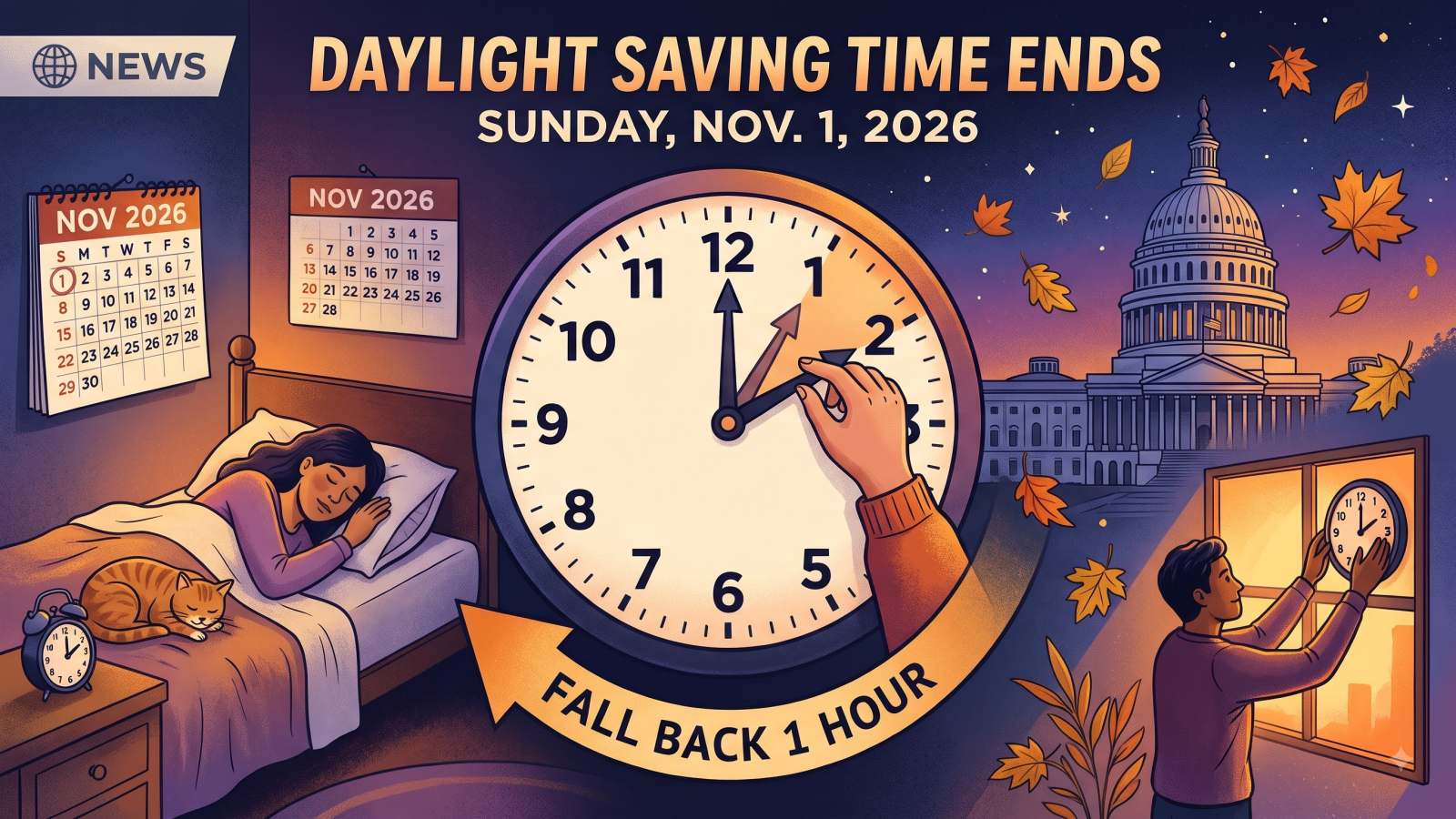
Clocks across most of the United States fall back one hour at 2 a.m. local time Sunday, Nov. 1, ending daylight saving time.
The change comes two days before the midterm elections, but the bill that would stop it is going nowhere in the Senate. Any legislation still awaiting approval when the new class of lawmakers elected on Tuesday takes office will expire in early January. The Sunshine Protection Act and everything else left on the calendar run out unless the Senate moves first.
no clear path forward or consensus
Thune said earlier this month that the Senate had neither a route nor an agreement on the measure.
Daylight saving time began at 2 a.m. on 8 March. It ends at 2 a.m. on Sunday, 1 November, as it has since 2007. A 2005 law changed where the end fell, moving it off the final Sunday of October. The Uniform Time Act of 1966 standardised the dates but let states and localities opt out.
What the House passed
The Sunshine Protection Act would keep the country on daylight saving time all year, rather than dropping back to standard time each winter. The House passed the 2025 version on July 14 by a bipartisan 308-117 vote and sent it to the Senate's Commerce, Science and Transportation committee. It's stayed there.
Trump has pushed to end the twice-yearly clock change and hold the country on daylight saving time throughout the year. In August he pressed Republican senators in a Truth Social post to act, and he described the practice of changing clocks as:
foolish, inconvenient and, in some cases very costly
His post told senators to:
PASS THE SUNSHINE PROTECTION ACT, ASAP
The president also posted what he said was the cellphone number of Senator Tom Cotton of Arkansas and urged people to call and voice support for the bill.
Cotton has objected on the grounds of what permanent daylight saving time would do to winter mornings, and he pointed to the record of previous attempts.
No one likes changing the clock, me included, but Congress has enacted permanent Daylight Savings Time multiple times before and repealed it each time once Americans experienced absurdly late sunrises in the winter. Arkansans don’t want their kids going to school in the pitch dark, and I’ll always put Arkansas first
Who sits the change out
Hawaii, most of Arizona, and U.S. territories and possessions don't change their clocks this weekend. These include American Samoa, Guam, Puerto Rico, the U.S. Virgin Islands and the Northern Mariana Islands. So not every American will adjust a clock.
The Navajo Nation, which lies partly in Arizona, is the exception inside that state: it changes its clocks so that it keeps the same time as communities in New Mexico and Utah.
Federal law sets the limits on what everywhere else can do. States may exempt themselves from daylight saving time and stay on standard time all year, but those that observe it must follow the federally mandated start and end dates. They can't adopt permanent daylight saving time by themselves.
That restriction explains the shape of the state-level effort. The National Conference of State Legislatures says 19 states have enacted measures providing for year-round daylight saving time if federal law is changed, laws that wait on Washington rather than take effect on their own.
A rival bill, and a rival preference
Not everyone who wants to end the switches agrees on what should replace them. The American Academy of Sleep Medicine favours ending seasonal clock changes and keeping standard time year-round, saying that option better matches human circadian biology.
Democratic Representative Mary Gay Scanlon and Republican Representative Pat Harrigan filed a bill in July to make permanent standard time the default. The Sunshine for Our Kids Act of 2026 is numbered H.R. 9638.
Two ways to stop changing the clocks
Permanent daylight saving time
Sunshine Protection Act
- Advocates say more evening daylight gives Americans more time for leisure after work
- Advocates say it may have some positive effect on crime rates and the economy
- Critics say it means very dark winter mornings, with sunrises after 9 a.m. along the western edges of time zones
Permanent standard time
Sunshine for Our Kids Act
- The American Academy of Sleep Medicine says it aligns more closely with circadian biology
- Vox reports it leaves more people with a reasonable sunrise time
- Vox reports it has less impact on what people described as a reasonable sunset time
Vox reports that retaining the current system is the most likely of the three outcomes. Permanent daylight saving time would mean darker evenings, which could be difficult to sell politically. Congress ended its previous trial of the policy after less than a year.
A century of switching, and one reversal
The Standard Time Act of 1918 established the practice, pushing sunset an extra hour later in summer. Congress repealed it in 1919, brought it back in the early days of World War II and kept it from 1942 to 1945, then standardised it in the Uniform Time Act of 1966.
The country tried year-round daylight saving time in 1974, when President Richard Nixon moved the nation onto it. The extended morning darkness drew wide criticism and was blamed for incidents in which vehicles struck students. Congress reversed the change after Nixon resigned later that year.
- 1918Standard Time Act
The practice is established to extend daylight hours in summer.
- 1919Repealed
Congress repeals daylight saving time.
- 1942-1945Wartime
Re-enacted in the early days of World War II and observed through the war.
- 1966Uniform Time Act
Daylight saving time is standardized.
- 1974Nixon's experiment
Year-round daylight saving time begins; Congress reverses it after Nixon resigns.
- 2005End date moves
A law moves the end date from the last Sunday of October.
- 2027Next start
Daylight saving time is set to begin on Sunday, March 14, at 2 a.m. local time.
Public approval of the 1974 experiment fell quickly. The Washingtonian reported in 2022 that support stood at 79 percent in December 1973, then sank to 42 percent three months later.
What the hour does to a city
The change is clear in Boston's daylight hours. Before the clocks change, the National Weather Service lists Saturday's sunrise at 7:16 a.m. and sunset at 5:39 p.m. With standard time returning Sunday, sunrise will be at 6:17 a.m. and sunset at 4:37 p.m.
| Boston | Saturday, Oct. 31 | Sunday, Nov. 1 |
|---|---|---|
| Sunrise | 7:16 a.m. | 6:17 a.m. |
| Sunset | 5:39 p.m. | 4:37 p.m. |
The debate hinges on whether to have more light in the evening or the morning. Advocates of permanent daylight saving time say extra daylight after work gives Americans more time for leisure activities and may benefit crime rates and the economy. Critics say winter mornings would be very dark, with sunrises after 9 a.m. along the western edges of time zones.
The change comes in the overnight hours after Halloween, giving revellers an extra hour for late-night costume parties, or an extra hour of sleep for those who skip them. For parents of young children, though, it can disrupt their kids' sleep schedules until they adjust.
California has an alcohol rule tied to the repeated hour. Bars there must stop serving two hours past midnight, even when 1 a.m. comes around twice. The rule varies elsewhere: some jurisdictions let bars base last call on Sunday's updated time.
Most clocks will handle the change themselves. Phones set to update automatically should show the correct time by morning. Apple, Google and Samsung publish support pages with instructions for changing the time on their devices.
The practice isn't uniquely American, and it's shrinking. Pew Research Center says daylight saving time is observed by roughly one-third of countries, while many countries that used to observe it have since stopped. About half of all countries once followed the practice.
Where the record diverges
The sources do not line up on every date and detail. One gives Nov. 7 as the date daylight saving time ends next year, while another gives March 14, 2027, as the date it next begins; the two refer to different events.
They also describe the legislation's path differently. One account says the Senate passed the Sunshine Protection Act in 2022 and the bill did not advance in the House, while another tracks the 2025 bill that passed the House on July 14, 2025, and is now with the Senate.
What we know
- Clocks fall back one hour at 2 a.m. local time on Sunday, Nov. 1, 2026.
- Daylight saving time began at 2 a.m. on March 8, 2026.
- The House passed the Sunshine Protection Act on July 14, 2026, by a 308-117 vote.
- Hawaii, most of Arizona and five territories do not change their clocks.
Still unclear
- Whether the Senate will act on the Sunshine Protection Act before the end of 2026.
- Whether the effort will have to restart from scratch if the bill dies in early January.
The next dated step is the calendar, not the Senate: daylight saving time is next set to begin on Sunday, March 14, 2027, at 2 a.m. local time.
Whether lawmakers act before then is open. If the Senate doesn't move on the Sunshine Protection Act or the standard-time alternative before the new class is seated, the bills expire in early January. Anyone wanting a different arrangement would have to start again.