A new U.S. Defense Intelligence Agency report includes what it describes as the first clear orbital image of China's reusable Shenlong spaceplane.
The image gives the public its most detailed look yet at a spacecraft whose missions China has said little about. It comes as U.S. intelligence warns Beijing could deploy orbital weapons by the late 2020s.
The DIA report is titled 'Challenges to Security in Space' and was released as an unclassified report.
The photograph was taken in 2024 by a WorldView 3 commercial imaging satellite from 56 miles (90 kilometers) away, with each pixel covering 4.5 centimeters (1.8 inches) on the ground. Space.com credits the satellite to Vantor, while Gizmodo and the South China Morning Post credit Maxar.
The photograph shows the robotic Shenlong space plane attached to a satellite with its solar panels extended. Shenlong's payload bay doors are open.
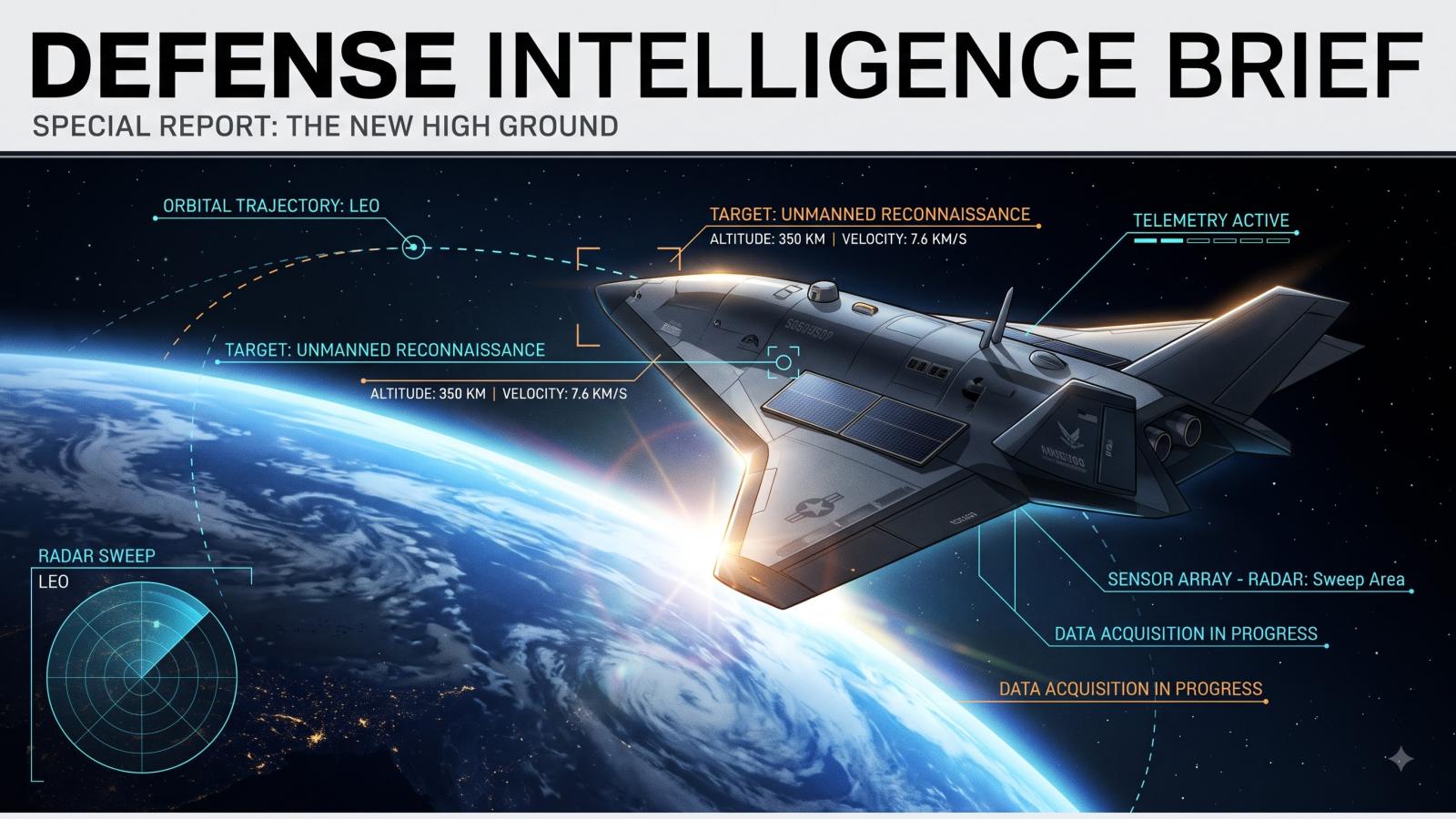
Delta wings, an atmospheric re-entry heat shield and a central payload bay are among the Chinese spaceplane's features. At the rear, a tail extension has solar panels deployed on both sides.
Known as Shenlong (or Divine Dragon), China's spaceplane first reached orbit in 2020. It returned to the Jiuquan Satellite Launch Center in the Gobi Desert after a two-day mission. A later flight began in August 2022 and lasted 276 days in Earth orbit. In December 2023, it launched again for a 268-day-long mission. The spaceplane is now on its fourth mission, launched on 7 February, according to Gizmodo; Space.com dates it to February 2026.
will pave the way for more convenient and affordable round-trip methods for the peaceful use of space in the future.
LeoLabs, an American space intelligence company, said in June 2026 that it had detected an object near Shenlong. The company collected additional observations through its global network, analysed them with LeoLabs Delta, then independently catalogued the object and expressed high confidence that Shenlong had released it.
This activity is consistent with sub-satellite deployments conducted by the space plane in previous missions.
Shenlong's third mission concluded in 2024, when a similar object release was noted. The space plane also released an object on its 2023 second mission and may have performed proximity and rendezvous operations, manoeuvres that bring two spacecraft close together.
In orbit, Shenlong has performed a range of activities, including orbital manoeuvres, capture and docking, formation flying, and vertical takeoff and horizontal landing. It's also released unidentified objects, some of which transmitted signals in orbit. China hasn't announced or confirmed those deployments, although the U.S. military catalogued the objects.
The China Academy of Launch Vehicle Technology, a state-owned maker of civilian and military space launch vehicles, developed China's spaceplane.
The Boeing-built X-37B is the United States' robotic space plane, and its missions and capabilities remain largely undisclosed. In February 2025, the U.S. Space Force published its first photo of the craft in space, providing an uncommon view of it in operation. The image appears to show the X-37B in a high Earth orbit, with its payload bay doors open. In 2023, the Space Force issued its first official painting of an X-37B-like space plane orbiting Earth and intercepting another satellite.
| Shenlong | X-37B | |
|---|---|---|
| Operator | China | United States |
| Public images | First clear image published in DIA report | First photo released February 2025 |
Beijing was strengthening its capacity to monitor American forces and might field space-based directed-energy weapons by the late 2020s, the DIA report said. China says it opposes space militarisation, while US intelligence warns orbital weapons could be deployed by the late 2020s.
Designed for orbital flight and a return through Earth's atmosphere, a spaceplane shares some features with the US Space Shuttle. China's secretive craft is thought to be uncrewed, more like the smaller American X-37B.
Though the DIA report offers no fresh account of Shenlong's orbital activity, its photo reveals additional details about the experimental spacecraft.
China and the United States are competing for primacy in what many observers call a new Space Race. Images such as these offer militaries and intelligence agencies a chance to hint at capabilities without disclosing them fully to the public.
The image doesn't reveal which satellite Shenlong may have been docked to. The public has received little information on Shenlong's operations, and China hasn't announced or confirmed the deployment of objects released by Shenlong.
Shenlong remains on its fourth mission, which launched in February 2026, according to Space.com.