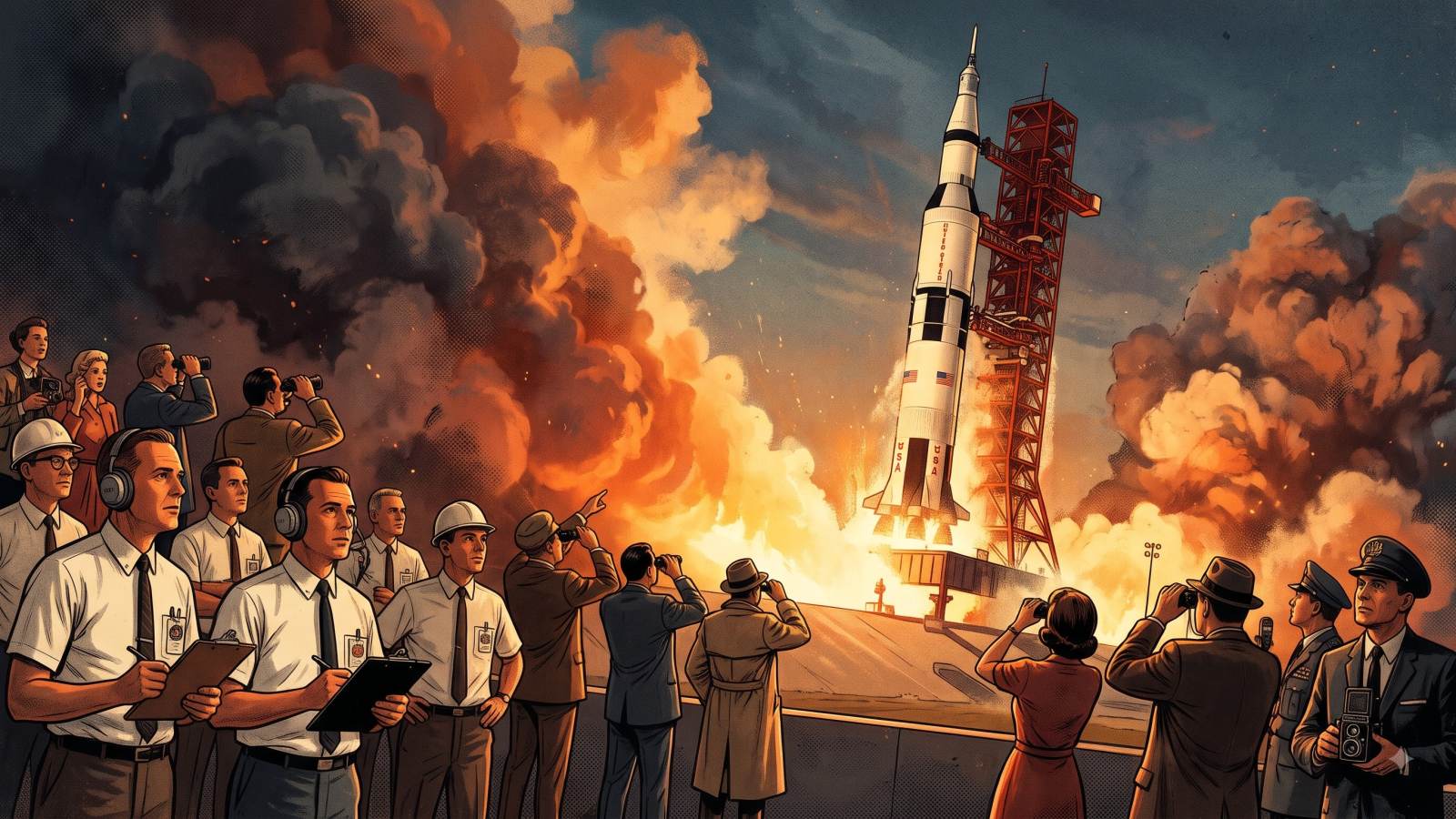
Sixty-five years ago today, NASA launched its first Saturn rocket at Cape Canaveral in a key test of the U.S. space program.
The launch on Oct. 27, 1961, was the first test flight of NASA's new Saturn I space launch vehicle. NASA named the mission the Saturn SA-1 flight.
The Saturn I was designed as the United States' first heavy-lift rocket for sending large payloads beyond low Earth orbit. It also opened the Saturn family, which later included the Saturn V rocket used to send astronauts to the moon during the Apollo program.
The test was brief by later standards. The rocket reached an altitude of approximately 85 miles and traveled more than 214 miles downrange before splashing down in the Atlantic Ocean about eight minutes after launch. The flight demonstrated that the clustered booster design could perform as intended.
The Saturn SA-1 vehicle stood 162 feet tall and weighed approximately 460 tons at liftoff. Its eight H-1 engines generated about 1.3 million pounds of thrust, meeting the intended performance for the initial flight tests. Later versions of the Saturn booster were upgraded to produce approximately 1.5 million pounds of thrust.
NASA's historical account describes the SA-1 flight as essentially flawless. The four inboard engines shut down after approximately 109 seconds of operation, followed by the four outboard engines six seconds later. The rocket followed its planned trajectory and splashed down in the Atlantic Ocean more than 214 miles downrange.
The flight was considered essentially flawless
NASA's historical account describes the SA-1 flight as essentially flawless. The test demonstrated the structural integrity of the Saturn booster and the viability of its clustered-engine design, providing an important foundation for subsequent Saturn missions.
Saturn I represented a major advance in American launch-vehicle capability. The earlier Jupiter-C design contributed to the development of the Juno I rocket, which launched Explorer 1, the first American satellite, in January 1958. Saturn I's much greater size and thrust reflected the growing need for powerful launch vehicles capable of supporting ambitious human-spaceflight missions.
Saturn I compared with Jupiter-C
Jupiter-C
Earlier American rocket
- Launched the first American satellite into orbit in 1958
- Less than one-tenth of Saturn I's thrust
Saturn I
First Saturn heavy-lift rocket
- Almost three times the height of Jupiter-C
- 1.3 million pounds of thrust
The Saturn program began with earlier rocket work
The Saturn program originated in 1957, when Wernher von Braun and his engineering team at the Army Ballistic Missile Agency in Huntsville, Alabama, began studying a powerful new rocket. The Department of Defense's Advanced Research Projects Agency formally authorized the project in August 1958. The vehicle was subsequently designated Saturn C-1 and was renamed Saturn I in February 1963.
The Saturn C-1's first stage used a central liquid-oxygen tank derived from the Jupiter rocket, surrounded by eight tanks adapted from the Redstone missile. Four of the surrounding tanks held RP-1 kerosene, while the other four held liquid oxygen. Eight H-1 engines powered the booster, combining the propellants to generate the thrust required for liftoff.
The design drew on the Redstone missile, the Jupiter rocket and the Thor rocket. Some hardware was reused, a method that lowered costs, although the sources do not provide a figure for the Saturn I program's cost.
After an array of tests, the Saturn program moved to the newly opened George C. Marshall Space Flight Center in Huntsville, Alabama, where assembly began. The Saturn I boosters and engines were tested there in April 1961.
- May 1960Saturn C-1 begins
Assembly of the SA-1 booster begins at the Redstone Arsenal.
- April 1961Booster and engine tests
The first-stage booster completes a static firing test at Marshall Space Flight Center.
- Summer 1961Components arrive
The dummy third stage arrives at Cape Canaveral.
- August 1961Further testing
The live first stage and dummy second stage arrive at Cape Canaveral.
- August 20–21, 1961SA-1 launches
The rocket is assembled at Launch Complex 34.
- September 6, 1961Saturn record ends
The first-stage tank pressurization test is completed.
- October 27, 1961first flight launches
Saturn SA-1 launches on its first flight.
Saturn I had its own launch site. Construction at Florida's Launch Complex 34 at the Cape Canaveral Air Force Station started in June of 1960. The facility received its dedication in June 1961. Another description said the pad is at what is now Cape Canaveral Space Force Station, and NASA took charge in June 1961.
Rocket components arrived throughout the summer for stacking. After the September tests, the vehicle was ready for the October launch.
The test came as the moon race accelerated
NASA launched its first Saturn rocket when the agency was 3 years old. Human spaceflight had begun only six months earlier, with Soviet cosmonaut Yuri Gagarin's April 12 launch that year.
President John F. Kennedy had made his pledge five months earlier: America would put a man on the Moon. The Saturn SA-1 flight therefore linked NASA's early heavy-lift work to the larger rockets needed for that promise.
NASA later built three Saturn rocket types. Saturn I was followed by the more powerful Saturn IB and then the super-sized Saturn V, which was built for Apollo moon launches.
Saturn SA-1 was an uncrewed test flight designed to evaluate the performance and structural integrity of the new booster. Its dummy upper stages were filled with water to provide ballast during the flight. The mission did not carry astronauts or perform an operational satellite deployment.
What we know
- NASA launched the Saturn SA-1 test from Cape Canaveral on Oct. 27, 1961.
- The Saturn family later included Saturn I, Saturn IB and Saturn V.
Still unclear
- The sources do not say what payload, if any, the first Saturn I test flight carried.
- The exact time of the Oct. 27, 1961 launch is not given.
- The cost of the Saturn I program is not provided.
NASA's Saturn program completed 32 successful launches between 1961 and 1975: 10 Saturn I launches, nine Saturn IB launches, and 13 Saturn V launches. The final Saturn launch took place in July 1975 during the Apollo-Soyuz Test Project.
The Saturn SA-1 flight was the first of 32 successful Saturn rocket launches — 10 Saturn Is, 9 Saturn IBs, and 13 Saturn Vs — between 1961 and 1973.
The 32 launches also included Saturn V rockets, used to power every crewed Apollo flight.
NASA also said Saturn was "the only family of rockets to have had a 100 percent success rate". That claim appears alongside the differing descriptions of SA-1: one account records the engine cutoff 1.6 seconds early, while another describes the launch simply as successful.
The documented next phase after Saturn I was the more powerful Saturn IB and the Saturn V. Together with Saturn I, those rockets carried the Saturn program through its 32-launch record ending in 1973.