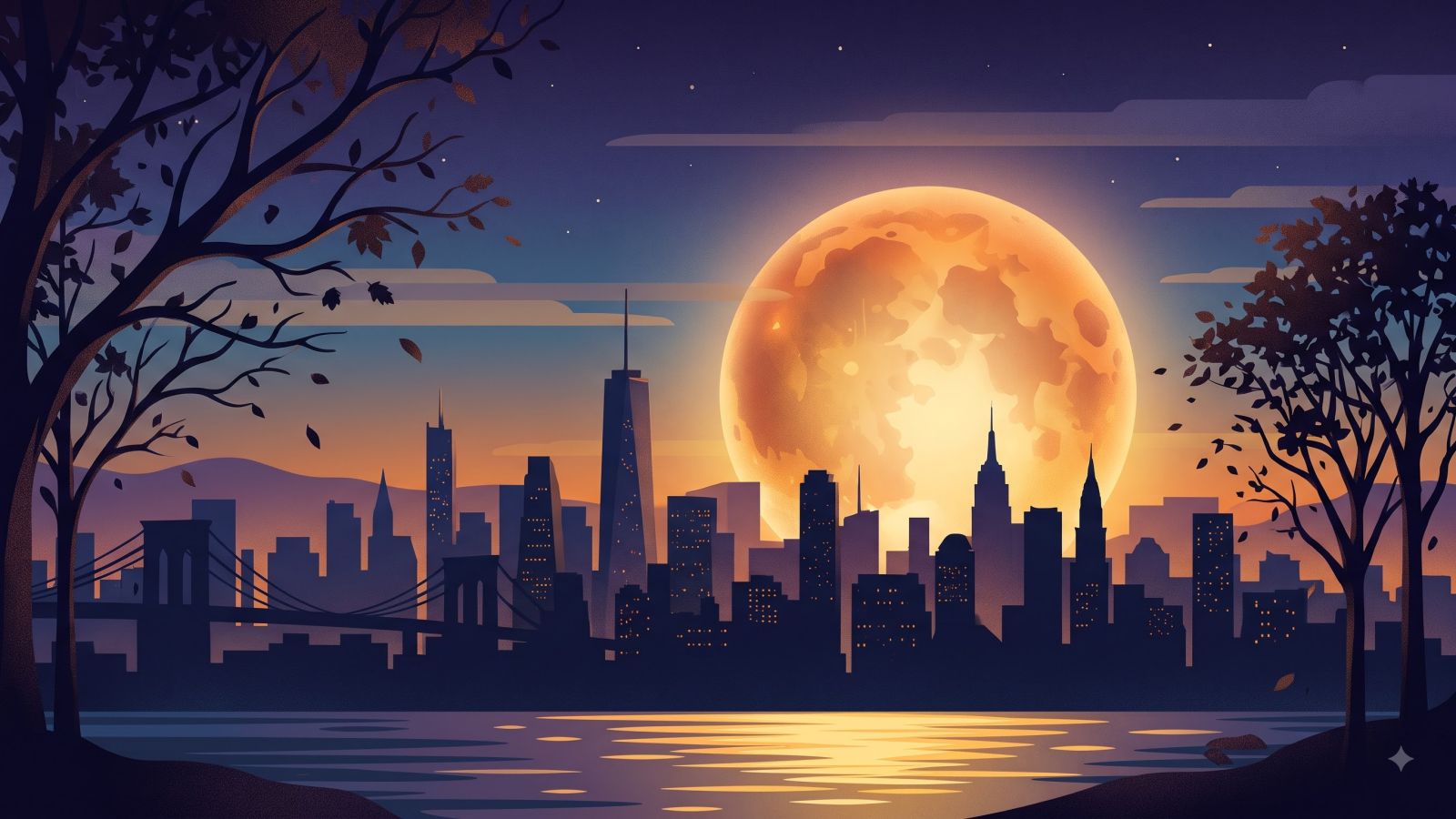
The October Full Moon, known as the Hunter's Moon, reached its peak early Monday, 26 October 2026, and was photographed from New York to Istanbul.
The Hunter's Moon is prized by observers because it stays visible longer and brighter than most Full Moons, a quality tied to traditional autumn hunting practices. Understanding why this Moon has its name and how it differs from other Full Moons helps explain what makes October's lunar display special.
Peak time across sources
Time and Date
Peak time
12:11 a.m. ET
Astronomy magazine
Peak time
12:12 a.m. EDT
The peak fell late on Sunday, 25 October, in some places in the United States and around the world because of time zones.
Why October's Full Moon earned its name
The October Full Moon is traditionally called the Hunter's Moon, a name rooted in Northern Hemisphere historical traditions. The name comes from traditional hunting practices, when people hunted animals to prepare for the colder winter months.
The Hunter's Moon follows the Full Harvest Moon seen in September. Full Moons through the year traditionally carry names reflecting what is happening in nature. Most monthly Full Moon names come from Native American, Colonial American or other North American traditions.
The Hunter's Moon remains visible for an extended period, much like the Harvest Moon that precedes it, providing hunters with additional nighttime illumination. According to Royal Museums Greenwich, this Moon appears brighter and stays longer in the sky, allowing hunters to extend their time outdoors after dark.
Understanding Full Moons and lunar phases
A Full Moon happens when Earth sits precisely between the Sun and the Moon, so the whole Earth-facing side is lit. The lunar cycle from one Full Moon to the next, the synodic month, lasts about 29.5 days and is divided into eight phases.
What we know
- The eight phases are New Moon, waxing crescent, First Quarter, waxing gibbous, Full Moon, waning gibbous, Last Quarter and waning crescent.
- Although a Full Moon is exact only at one moment, to our eyes the Moon seems Full for around three days.
Still unclear
- Whether unexpected local weather patterns and heavy cloud cover completely blocked visibility for observers in specific parts of the United Kingdom and San Francisco.
- The exact levels of localized particulate pollution and atmospheric moisture that caused the moon's color intensity to vary from a light gold to a deep, burnt orange between different cities.
- • The total number of spectators who tuned into international virtual observatory live streams to watch the lunar peak across different time zones.
The Moon can look orange or reddish when low in the sky because short-wavelength blue light scatters as it passes through a large depth of atmosphere.
The Hunter's Moon photographed worldwide
The BBC published a photo of the Hunter's Moon rising behind the midtown Manhattan skyline in New York City, credited to Gary Hershorn / Getty Images.
A photo by Tayfun Coskun / Anadolu via Getty Images showed the Hunter's Moon setting in San Francisco, California. Another image by the same photographer showed the Moon over San Francisco Bay as seen from a plane.
The orange Moon rose over the Basilica of the Madonna dei Martiri, located in Molfetta, Italy, in a photo by Davide Pischettola / NurPhoto via Getty Images.
A photo by Salih Zeki Fazlioglu / Anadolu via Getty Images showed the full Moon glowing burnt orange over the Galata Tower in Istanbul, Turkey. Moonrise appeared in Baghdad's Firdous Square, Iraq, in a photo by Ahmad al-Rubaye / AFP via Getty Images.
BBC Weather Watchers contributed UK photos of the Moon over Stoney Middleton in Derbyshire, Kimmeridge in Dorset, and Felixstowe in Suffolk.
How to observe and understand the Full Moon better
Observing a Full Moon is challenging because the Sun is overhead from the nearside, shadows are shortest and the landscape looks less three-dimensional. Astronomy suggests a Moon filter for telescopes, or sunglasses worn only at the eyepiece, and higher magnifications to cut glare.
During a Full Moon, bright ejecta rays from craters such as Tycho, Copernicus, Proclus, Aristarchus, Stevinus and Byrgius can be seen; Tycho's rays stretch hundreds of miles.
Planetary alignments during the lunar cycle
On Friday, 23 October, the nearly Full Moon passed 5° north of Neptune at 11 p.m. EDT, forming a triangle with Neptune and Saturn. On Saturday, 24 October, the Moon passed 7° north of Saturn at 2 p.m. EDT, and the ringed planet was visible to the naked eye after dark.
On Wednesday, 28 October, the Moon passed 5° north of Uranus at 6 a.m. EDT, forming a triangle with the Pleiades in Taurus.
Other types of Full Moons explained
A Super Moon is a Full Moon within approximately 90 percent of its closest distance to Earth. A Blue Moon occurs when two Full Moons appear in a single month, an event that happens roughly every 2.7 years, despite its name having no connection to the Moon's actual color. A Black Moon is an unofficial term for either the third of four New Moons in a season or a second New Moon appearing within a single month.
On 24 November 2026, the next Full Moon will rise.