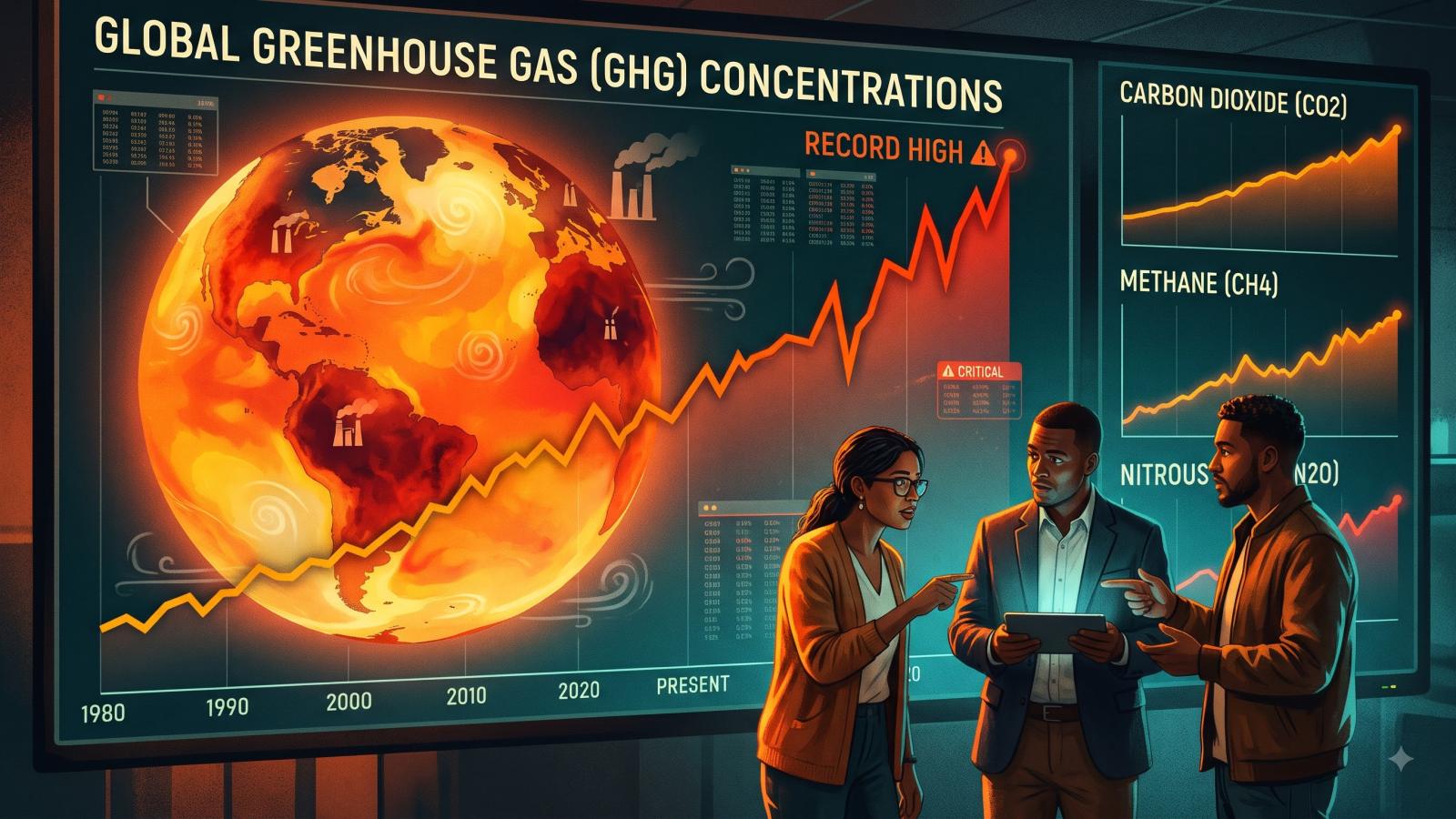
The WMO said greenhouse gas concentrations reached record levels in 2025 and are likely to rise again in 2026.
The bulletin shows why a slower annual increase is not a climate reprieve. Atmospheric concentration figures measure gases accumulating in the air, and the carbon dioxide increase remained above its average for the past decade.
The findings will go to negotiators before COP31, where the record atmospheric baseline will form part of discussions on long-term temperature increases and worsening extreme weather.
The WMO said global average atmospheric carbon dioxide reached 426.8 ppm in 2025. Methane reached 1,948 parts per billion, while nitrous oxide reached 339.1 parts per billion.
“Another year, another new record,” Ko Barrett, the WMO deputy secretary-general, said of the three main greenhouse gases.
The bulletin measures concentrations that have accumulated in the atmosphere. It does not measure only the new emissions released during a single year.
The annual carbon dioxide increase
2025 carbon dioxide rise
From 2024 to 2025
2.8 ppm
- Above the past-decade average of 2.6 ppm
- Continued accumulation in the atmosphere
Earlier comparisons
Previous record and 1960s rate
3.6 ppm
- Record surge from 2023 to 2024
- The 1960s rate was 0.8 ppm
Carbon dioxide rose by 2.8 ppm between 2024 and 2025. That was below the record 3.6 ppm increase from 2023 to 2024, but above the average annual growth of 2.6 ppm over the past decade.
The comparison with the 1960s is wider still. The average increase then was 0.8 ppm.
A smaller rise therefore does not mean that atmospheric carbon dioxide fell. It means that the accumulated total grew more slowly than in the previous year. The atmosphere still received an additional 2.8 ppm, while the overall concentration reached a new record.
“However, a 2.8 ppm annual increase is still a substantial addition of carbon to the atmosphere from fossil fuel burning,” said Oksana Tarasova, a WMO senior scientific officer.
Tarasova said the 2025 increase was smaller because land carbon sinks recovered and fire-related carbon emissions fell after the strong 2023/2024 El Nino.
Those temporary changes can alter the size of the annual increase without reversing the longer process of accumulation. Around half of the carbon dioxide emitted each year remains in the atmosphere, while land and oceans absorb the rest.
The WMO expects the concentration to increase again in 2026. It said fossil fuel burning and a powerful El Nino will dry conditions, making it more difficult for carbon sinks to take up emissions.
“We can expect to see a further increase in concentrations in 2026 because of fossil fuel burning and the development of a powerful El Nino which will impact land carbon sinks, as it did in 2023/2024,” Tarasova said.
- 27 October 2026Bulletin released
The WMO publishes its 22nd annual Greenhouse Gas Bulletin.
- 2026Further rise expected
The WMO expects carbon dioxide concentrations to increase because of fossil fuel burning and a powerful El Nino.
- November 9 to 20, 2026COP31
Negotiators meet in Antalya, Turkey, while the WMO findings are shared with them.
Carbon dioxide accounts for about 66 percent of the warming effect from the three main greenhouse gases. Its importance comes from both its share of the warming effect and its persistence in the atmosphere.
Methane accounts for about 16 percent of the warming effect from long-lived greenhouse gases, but it has a much shorter lifetime than carbon dioxide. About a third of methane emissions come from natural sources such as wetlands, with the rest coming from human sources including cattle, rice farming, landfills and biomass burning.
Reducing methane emissions matters because methane has a shorter atmospheric lifetime. Carbon dioxide remains the central long-term accumulation problem because a large share of annual emissions stays in the atmosphere and continues to affect the climate.
The bulletin also identified a separate warning involving SF6, a gas used mainly as a spark suppressant in electricity distribution. Its concentration recorded a record increase in 2025 and has risen steadily over the past three decades.
SF6 has a global warming potential more than 24,000 times that of carbon dioxide and may persist in the atmosphere for over 1,000 years.
The WMO said hydrogen concentrations rose 5.3% between 2010 and 2024. Hydrogen is not a greenhouse gas, but leaks can affect atmospheric chemistry and indirectly contribute to warming.
The reason hydrogen levels have risen over the past decade is unknown, the WMO said. Hydrogen has begun to be used as an energy storage medium.
The global energy transition's climate benefits could be reduced by hydrogen leakage and the fact that SF6 persists for a long time, the WMO said.
“The energy transition is essential and welcome, but as with every transition, it has to be done in a smart way and informed by environmental observations,” Barrett said.
The WMO said the latest 11-year period was the hottest ever recorded and that this trend will continue. In 2026, scorching summer temperatures affected Europe and other parts of the world, while devastating floods hit Asia and elsewhere.
“The past 11 years have been the warmest on record and this trend is set to continue. Carbon dioxide (CO2) has a very long life-time and so will affect the global climate not just for years but for decades and even centuries,” Barrett said.
The United Nations said the record 2025 levels lock in climate impacts that will persist for centuries. The gases will continue trapping more heat and worsening extreme weather.
That persistence means the consequences of the 2025 readings extend beyond the year in which they were recorded. The concentration baseline affects future temperature increases and the risks associated with extreme weather.
“Greenhouse gases are trapping an unprecedented amount of heat in the atmosphere, providing energy for more extreme weather and associated risks to our economies and societies,” Barrett said.
The WMO will share the findings with negotiators at COP31 in Antalya, Turkey, in November. The summit will run from November 9 to 20, 2026.