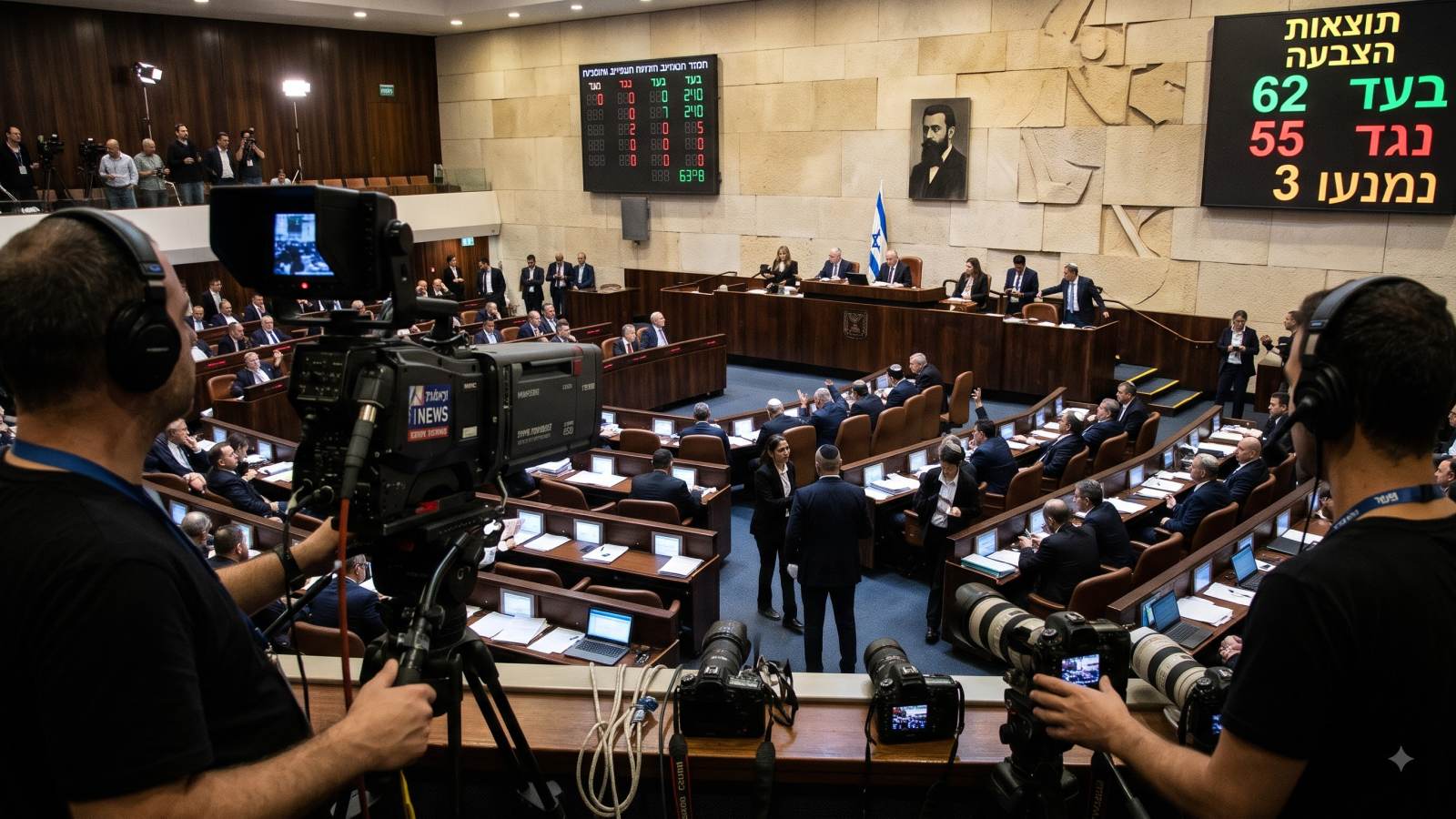
Neither camp is close to the 61 seats needed to govern, so 19 Arab-led seats now decide who becomes prime minister, and Likud is questioning those votes before talks start.
The final arithmetic
Israel's Central Elections Committee released the final count early Friday, leaving no bloc at the 61-seat threshold required to form a government. Negotiations could now run for weeks, or another election could follow if they fail.
Benjamin Netanyahu's camp finished ahead of the opposition, but well short of a majority. His coalition of right-wing and far-right parties took 53 of the Knesset's 120 seats.
On 27 seats, Likud remained the largest single faction. The opposition bloc, led by the centrist Gadi Eisenkot, secured 48.
The two Arab party groupings, Raam and the Joint List, won a combined 19 seats, making them potential kingmakers.
| Grouping | Seats |
|---|---|
| Likud | 27 |
| Netanyahu bloc | 53 |
| Opposition bloc | 48 |
| Raam and Joint List | 19 |
| Total Knesset | 120 |
A fall from 64 seats
Set against the last election, the result is a clear reverse for the prime minister. Netanyahu's alliance held 64 seats after the 2022 vote and now holds 53.
The movement on the Arab side went the other way. Arab political groups recorded an unprecedented performance, with their combined representation rising from 10 seats to 19.
Turnout reached its highest level since 1999. Widely seen as a referendum on Netanyahu's leadership, the election came particularly after the Hamas-led attack of October 7, 2023 and the war in Gaza that followed.
Then and now
2022 election
Netanyahu alliance
- 64 seats
- Arab representation: 10 seats
This election
Netanyahu alliance
- 53 seats
- Arab representation: 19 seats
The fraud claims
After the final tally was announced, Netanyahu's camp circulated unproven claims on Thursday that foreign money had gone to Arab-Israeli groups to sway voters. During voting, Netanyahu had also alleged fraud, claiming Arab parties were caught with envelopes of cash. Likud continued promoting the claims through Thursday.
The allegation at the heart of the dispute is that Qatar, a wealthy Gulf powerbroker with channels to Hamas, sent funds to Raam for vote-buying. Likud gave the affair a name.
The Raamgate scandal is a political earthquake. Israel's elections have been stolen!
Raam leader Mansour Abbas said he had done nothing wrong and welcomed an investigation. The two Arab-majority lists and Qatar rejected the claims. Qatar called them ridiculous and dangerous.
No'am Sohlberg, the Supreme Court judge who heads the Central Elections Committee, sent the allegations to the Shin Bet for examination. He said he'd been alerted to concerns about possible improper foreign involvement in voter mobilisation, but couldn't verify the claims himself.
The Shin Bet said it was investigating suspected irregularities, while stressing the limits of the work in hand.
cast aspersions or place blame on an entire sector that went out to vote in a democratic and lawful manner
The service later said its probe into possible foreign interference had a narrow scope and was not launched in response to information supplied by any political party.
Suggestions of widespread problems were entirely groundless, said Dean Livne, acting director general of the Central Elections Committee. In a letter to Yesh Atid lawmaker Vladimir Beliak, Livne wrote that the committee knew of no evidence to support allegations of widespread violations.
entirely groundless
Israeli police said their investigation and intelligence work had produced no evidence for Likud's claims. Three suspects were arrested. The election commission described the incident as an isolated local case.
The opposition responds
After Netanyahu failed to win a governing majority, opposition figures accused him of trying to undermine confidence in the results. Eisenkot said Likud and the prime minister had set out to discredit the outcome.
It's already clear that Likud and Netanyahu have embarked on a coordinated, organised campaign seeking to delegitimise the results of the election.
Eisenkot said he'd been briefed by the Shin Bet and the election committee. It was too early to understand what happened, or whether anything happened at all.
Yair Golan, a left-wing candidate, was more direct about the prime minister's motive.
He is trying to challenge the election results
The Joint List said Netanyahu and his allies were seeking to stir hostility because Arab voters were gaining political influence.
Netanyahu's own Qatar record
The prime minister has long been under a cloud of allegations connected to Qatar. Last year, two of his aides were arrested over allegedly receiving payments from the Gulf state.
For years, Netanyahu tacitly backed Qatar's funding of Hamas in Gaza, hoping to preserve stability. That approach collapsed on October 7, 2023. Netanyahu is Israel's longest-serving prime minister.
The talks ahead
Yousef Jabareen, head of the Joint List, told AFP he was willing to work with the opposition to bring Netanyahu down, but not to join it in a government.
On 29 October, Israeli left-wing activists held placards outside Eisenkot's home in Herzliya, calling for a government that includes Arab parties. Eisenkot leads the Yashar party.
The certified results are still expected to be formally submitted to President Isaac Herzog on 4 November, without delay from the Shin Bet's inquiry. Coalition talks will follow. Another election is possible if they fail.
- 29 October 2026Protest in Herzliya
Left-wing activists demonstrate outside Eisenkot's home for a government that includes Arab parties.
- 30 OctoberFinal count
The Central Elections Committee releases the final tally early Friday.
- 4 NovemberCertification
Certified results are due to be submitted to President Isaac Herzog.
What we know
- Netanyahu's bloc holds 53 seats and the opposition 48, with no bloc at 61.
- Raam and the Joint List hold a combined 19 seats.
- Police found no evidence supporting Likud's fraud claims.
- Certified results go to President Isaac Herzog on 4 November.
Still unclear
- Whether the fraud allegations are true.
- Whether a government can be formed or Israel heads to another election.
- The outcome of the Shin Bet inquiry into suspected irregularities and possible foreign interference.
- The date of any new election if talks fail; sources say only early next year.
If the fraud allegations aren't established, the argument is being asked to overturn a 12-seat gap between the two camps: 53 for Netanyahu against 48 for the opposition, with 19 seats held by the Arab-led lists in between.