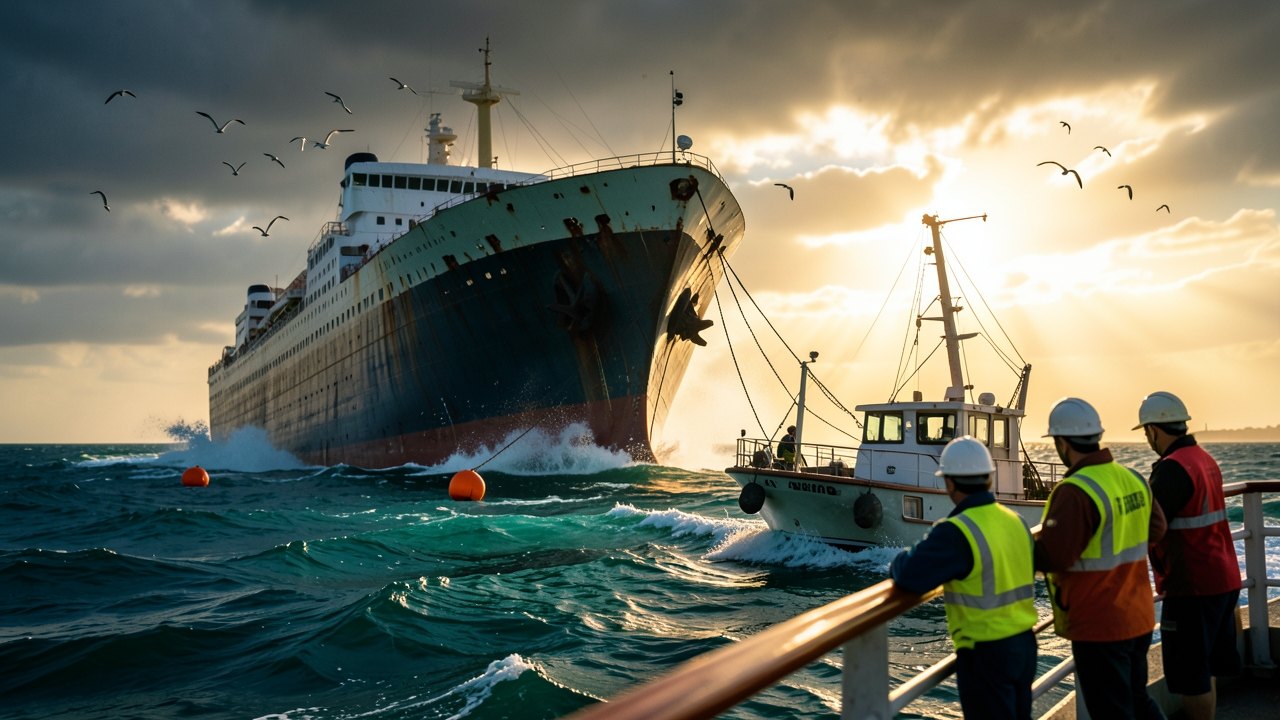
The SS United States was deliberately sunk off Destin, Florida, on 11 November 2026, beginning its conversion into the world’s largest vessel-based artificial reef.
Okaloosa County led the $13.5 million project, giving the former passenger liner a new role as marine habitat and an attraction for divers and fishing enthusiasts. It takes the vessel-reef record from the USS Oriskany, sunk off Pensacola in 2006.
The controlled sinking took several hours longer than organisers expected, and in its final moments the liner tilted to one side before going beneath the surface.
To help the ship settle evenly on the ocean floor, crews filled 128 tanks that had held fuel and lubricants with water.
The new vessel-reef record
SS United States
Vessel-based artificial reef
- 108 feet longer than the Titanic
USS Oriskany
Sunk off Pensacola in 2006
- Previously the largest artificial reef created from a vessel
The SS United States is 108 feet longer than the Titanic, whose length was 882 feet nine inches. The USS Oriskany, which the liner replaces as the largest vessel reef, measured 911 feet.
The ship is expected to lie about 180 feet (55 metres) deep, roughly 25 miles (40 km) southwest of Destin. But those figures are projections; its final resting depth and position haven't been confirmed through post-sinking measurements.
What we know
- The SS United States was sunk off Destin, Florida, on 11 November 2026.
- The project was led by Okaloosa County and cost $13.5 million.
Still unclear
- The wreck’s confirmed final depth and position.
- How close the upper sections will lie to the surface. One source expects the upper deck to sit 50 to 60 feet below the surface; another says upper sections will rise to within about 17 metres.
Okaloosa County said the reef would create habitat that didn't previously exist, benefiting marine life, fishing and tourism.
Artificial reefs prepared in this way are a benefit to the marine ecosystem, not the other way around. They create habitat that did not previously exist and foster the development of a diverse environment that can thrive for the overall health of the environment that benefits marine life, our fishing industry and tourism as a whole
Nicholas Ray of Nottingham Trent University described a possible sequence of marine growth on the cleaned hull, with bacteria and microalgae expected to form a biofilm within hours of immersion, followed by small animals and algae within three months.
By the end of the first year, hard corals are expected to begin establishing themselves permanently. Ray said the hull could become increasingly encrusted over the following five to ten years, while fish and other marine life are expected to colonise the wreck naturally.
The county bought the vessel for $1 million in 2024 and later sent it to a shipyard in Mobile, Alabama, for preparations. The yearlong cleanup removed residual fuel, wiring, glass and other non-metal components; no explosives were used.
Workers cut openings into the hull and decks to let seawater enter, and removed more than 400 portholes. Before the sinking, the ship’s two 65-foot smokestacks were taken off; they're expected to become part of a museum celebrating the liner.
She is an amazing lady who will not lay down without a fight
During its 1952 maiden voyage, the liner set a transatlantic passenger-ship speed record of three days, 10 hours and 40 minutes, averaging 35.59 knots. That record remains unbroken.
The liner completed more than 800 transatlantic crossings before its decommissioning in 1969, as commercial air travel gained popularity. After retiring, it spent decades moored in Philadelphia.
In 2021, port authorities raised the daily dockage fee to $1,700, a cost the nonprofit conservancy could no longer afford.