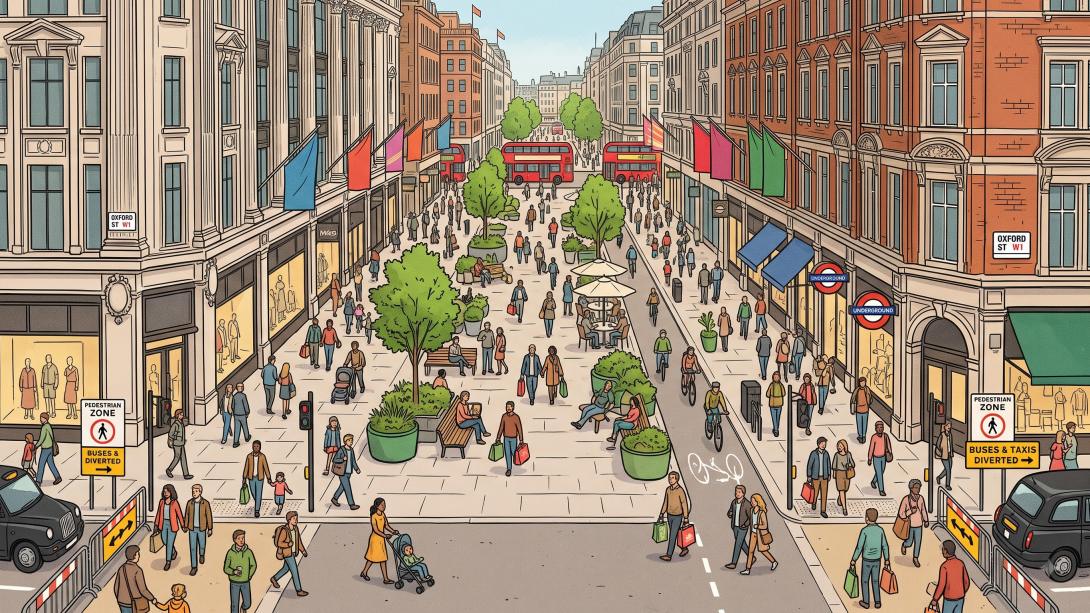
An almost 1km section of London’s Oxford Street closed permanently to traffic on Monday as the first phase of its regeneration began.
The change affects buses, taxis, cars, cycles and other vehicles on a street visited by about half a million people daily. Supporters expect a greener, more attractive shopping district, while residents and Westminster City Council fear diverted traffic will burden neighbouring roads.
| Change | Details |
|---|---|
| Closed section | Between Orchard Street near Selfridges and Great Portland Street |
| Vehicles barred | Buses, cars, taxis, private hire vehicles, cycles, scooters and pedicabs |
| Deliveries | Midnight to 7am |
| Diversion routes | Wigmore Street, Henrietta Place and Cavendish Place |
Deliveries to the pedestrianised section are now limited to overnight hours, between midnight and 7am. Vehicles that cannot use Oxford Street are being sent through surrounding roads, while new bus stops are about 200 metres from the pedestrianised area.
The mayor’s office says around half a million people visit Oxford Street each day. It generates around £3.1bn in annual spending, making the street a major part of London’s retail economy.
The closure starts a wider redesign
The wider regeneration project will move into its next phase in 2027, with plans for two public squares, rest areas, improved signage and lighting, 100 new seats and more than 50 new trees.
The project will remain relatively quiet before Christmas. More substantial construction is scheduled for spring 2027, while only minimal construction will take place during the run-up to the Christmas trading period.
- 2018Earlier proposal blocked
Westminster Council blocked an earlier plan to pedestrianise Oxford Street.
- Last two yearsDevelopment body created
The mayor’s office created the Oxford Street Development Corporation to shepherd the project.
- Monday 26 October 2026Traffic restriction begins
An almost 1km section closes permanently to traffic.
- Spring 2027Major construction
Substantial construction is scheduled to begin.
Momentum built over the last two years after the mayor’s office created the Oxford Street Development Corporation. The corporation took key planning powers away from Westminster City Council and transferred them to a mayoral body.
A public consultation found that removing traffic would attract new shops and visitors and help make Oxford Street an iconic destination. The project was also helped by the Elizabeth train line, which has a stop on Oxford Street.
London Mayor Sadiq Khan said the opening was a turning point: “This is a momentous day for London, a momentous day for Oxford Street,” he said. “After so many false dawns and now working with a government who share the scale of my ambition, I’m proud that we’re finally unlocking a new era for the street.”
This marks an exciting new chapter for Oxford Street, creating a greener, more vibrant place that will attract visitors and investment, support businesses and jobs, and drive growth in the heart of our capital

Rayner said the project would bring more greenery and make the street livelier, attract visitors and investment, help businesses and jobs, and fuel growth in the capital.
The plan has faced local opposition
Residents opposed the scheme because they said diverted vehicles would clog their neighbourhoods and reduce their influence over decisions. Westminster City Council also objected, warning that traffic moved away from Oxford Street could increase congestion on neighbouring roads.
It feels rushed, it feels under-resourced, and it feels slightly undercooked
Barnes said the council’s concerns centred on the speed of the plan, the resources behind it and the arrangements for streets around Oxford Street. Buses and other vehicles are being redirected through Wigmore Street, Henrietta Place and Cavendish Place.
Andy Lord, London’s Transport Commissioner, said Transport for London would track traffic movements, make changes where needed, and was “closely monitoring these changes to make sure they are working for everyone”.
Opposition and support
Residents and Westminster Council
Concerns
Traffic pressure
- Diverted vehicles could clog neighbourhoods
- Congestion could rise on neighbouring roads
- Local influence over decisions could fall
Transport authorities and retailers
Support
Regeneration
- Traffic movements will be monitored
- Adjustments can be made where necessary
- Retail investment could be complemented
Retailers want the street to compete again
The project comes as Oxford Street faces changes in the retail market. Since the pandemic, the number of vacant shops has more than quadrupled. House of Fraser and Topshop, among the street’s flagship retailers, closed their stores in recent years, while the arrival of US candy stores put off many shoppers.
The street still includes major retailers such as Selfridges, Zara, John Lewis, Marks & Spencer and Tiffany & Co. It is also connected to Bond Street and Regent Street.
John Lewis, which has traded on Oxford Street for more than 160 years, said its multimillion-pound investment in its flagship store would be complemented by the changes; Selfridges backed the plans, while Savills reported increasing competition among retailers looking for space on the street.
We’re experiencing unprecedented appetite from brands for space on Oxford Street, with competition for prime units continuing to intensify
The scheme is expected to add £82m in value to the area each year, the Greater London Authority estimates, through higher footfall and longer visits. City officials say pedestrianising the street will help return it to the ranks of major global shopping destinations such as Times Square, the Champs-Élysées and La Rambla.
Khan said he wanted the street to offer stronger retailers: “I’m looking forward to good quality shops rather than the dross we’ve had,” the mayor said.
The economic and environmental gains remain untested
The projected £82m in annual area value has not yet been shown in results, and it is not known whether shop sales will rise. It is also unclear how much traffic will move onto surrounding roads or whether any congestion will ease over time.
Transport for London estimates that pedestrianisation will have only a minimal effect on nitrogen dioxide emissions, which were already falling because of Ulez. In 2014, Oxford Street had the world’s highest concentration of nitrogen dioxide pollution.
The final permanent design is also not yet known beyond the features announced for 2027. The future of the temporary arrangements after the Christmas trading period has not been set out.
The sources describing the closure agree that it runs between Orchard Street near Selfridges and Great Portland Street. Other descriptions use the Selfridges and IKEA stores as landmarks, and the accounts also differ over the full list of restricted vehicles. The broader list used for the closure includes taxis, private hire vehicles, scooters and pedicabs as well as buses, cars and cycles.
Substantial construction is scheduled for spring 2027, after minimal work during the run-up to Christmas.