Today

Times are shown in IST and UTC

New Delhi Smog Reaches Severe Levels After Diwali Fireworks

Thick smog blanketed New Delhi on 9 November after Diwali firecrackers, pushing air quality into the severe category despite a Supreme Court ban on conventional fireworks. The annual winter pollution crisis stems from multiple converging sources: holiday fireworks, crop burning in neighbouring states, stagnant weather, and local vehicles and industry.

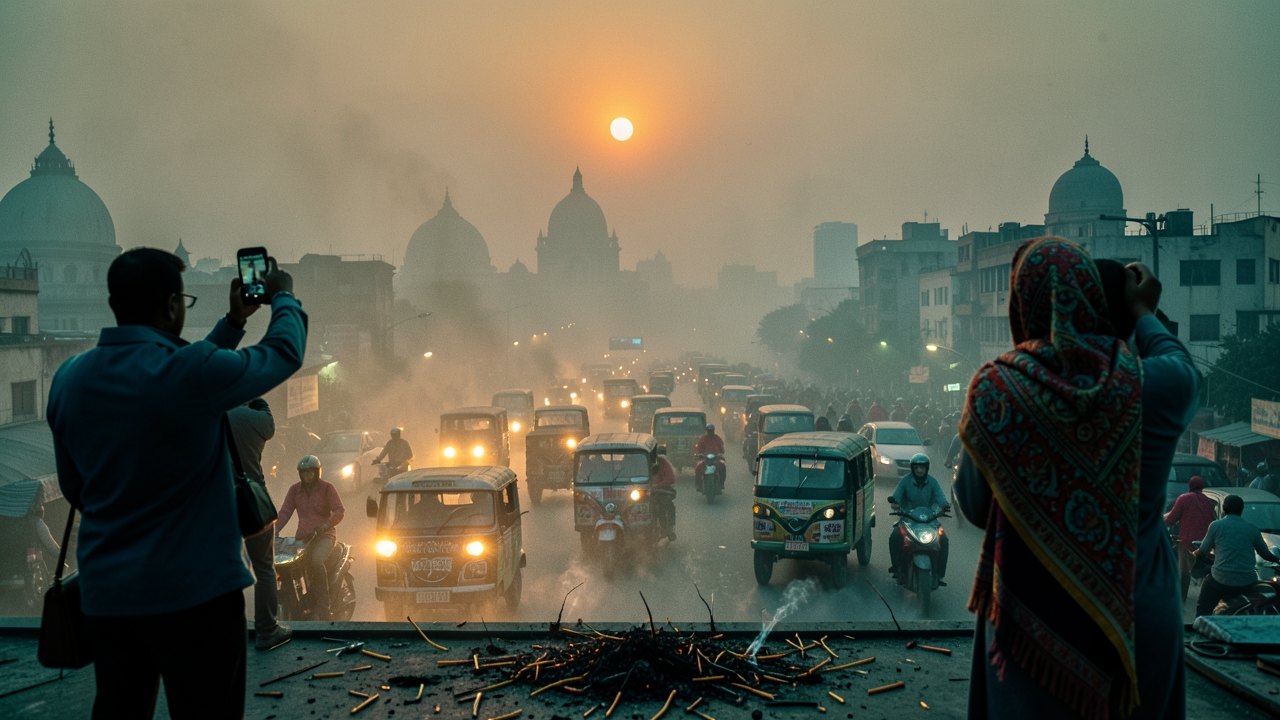
AI illustration of smog-covered New Delhi at dusk, with anonymous figures on a rooftop and traffic below in amber haze.
Illustration: AI-generated

The short version

  • The air quality index in New Delhi exceeded 350 on 9 November, placing it in the severe category despite court-ordered firecracker restrictions.
  • Approved green firecrackers emit less pollution but still release particulate matter and other pollutants into the city's already hazardous air.
  • Pollution worsens when Diwali fireworks coincide with crop-residue fires in neighbouring Punjab and Haryana, stagnant weather, and low wind speeds.
  • Vehicles, industries and construction dust compound the crisis alongside seasonal factors.
  • Authorities have limited construction and restricted diesel generators, but court orders and temporary measures have not stopped severe pollution returning each year.

Why it matters: New Delhi and its metropolitan region have more than 30 million residents and regularly rank among the world's most polluted areas in winter.

On this page
  1. The short version
  2. Court orders and approved alternatives
  3. Why winter worsens the crisis
  4. Why temporary measures fail
  5. Sources and further reading
  6. Frequently asked questions

Thick smog blanketed New Delhi on Monday after Diwali firecrackers, pushing air quality into the severe category despite a Supreme Court ban on conventional fireworks.

On the morning of 9 November, the air quality index exceeded 350 in several parts of the capital, placing it in the severe category. Monitoring stations across the city recorded similarly alarming levels, while a grey haze covered streets and high-rise buildings and visibility fell.

Isyad, a New Delhi resident, described the impact on his health: "Because of the pollution there is irritation in the throat and itching in the eyes."

With more than 30 million residents, New Delhi and its metropolitan region are staggering in scale. They regularly rank among the world's most polluted areas in winter.

The firecracker ban

Court orders and approved alternatives

India's Supreme Court in October 2026 restricted conventional firecrackers and allowed only approved green firecrackers under specified conditions, in three-hour windows on Saturday and Sunday. Yet the approved green firecrackers emit less but are not pollution-free, and still release particulate matter and other pollutants into the city's already hazardous air. The smog that engulfed New Delhi on Monday showed the limits of this approach.

Converging causes

Why winter worsens the crisis

Several sources fuel New Delhi’s winter pollution crisis. Diwali fireworks, cooler conditions and smoke from crop-residue fires in Punjab and Haryana all contribute. After harvest, farmers set fire to leftover rice stalks to prepare fields for the next planting season, sending smoke toward New Delhi.

Pollution peaks in late October and November. Cooler air, weak winds and still atmospheric conditions keep pollutants from dispersing, while vehicle emissions, industrial activity, construction dust and crop burning add to the problem. The resulting dense haze can linger over the capital and nearby areas for days.

Structural problems

Why temporary measures fail

New Delhi's authorities have limited construction work and put curbs on diesel generators, and courts have sought limits on firecrackers. Severe pollution still returns every year. Shweta Narayan, who works on public health for the Global Climate and Health Alliance, said the response so far had been "knee-jerk" and "temporary". "A lot of interventions happen only because the government is pressured or pushed in a corner to do something," she said.

Environmentalists say preventing the yearly crisis will require lasting measures, including a shift to cleaner energy and tougher limits on vehicle emissions.

Authorities have not announced further action after the 9 November readings.
Sources and further reading

  1. Diwali festivities contribute to New Delhi smog (opens in a new tab) Taipei Times
  2. Thick smog shrouds New Delhi after Diwali firecrackers add to seasonal pollution (opens in a new tab) Mongabay
  3. Thick smog shrouds New Delhi after Diwali firecrackers add to seasonal pollution (opens in a new tab) NPR

This article was prepared by the GlobePrism editorial team from the public reporting linked above. How we report

Frequently asked questions

What did the Supreme Court ban on firecrackers accomplish?

India's Supreme Court in October 2026 restricted conventional firecrackers and allowed only approved green firecrackers under specified conditions in three-hour windows on Saturday and Sunday. However, the approved green firecrackers still release particulate matter and other pollutants, and the smog that engulfed New Delhi on Monday showed these restrictions have not stopped severe air quality episodes.

Why does New Delhi's smog worsen in winter?

Pollution worsens when Diwali fireworks coincide with cooler weather and smoke from crop-residue fires in neighbouring Punjab and Haryana. In late October and November, stagnant atmospheric conditions, low wind speeds and cooler temperatures stop pollutants from dispersing, allowing thick haze to hang over the capital for days.

What sources contribute to New Delhi's pollution?

Vehicles, industries, construction dust and other local sources add to the pollution from crop burning. Farmers burn leftover rice stalks after harvest to clear fields for the next planting season, and the smoke drifts toward New Delhi.