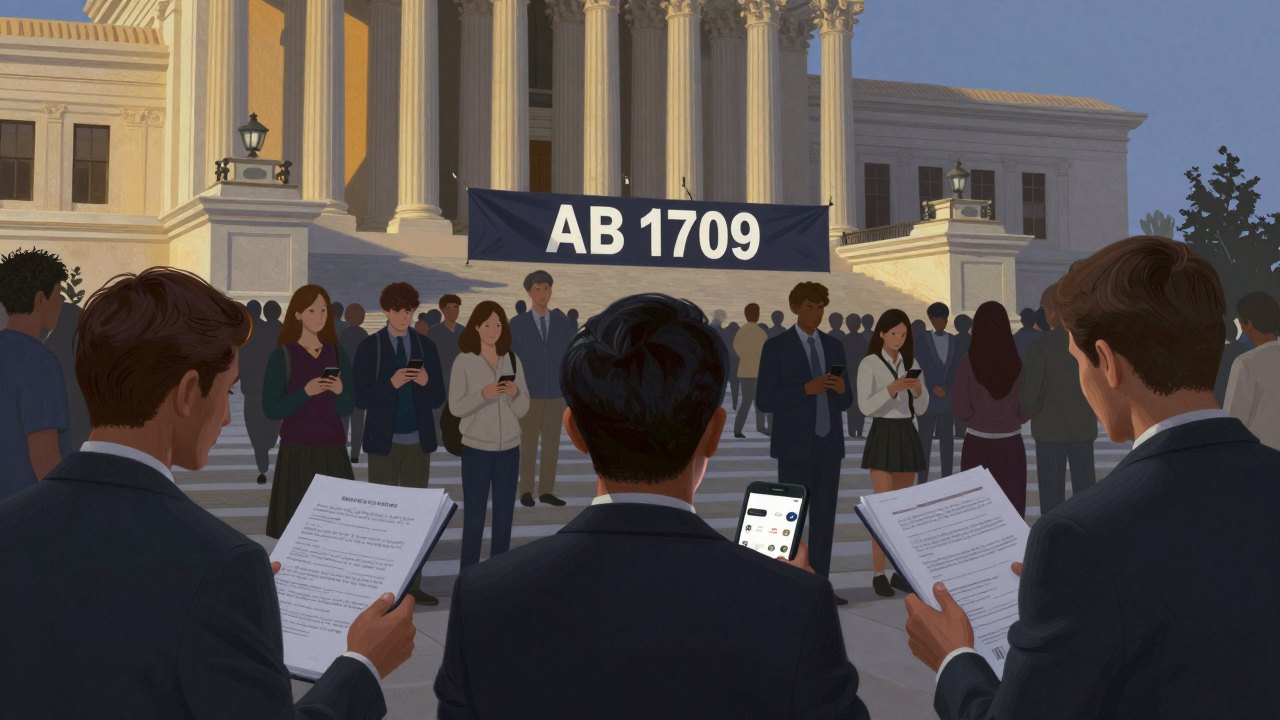
Google, Meta and TikTok sued California's attorney general this week to stop AB 1709, the state law that bans algorithmic feeds, endless scrolling and autoplay for users under 16 from January.
The companies filed separate lawsuits against Attorney General Rob Bonta on November 4 and 5, 2026, in three California federal districts. Meta filed in the Northern District, Google in San Jose and TikTok in the Central District.
All three want a court order blocking enforcement before the law begins.
| Platform | Federal court | Central claim |
|---|---|---|
| San Jose | First Amendment and Section 230 preemption | |
| Meta | San Francisco | First Amendment and Section 230 preemption |
| TikTok | Los Angeles | First Amendment and Section 230 preemption |
The complaints centre on free speech and federal preemption, with the First Amendment and Section 230 of the 1996 Communications Decency Act at their core.
What the law does
Governor Gavin Newsom signed AB 1709 on September 10, 2026.
For anyone under 16, the statute prohibits personalised feeds, endless scrolling and autoplay; platforms that continue offering those features must delete under-16 users’ accounts and the personal information attached to them.
Age verification for under-16 users is also required. Knowing violations expose a company to civil penalties of up to $50,000 for each minor affected.
In the filings’ view, California is substituting government control for parental judgment and overriding consent tools the platforms have already built.
What the filings say
Google said its complaint turns on what disappears without recommendations: the compilation of videos its youngest users would otherwise see.
Absent personalized feeds, under-16 users will be deprived of a compilation of videos tailored to their interests, preferences, and developmental needs — preventing them from effectively accessing the valuable content that YouTube provides
TikTok cast the ban as an attack on curation itself, a practice it said bookshops, television networks and streaming services rely on.
blatantly unconstitutional restriction on free expression that erodes the long-standing and protected practice of curating content based on user preferences, which bookstores, TV networks and streaming services all use
Meta's complaint put the point more broadly, arguing that the law would make it unlawful to disseminate speech to minors at all.
Bonta says he will defend the law
Bonta's office said it was reviewing the filings.
Our office is committed to defending California's commonsense laws to protect kids online
Josh Lowenthal, the Long Beach Democrat who wrote AB 1709, said the challenge "comes straight out of Meta’s playbook".
It’s just a continuation of Meta’s fight to addict children for profit. As disappointing as this development is, I do trust the courts will put children’s safety over corporate greed.
From the opposite flank, the Electronic Frontier Foundation called the law a massive privacy and free speech nightmare.
Lennon Torres, director of movement partnerships at the Heat Initiative, rejected the free speech framing behind the suits.
They're framing this as a free speech fight, but what's really at stake is a business model that profits from keeping kids scrolling, even when it puts them at risk
What Meta has already agreed to
In August, Meta settled a multistate case over teen social media addiction. Mashable reported the figure at $17 billion, while TheWrap and The Independent put it at $18 billion.
Under that deal Meta agreed to cap teen time on Instagram and Facebook at two hours a day, block access overnight and during school hours, offer a non-algorithmic feed by default and let teens switch autoplay off.
AB 1709 against what Meta already accepted
AB 1709
Signed September 10, 2026
- Bans personalised feeds for under-16 users
- Bans endless scrolling and autoplay
- Requires deletion of under-16 accounts and personal information where restricted features are offered
- Requires age verification for under-16 users
Meta's August 2026 settlement
Multistate case over teen addiction
- Two-hour daily limit for teens on Instagram and Facebook
- No access overnight or during school hours
- Default feed without an algorithm
- Teens can switch autoplay off
The record before these filings
In August, a judge declined to grant a preliminary injunction sought by TikTok, Meta, YouTube and Google against an earlier California law on social media safety.
Earlier this year, a jury in Los Angeles held Meta and YouTube liable for the social media addiction of a plaintiff when she was a child. Separately, a New Mexico jury found that Meta had breached consumer protection law and been negligent in shielding minors from predators, setting penalties of $375 million.
Thousands of suits from individuals, school districts, municipalities and other government bodies remain pending against the companies and against Snapchat parent Snap.
Australia bars under-16s from social media entirely.
- August 2026Meta settles
A multistate settlement over teen social media addiction covers claims filed by nearly every state.
- August 2026Injunction refused
A judge denies TikTok, Meta, YouTube and Google a preliminary injunction against an earlier California safety law.
- September 10, 2026Signed
Governor Gavin Newsom signs AB 1709.
- November 4 and 5, 2026Suits filed
Google, Meta and TikTok sue Rob Bonta in San Jose, San Francisco and Los Angeles.
- January 1, 2027Enforcement
AB 1709 takes effect unless a court orders otherwise.
What we know
- Google, Meta and TikTok each filed a separate lawsuit against Attorney General Rob Bonta.
- AB 1709 was signed on September 10, 2026.
- The law bans personalised feeds, endless scrolling and autoplay for under-16 users.
Still unclear
- Whether a court will pause enforcement before January 1, 2027.
- Whether the law survives the First Amendment and Section 230 challenges.
- Whether the three suits will be consolidated or heard separately.
- Whether the August Meta settlement was $17bn or $18bn.
Unless a court orders otherwise, AB 1709 takes effect on January 1, 2027. The three requests for an order now sit with judges in San Jose, San Francisco and Los Angeles.