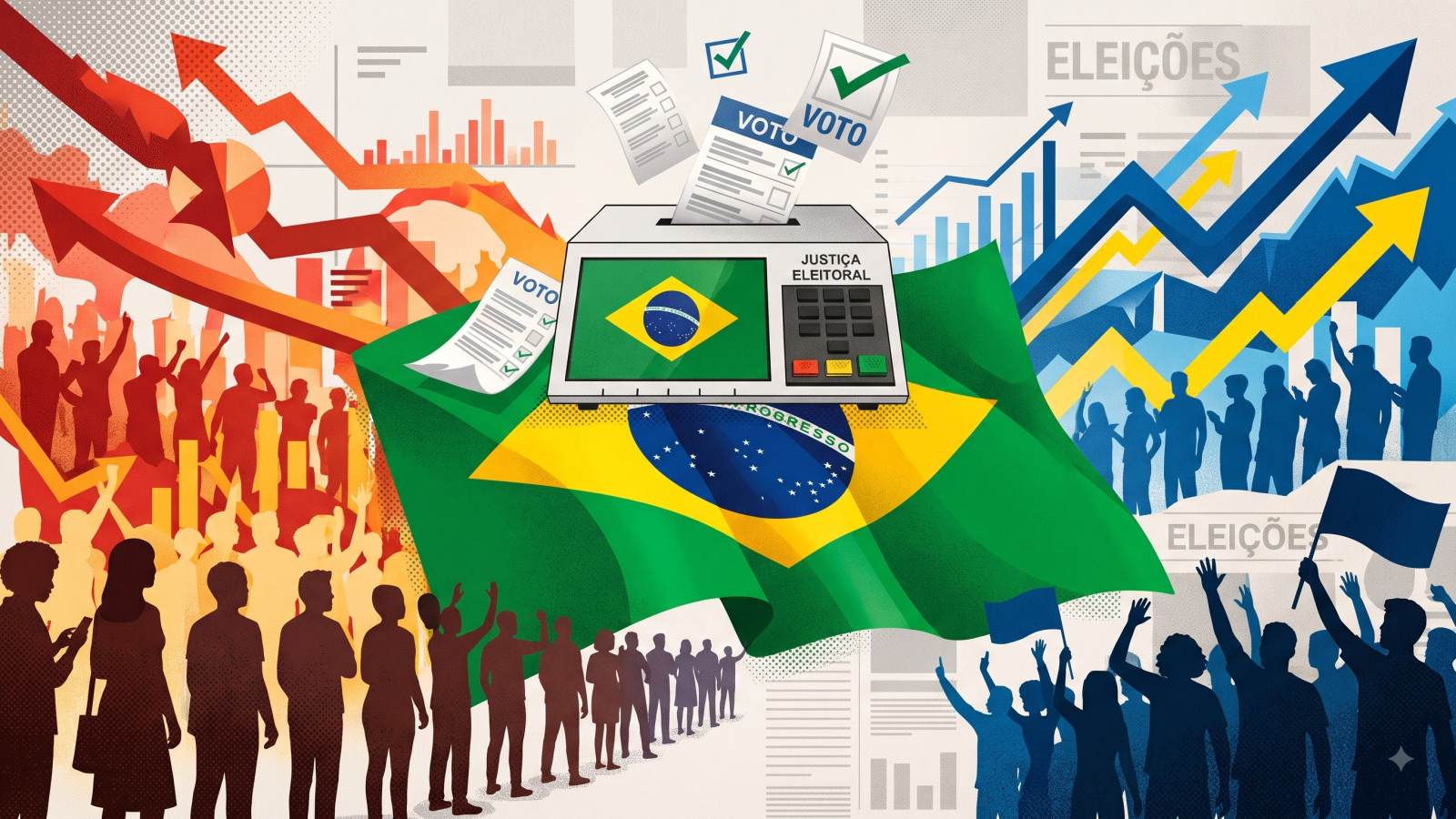
Luiz Inacio Lula da Silva won Brazil's presidential runoff with 51.7 percent of the votes, but Flavio Bolsonaro refuses to accept the outcome.
Bolsonaro said he will not recognize his defeat and will request the annulment of the vote, claiming it is impossible to recognize the elections under these conditions.
Lula's victory gives him an unprecedented fourth term. He turned 81 on Tuesday. Bolsonaro, 45, is a senator for the Liberal Party and the son of former far-right president Jair Bolsonaro, who led the first round.
Since Brazil's first direct election after the end of its dictatorship in 1989, no losing first-round candidate had ever advanced to win a runoff. Lula grew up poor in Brazil's northeast in a family of illiterate farmers and first took office in 2003. He was re-elected in 2006 and returned to office in 2022 after a corruption scandal led to his imprisonment for over 18 months; a court later annulled the charges on procedural grounds.
The voting-extension dispute
Voting day was disrupted when the Supreme Court issued a last-minute ruling that pushed back the voting deadline by two hours. Lula requested the extension, saying buses had been pulled from circulation in various cities. Supreme Court justice Cristiano Zanin ordered the extension until 7:00 p.m. at all polling stations on grounds of evident urgency and instructed the Superior Electoral Court (TSE) to implement it.
Bolsonaro said his central complaint is that Zanin extended voting by two hours across all polling stations, calling the extension unacceptable and illegal. He contended that Zanin, Lula's former personal lawyer, changed the rules mid-race at the request of a former associate, and that his party's personnel were removed from the data processing centre following the decision, taken at 5:01 p.m.
Bolsonaro's own campaign had asked to extend voting, but only in certain municipalities in the south and southeast. The nationwide extension that took effect differed sharply from what his team had sought.
TSE president Kassio Nunes Marques said the injunction issued after the official closing caused difficulties but that the technical problems were resolved and data flowed safely from 7:00 p.m.
What we know
- Supreme Court justice Cristiano Zanin ordered a two-hour extension on grounds of evident urgency and instructed the electoral court to implement it.
- The extension applied to all polling stations until 7:00 p.m.
- Bolsonaro's campaign had itself asked for an extension, but only in certain municipalities.
Still unclear
- Whether Bolsonaro's annulment request has been formally filed.
- How and when the electoral court will rule on any annulment challenge.
There was no indication that Bolsonaro's challenge had been formally filed as of the latest reports.
Campaign and recovery
The campaign was marked by scandals and mudslinging and exposed deep divisions in a country of over 200 million people. After the first-round defeat, Lula's camp held massive rallies under the slogan "Never Again Bolsonaro" and revamped its social media strategy.
Abstention fell from 21 percent in the first round to 19 percent in the runoff, indicating improved voter engagement for the runoff.
In his third term Lula reduced inflation and unemployment and lifted millions out of hunger, but many voters felt gloomy about the economy and fed up with crime. Flavio Bolsonaro pitched himself as more moderate and jovial than his father and galvanised conservatives and voters who rejected ideological politics, frustrated by crime, soaring living costs and economic stagnation.
Celebrations and immediate response
Celebrations broke out in Rio de Janeiro and São Paulo, where thousands dressed in red, the colour of Lula's Workers' Party, took to the streets. Lula appeared in a social media video jumping for joy while wearing red, star-shaped glasses at a São Paulo hotel where he was scheduled to address the press.
Challenges ahead and regional significance
When his term ends in 2030, Lula will be 85 and will have spent 16 years in power counting his 2003-2010 stint. He faces a hostile Congress dominated by the right, an economic outlook with growth expected to slow, and pressure to confront rampant security problems from criminal factions.
Lula's victory was framed as staving off a conservative wave that has seen Argentina, Chile, Colombia and Peru shift right, backed by US President Donald Trump. Lula's campaign leaned heavily on sovereignty against commercial and diplomatic pressure from Trump's US; he said his rival wanted to govern with the American flag.
António Costa, President of the European Council, and European Commission President Ursula von der Leyen both said they had spoken with Lula to congratulate him on his re-election. They said democracy and multilateralism had won in Brazil and that the EU would keep working toward free trade, globally binding rules and climate ambition.
The Superior Electoral Court's handling of Bolsonaro's expected annulment request will determine whether the result stands unchallenged.