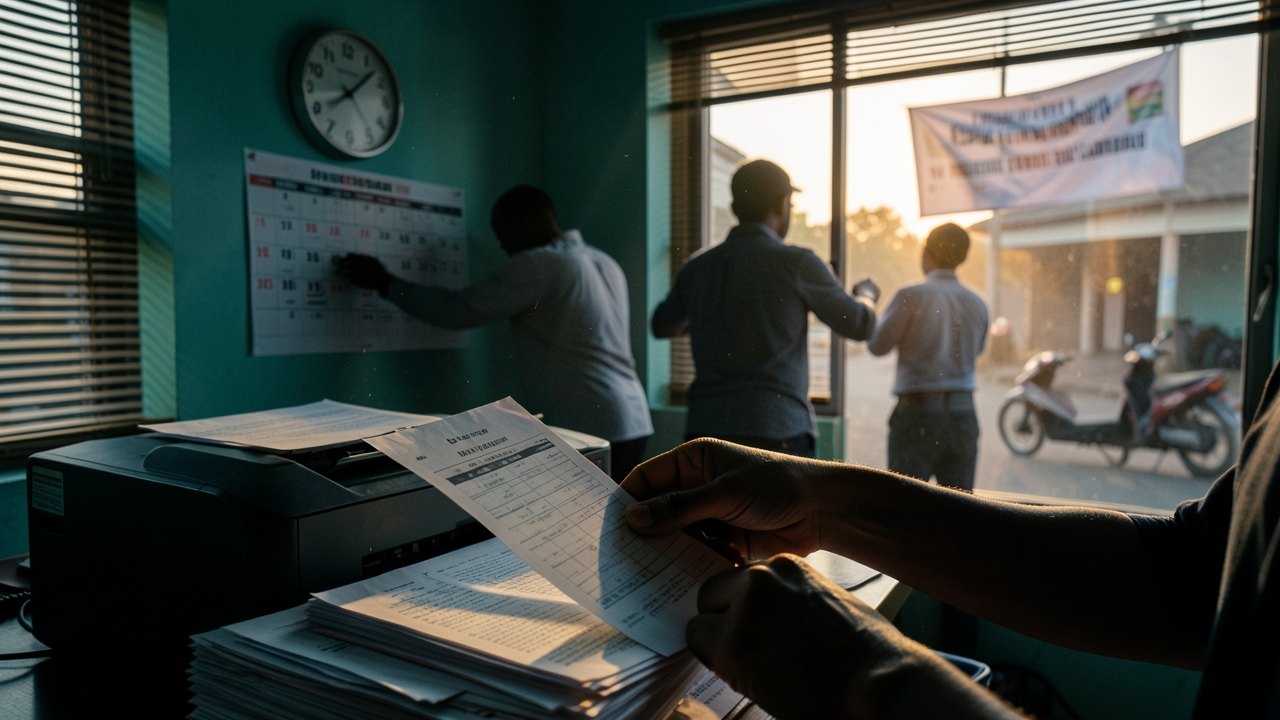
South Sudan pushed its first national election from 22 December to 11 February 2027, publishing a new timetable as voter registration was due to begin.
On Saturday, 14 November, the National Elections Commission moved both the presidential and legislative votes, while voter registration, scheduled to open the same day at 3,161 centres across the country's 10 states and three administrative areas, will now run to 28 November.
South Sudan has never held a national election since independence from Sudan in 2011. The vote has already slipped twice before, in 2022 and 2024.
We didn't postpone the elections. We have just adjusted the time to allow other processes to be implemented and that is according to the law
Article 57 of its founding law allowed the date to be adjusted, the commission said. Information minister Ateny Wek Ateny explained that the additional time would be used to register and educate voters. Ahon Malou Lueth, the commission's secretary general, confirmed the change to AFP but offered no explanation, and the published timetable didn't state a reason.
The political upheaval behind the delay
Since President Salva Kiir dissolved the transitional government in September, he has ruled by decree in a caretaker administration. Kiir fired Vice President Riek Machar, who was placed under house arrest in Juba in March 2025 and charged with treason.
Machar and seven co-defendants face charges of treason, murder and crimes against humanity over an assault on an army garrison in Nasir. They deny the allegations.
The upheaval followed a peace deal signed in 2018, which produced a transitional government of national unity in 2020. Since March 2025, the arrangement has unravelled.
The commission had yet to publish the locations of registration centres on the day voter registration was set to begin, said Edmund Yakani of the Community Empowerment for Progress Organization, who urged greater transparency in its decisions. Officials reported that some required equipment hadn't reached the centres.
Most South Sudanese lack state-recognised ID, the World Bank says, complicating voter registration. The compressed two-week registration window adds another obstacle.
International monitors warn conditions are not in place
The conditions for credible polls are not currently in place
Rushed elections could be a decisive final blow to the 2018 framework and would open the door to a return to sustained large-scale violence.
On 10 November, Anita Kiki Gbeho, who leads the United Nations Mission in South Sudan, told the Security Council that Kiir's SPLM was the only registered party showing much electoral activity. The conditions needed for credible polls were absent, she warned.
Elections must be a milestone in the transition, not its conclusion. Elections cannot substitute for political dialogue, confidence-building and continued implementation of the Peace Agreement
In late October, the South Sudan Civil Society Forum said the time remaining didn't allow for elections that were fair, credible, peaceful and inclusive, and urged inclusive dialogue. The UN Commission on Human Rights in South Sudan warned in October that an election might reignite conflict.
Two SPLM delegates were killed on Thursday in an attack in Miri Loko village, Western Equatoria state, as they returned from party primaries and congresses. Deng Dau Deng, chair of the SPLM's high-level committee in Western Equatoria, said the party's primaries and congresses in the state had now faced three security incidents.
The weight of crisis weighing on the vote
The 2013-2018 civil war between forces loyal to Kiir and Machar killed more than 400,000 people. Government employees haven't been paid for more than a year, while armed groups, among them Machar's forces, control parts of the country.
About 10 million people in South Sudan need humanitarian assistance, and the conflict in Sudan has also driven 1.4 million people into the country. Food assistance is needed by more than 8 million of South Sudan's roughly 12 million people, the Famine Early Warning Systems Network says.
South Sudanese also face soaring food prices, drought and flooding.
Information minister Ateny acknowledged that the government could not reach some remote areas, but maintained that the election would be credible. He said, "It's not always 100 percent, but it can be good for the sovereignty of the country and it's good for the mandate of the state,".
What remains to be seen
Still unclear
- The official reason for the postponement: the commission's published timetable gave none, and its secretary general declined to elaborate.
- Whether the 11 February 2027 vote will actually take place or slip again.
- The outcome of Machar's treason trial and what it means for the transition.
Voter registration is scheduled to run to 28 November 2026. The vote is set for 11 February 2027, with results due four days later.