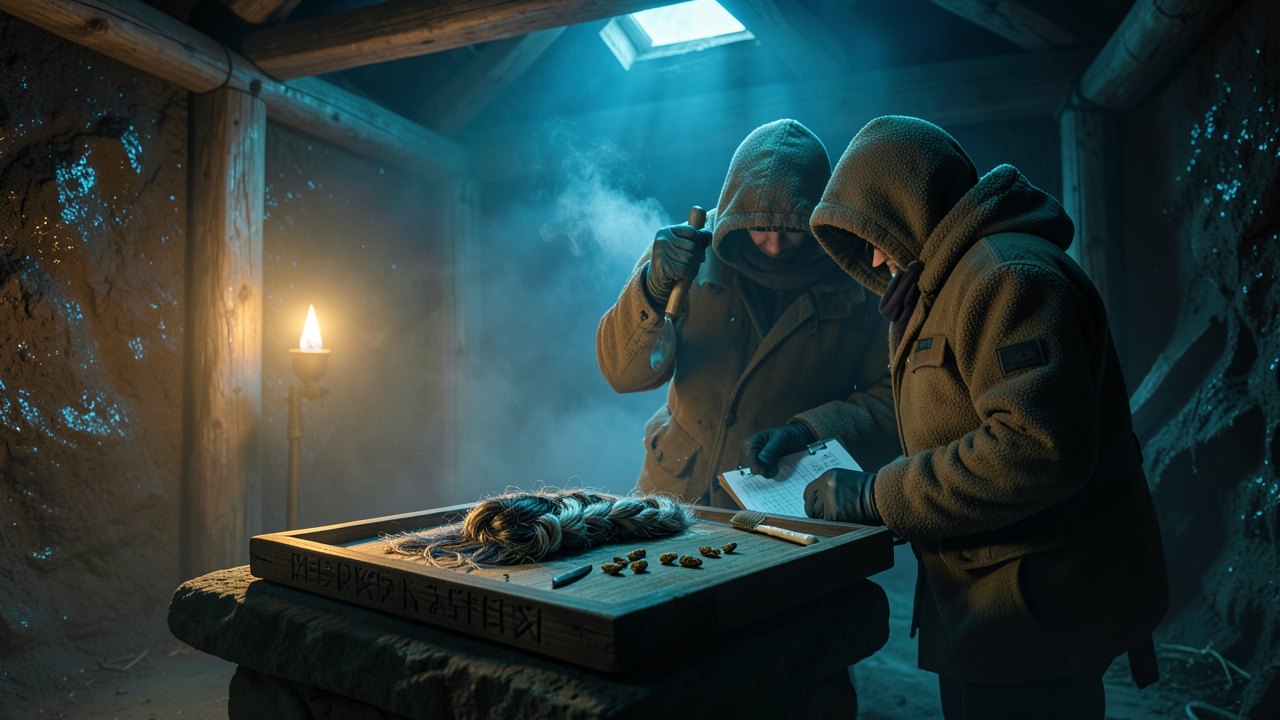
Braided hair from a 2,800-year-old Scythian royal tomb in southern Siberia has yielded the earliest direct evidence of cannabis used to get high.
Researchers describe the find in the journal Science as the oldest direct evidence that people consumed cannabis for its mind-altering effects, from a burial mound in Siberia dated to about 2,800 years ago. The mound sits in the Uyuk Valley, in Russia's Republic of Tyva in southern Siberia.
It's a monumental structure. The tomb measures around 460 feet across, was built with larch logs and clay, and was encased in thousands of tons of stones.
Inside lay high-ranking members of Scythian society, a people known for horseback warfare, gold craftsmanship and a largely nomadic life across the Eurasian steppe.
Excavators recovered more than 1,400 cannabis seeds from the burials. Six of the seeds were radiocarbon-dated, and with other dating evidence they place the deposit in the early eighth century BCE; the seeds were carbon-dated to between 800 and 760 BCE. Two summaries of the paper give a lower total of more than 1,000 seeds, and a third account describes more than 1,000 whole seeds with about 500 partial ones.
Chemical analysis of braided hair from several people in the central burial chamber found signatures consistent with THC, the compound that makes cannabis psychoactive, and traces of cannabinol. Working with high-resolution mass spectrometry and other techniques, the team reported clear cannabinol signals in several hair samples and weaker signals matching the mass of THC.
Our study shows the earliest direct evidence of psychoactive cannabis consumption
Caspari said speculation about psychoactive drug use in the ancient past is common, while hard confirmation isn't.
There is a lot of speculation about the use of psychoactive drugs in the past, but very rarely do we find concrete evidence and can actually confirm that a plant was consumed for this purpose
Where the new find sits in the record
The discovery moves the record back past several earlier lines of evidence. Implements for burning cannabis have been found in the Middle East and the Pamir Mountains in Central Asia and dated to the first millennium BCE, while a cemetery in China dated to about 500 BCE held earlier evidence of use, a date the new study pushes back by three centuries. A separate account of the earlier record puts it at around 2,500 years ago, from charred cannabis remains in eastern China that contained high levels of THC.
| Detail | Figures given |
|---|---|
| Cannabis seeds recovered | more than 1,400 in the account of the excavation; more than 1,000 in two summaries of the paper; more than 1,000 whole seeds with about 500 partial seeds in a third |
| Age of the deposit | about 2,800 years ago for the burial mound; 800-760 BCE for six carbon-dated seeds; eighth to ninth century BCE for the mound in another account |
| Earlier evidence of use | a cemetery in China dated to about 500 BCE; around 2,500 years ago, from charred remains in eastern China |
The seeds were identified as Cannabis ruderalis, a wild type of cannabis. They were probably from wild plants, and the researchers couldn't determine whether people cultivated them deliberately for psychoactive properties.
We had our suspicions when the little seeds first appeared in the tomb, but when we spotted the netlike pattern on the surface, this was a real moment when we knew we were holding something very special in our hands
A little later the team saw preserved human hair in the same burial, which Caspari said was almost too good to be true.
Herodotus, writing in the fifth century BCE, said the Scythian nomads inhaled fumes from burning hemp seeds.
Herodotus described the spectral cavalcade ritual but we were always quite hesitant to believe his writings, as he tends to drift into the fantastic. After finding the remains in southern Siberia, we know that at least some of his descriptions about the steppe peoples had some truth
Caspari said cannabis found in a large burial has to be read in a ritual context. Animal and human sacrifices appear to have been built up on the surface of the mound as a spectral cavalcade, and horses and dead riders propped on stakes would have featured as a display of extreme social power within steppe communities.
The remains of 18 horses, deliberately positioned on the burial mound, were found during previous work at the site. As excavation continued, several dozen more sacrificed horses turned up, along with scattered human bones among the remains.
Caspari said the princely tomb held extensive horse offerings and likely human sacrifices, too.
The study's authors suggest human sacrifice may have made the plant a useful agent for calming people who were to be included in the rites.
Two outside assessments
Bard College archaeologist Casper Meyer, who didn't take part in the study, said the seeds and human hair together provide compelling evidence that people used the plant to get high. The discovery offers a way to consider what ritual can involve and how it can unite people.
William Taylor, an archaeologist with the University of Colorado Boulder who was not involved in the work, said the evidence fills an important gap in understanding human history. The find could lead people to conclude that the Scythians simply smoked the plant.
But in fact, it is a tremendously powerful snapshot into an interconnected world in which the people and cultures of the steppe were starting to shape life on both ends of a massive continent.
The seeds still hold DNA
The researchers have begun sequencing some of the seeds and report well-preserved DNA, which Caspari called currently the oldest cannabis DNA known.
That genetic material, he said, is rarer than the plant remains themselves, and he expects the coming years to add detail and partly rewrite the domestication history of the crop.
The Scythian culture had no written language, so researchers rely on sites such as Tunnug 1 for clues to an empire that spanned from as early as the ninth century BCE to as late as the third century CE. Cannabis itself has been cultivated for agricultural purposes for at least 6,000 years, including as an oilseed crop, according to the study.
The study adds a measure of realism to these arguments, Caspari said. Evidence of psychoactive use is extremely rare, and cannabis has a deep cultural history that might inform ongoing discussions of legalisation and medical use.
What the evidence cannot say
The findings don't reveal the amount consumed or the route by which the compounds entered the body. The individuals might have breathed in smoke or taken the plant in another form. Questions about the chemistry include the ancient cannabis’s THC content, its potency, and whether Scythian communities had begun selecting or growing varieties with higher concentrations of psychoactive compounds.
What we know
- Braided hair from the central burial chamber carried signatures consistent with THC and clear cannabinol signals.
- Six seeds were radiocarbon-dated to between 800 and 760 BCE.
- The seeds were identified as Cannabis ruderalis, a wild type of cannabis.
Still unclear
- How much THC the ancient cannabis contained.
- How much was consumed and by what route.
- Whether Scythian communities were selecting or cultivating plants for psychoactive compounds.
- Whether the seeds came from wild or deliberately cultivated plants.
What the find does and does not show
What the tomb establishes
Chemistry and DNA
- Signatures consistent with THC in braided hair
- Clear cannabinol signals in several hair samples
- Seeds identified as wild Cannabis ruderalis
- Well-preserved DNA, described as the oldest cannabis DNA known
What it cannot establish
Open questions
- How much THC the plants contained
- Whether the plants were unusually potent
- How much was consumed, and by what route
- Whether the seeds came from wild or cultivated plants
Caspari said inhalation seems likely on the basis of later evidence in the region, though the hair alone can't show how the cannabis was consumed.
Future work, he said, will help establish the history of the domestication and spread of the crop.