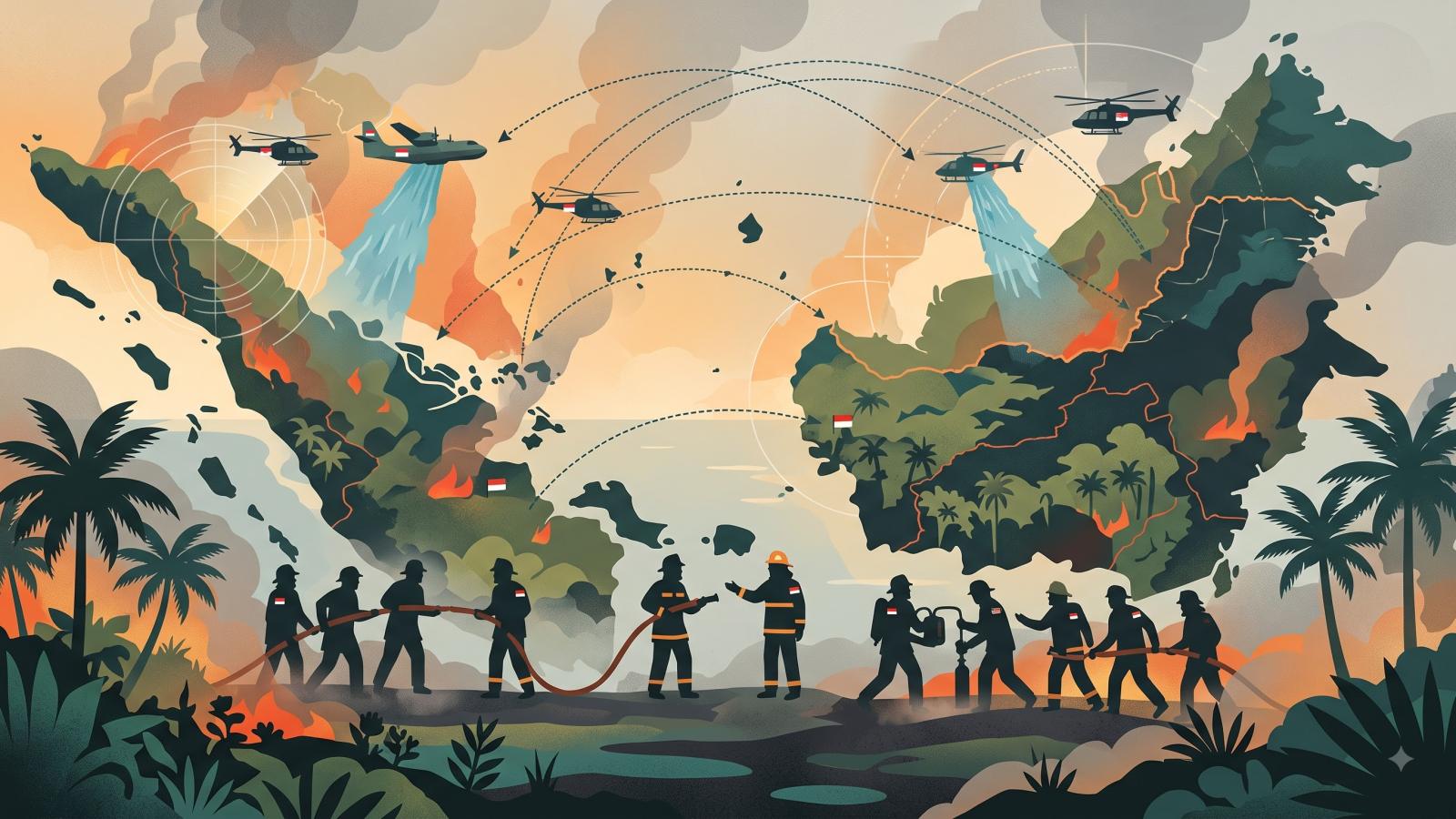
Malaysia and Indonesia have begun discussions on joint action against fires in Kalimantan and Sumatra that are sending haze across borders.
The talks are an initial attempt to coordinate a crisis affecting Malaysia, Indonesia and Singapore. The haze has continued for almost two months, with respiratory conditions reported across the three countries and schools closed in parts of Malaysia.
The practical question is what form of assistance can speed up work at the fire sites. Malaysia has offered firefighting aircraft, three helicopters and 52 people. Singapore has also said it is ready to help Indonesia wherever necessary.
Malaysian Foreign Minister Datuk Seri Mohamad Hasan said agencies and ministries from both countries are involved, including Malaysia's National Disaster Management Agency, Foreign Ministry and National Security Council.
Our secretary-general (Tan Sri Amran Mohamed Zin) has held discussions with MKN, Nadma and the Indonesian side on how we can jointly address these fires. This is the latest development.
The two governments have not settled the eventual arrangement. Hasan said the talks are the first cooperation effort of this kind between the authorities, but the details will depend on their outcome.
The form of cooperation will depend on the outcome of the discussions, but the authorities of both countries have, for the first time, begun talks on how we can work together to tackle the haze, which appears to be getting worse
Indonesia's firefighting effort is concentrated in Central Kalimantan and South Sumatra. Limited water supplies and operational difficulties are continuing to slow the response.
Environment Minister Jumhur Hidayat said discussions with Indonesia's National Disaster Mitigation Agency indicated that putting out the fires should take a few weeks. The fire intensity had begun to decline, creating hope that the work could finish in less than a month, although that target is not certain.
Based on discussions with the National Disaster Mitigation Agency (BNPB), it should take a few weeks (to extinguish the fires). But since intensity is already starting to decline, hopefully it will take less (than a month)
Aerial aid versus ground crews
Aerial support
Aircraft and helicopters
- Malaysia offered firefighting aircraft and three helicopters
- Indonesia says water-bombing aircraft must be judged on operational need and effectiveness
- Thick smoke can make helicopter access and visibility difficult
Ground crews
Personnel at fire sites
- Indonesia has already deployed tens of thousands of responders
- Officials say ground work may be more practical in some areas
- Indonesia prefers assistance that accelerates operations on the ground
Indonesia has welcomed help from its neighbours while saying that outside support must match its operational needs. Jumhur said small groups of additional personnel could have limited effect because tens of thousands of responders are already deployed, and that offers involving water-bombing aircraft should be assessed for their usefulness in the areas being fought.
Berton Panjaitan, acting spokesman for the National Disaster Mitigation Agency, said ground personnel may be more effective than aircraft in some locations. Very thick smoke reduces visibility and makes helicopters less useful, while firefighters on the ground can work directly around the affected areas.
deploying ground personnel is far more practical than utilizing aircraft
The Indonesian government has also outlined legal changes intended to reduce the risk of new fires. It plans to remove a clause that permits each household to clear up to two hectares of land by burning under traditional practices.
The government is beginning to revise Paragraph (2) of Article 69 in Law No. 32/2009 on Environmental Protection and Management. It is also considering a ban on replanting plantation crops, including oil palm, on concession land that has burned before commercial planting.
Jumhur said strict sanctions would follow if investigators found that burning in concession areas had been deliberate.
We will remove the clause permitting land clearing by burning up to two hectares, as that serves as the starting point
The fires have produced effects well beyond the areas where firefighting is taking place. The haze has affected three countries and has been linked to a rise in respiratory conditions. Malaysia has suspended schools in several heavily affected areas, most recently in Johor, while Singapore has activated medical subsidies for haze-related care.
Singapore was ranked the world's most polluted city by Swiss air-quality monitor IQAir on Oct. 9 and Oct. 12. Kuala Lumpur was ranked among the five most polluted cities for several days.
Syahganda Nainggolan, head of the Indonesian Government Communications Agency, said the forest fires producing haze in Malaysia and Singapore were a natural phenomenon. Other Indonesian officials have focused on firefighting logistics, possible foreign assistance and legal changes aimed at preventing fires.
Malaysian Prime Minister Anwar Ibrahim said Indonesian President Prabowo Subianto had agreed to take necessary steps after talks between the two leaders. Anwar did not disclose the specific measures, leaving the content of that agreement unresolved.
Anwar said he had instructed Malaysia's foreign minister to seek a meeting of the 11-member ASEAN group to discuss the pollution crisis; Hasan's later announcement was that Malaysia would raise transboundary haze at an ASEAN foreign ministers' meeting before the bloc's 49th Summit in Manila next month.
- CurrentBilateral talks
Malaysia and Indonesia begin discussions on joint action against fires in Kalimantan and Sumatra.
- A few weeksFirefighting target
Indonesia says the fires should take a few weeks to extinguish and hopes to finish in less than a month.
- Next monthASEAN discussion
Malaysia plans to raise transboundary haze at an ASEAN foreign ministers' meeting before the bloc's 49th Summit in Manila.
The exact date of the ASEAN foreign ministers' meeting has not been provided. The specific form of Malaysia-Indonesia cooperation is also still undecided, and the timeline for extinguishing the fires could extend beyond Indonesia's less-than-one-month hope.
The next stated regional step is the planned meeting of ASEAN foreign ministers before the bloc's 49th Summit in Manila next month.