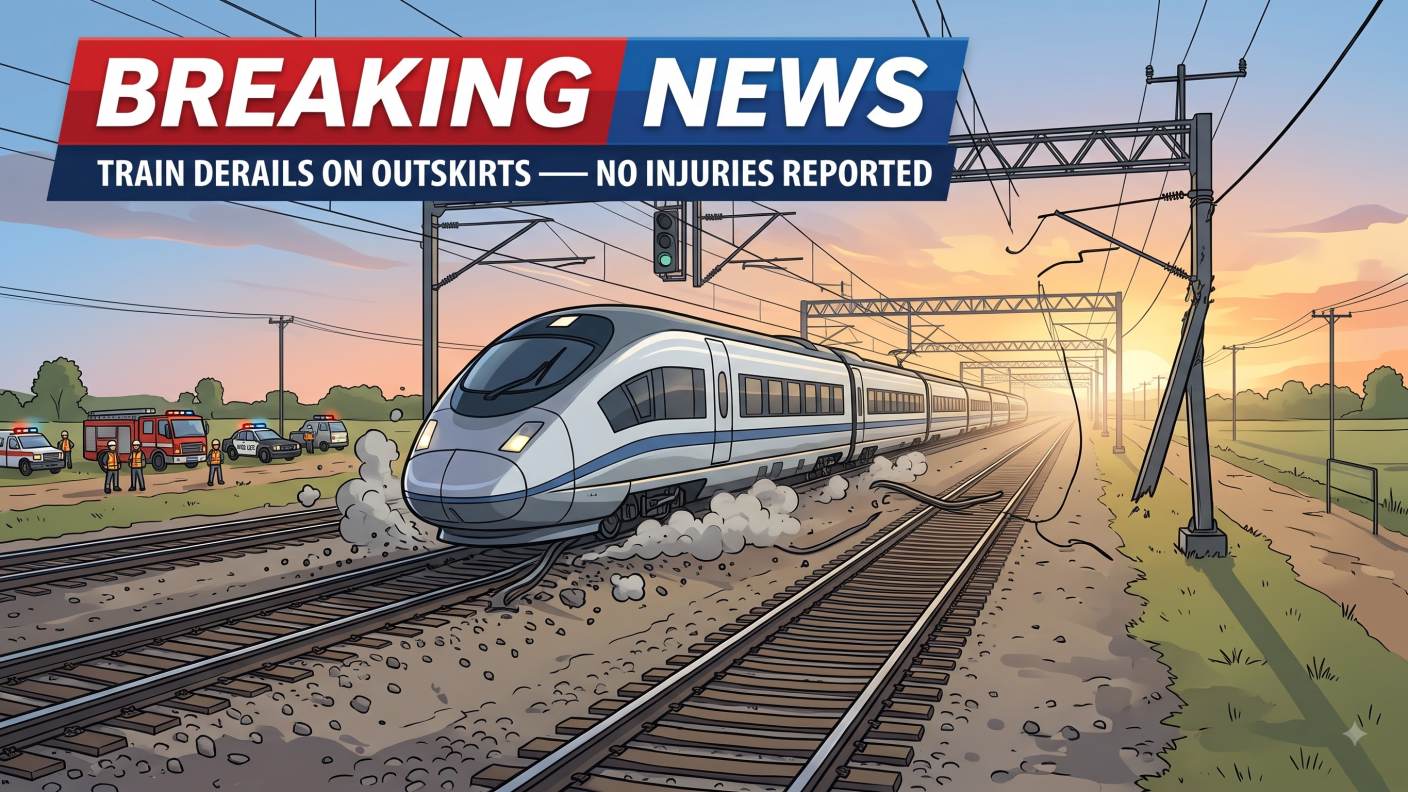
At least 64 people died when a Renfe high-speed train hit a stopped Iryo train near Urda, in Spain's Toledo province, on Wednesday morning.
The Associated Press reported at least 68 deaths, and the regional government for Castilla La Mancha said another 58 people required hospital treatment.
On Wednesday morning, two high-speed trains carrying hundreds of passengers were heading in the same direction from Madrid to Seville, in the province of Toledo.
Operated by the state, the Renfe service struck the stationary Iryo train from behind. Two of its cars left the tracks in the countryside between two villages.
Iryo said in a statement that 147 passengers and five staff members, including the driver, were aboard its train when the Renfe service struck it from behind.
Ignacio Relaño, a passenger on the Renfe train, said: "We all felt the train abruptly slowing down and then the impact."
He added: "The car leaned to one side like it was about to tip over. I hit my nose, everything went flying, luggage, cell phones. Everything shook."
David Gómez, a construction worker, described the rescue: "People were trying to get out through the windows ... We cut through some fences to access the area and treated people with the first-aid kits we had brought."
He also said: "As I was trying to pull a young woman out, there was a piece of a leg."
Between the towns of Urda and Los Yébenes, the crash took place on flat ground amid olive groves. One car was ripped apart, leaving metal and other debris strewn down a gravel slope.
A military emergency brigade joined firefighters, police and other emergency crews at the scene. Ambulances and medical helicopters shuttled between the site and medical facilities, while buses carried survivors who weren’t injured.
Rescuers were concentrating on reaching survivors and recovering bodies from the two train cars that suffered the worst damage, Spanish Health Minister Mónica García said. Hospitals across the area are receiving the injured.
García said: "It was a high-speed impact, so we are expecting this to be a tragedy."
A security system failure prompted a central command centre to issue what he called an "inexplicable" order, Transport Minister Óscar Puente said. The train engineers weren’t responsible for the crash.
Puente said a computer malfunction disabled the security system along a 63 kilometers (39 miles) stretch at 8:30 a.m., bringing all trains there to a halt. Central command then authorized the Renfe train to resume its journey without speed limits. At 8:53 a.m., it struck the stationary Iryo train.
An active "stop signal" meant the train should have remained stationary on that line, he said. If it had to move, it should at least have been instructed to travel at reduced speed.
Puente said: "The decision to resume traffic, while that system had not been restored, belongs to the control centre, and the control centre … took the decision to resume traffic in circumstances that, from our point of view, are inexplicable."
He also said: "I am not attributing responsibility to anyone, I am just stating the facts."
Officials were continuing to examine data to determine the train's speed, which may have been 200 kph (124 mph) on that section of track, Puente said.
As rescuers search the wreckage, the death toll might increase, the Castilla La Mancha regional government said.
Regional officials reported 80 or more injured people. About 50 were in serious condition, and 15 were critically injured.
A spokeswoman for the Castilla-La Mancha government said more than 100 people were hurt. Fifty-eight were admitted to hospital, including 15 in critical condition.
At the scene, Castilla-La Mancha leader Emiliano Garcia-Page put the death toll at approximately 64, up from an earlier toll of 31, and said it was likely to rise further.
The country will hold three days of mourning following the crash, Spanish Prime Minister Pedro Sánchez said.
From the scene in Castilla-La Mancha, Sánchez said that "All of Spain is in mourning" and that it was "not acceptable for a country like Spain" to suffer two such disasters in the same year.
The Spanish government said in a statement that "The priority is to attend to the victims and ensure the maximum coordination between administrations."
Blood donation centres in Madrid and Toledo called on people to donate urgently, preparing for greater medical care needs.
Sánchez's Socialist Party and the conservative People's Party called off planned events as the collision disrupted campaigning before the 29 November election.
Opposition leader Alberto Núñez Feijóo said the priority was to care for victims.
Santiago Abascal, leader of the far-right party Vox, kept campaigning and criticised Spain's infrastructure. He blamed its "deterioration of infrastructure and institutions in Spain" on the current government.
Another high-speed train collision has occurred, bringing a January crash in southern Spain involving trains operated by the same two companies back to mind.
After a January crash near the southern village of Adamuz, safety on the country's railways came under serious scrutiny. That collision between two high-speed trains killed 46 people.
A derailment near Santiago de Compostela in north-western Spain killed 80 people in July 2013.
Spain's dedicated high-speed lines had no fatal crashes between the network's opening in 1992 and this year.
Spain has invested heavily in high-speed rail in recent years. Its network ranks second in size worldwide, behind China, and is a source of national pride.
This year's two accidents both occurred on the route between Madrid and Seville, in the south.
The cause of the latest disaster remained unknown. The crash took place on a straight section of track in sunny, dry weather. Investigators in white overalls were inspecting the rails and photographing the scene.
On X, the Spanish royal household said the accident had left it "shocked and concerned" and expressed support for the victims, their loved ones and emergency services.
The bloc was "ready to help Spain if needed", an EU spokeswoman said, while European Commission chief Ursula von der Leyen said "Europe mourns" with the victims after the "devastating news".
As a gesture of solidarity and respect, the Spanish football federation called off 24 fixtures in the Copa del Rey's opening round.
Foreign Affairs Minister Helen McEntee said her thoughts are with the people of Spain and offered deepest condolences to the families of the victims, saying her Department, including the Embassy in Madrid, stands ready to provide consular assistance if needed.
Rail service was suspended between Madrid, Ciudad Real and Andalusia. All train services on the line have been suspended.
| Source | Deaths | Injured |
|---|---|---|
| Associated Press (via PBS) | at least 68 | 58 needed hospital treatment |
| Emiliano Garcia-Page, Castilla-La Mancha leader | approximately 64, likely to rise | not given |
| Other outlets (BusinessDay and AFP-based reports) | at least 64 | 80 to more than 100 injured, depending on the outlet; 58 taken to hospital, 15 critical |
Emergency workers continue searching the wreckage and the cause remains under investigation.